Trevor Swisse of Sidney not only harvested the biggest paddlefish in Montana in 2026, but the nearly 117-pound female had avoided recapture by fisheries crews and anglers in Montana and North Dakota for 22 years.
“That’s the biggest one I’ve ever caught,” Swisse said.
Montana’s state-record paddlefish, caught in 1973 in the Missouri River, was 142.5 pounds, but 117 pounds is definitely on the larger end of fish harvested.
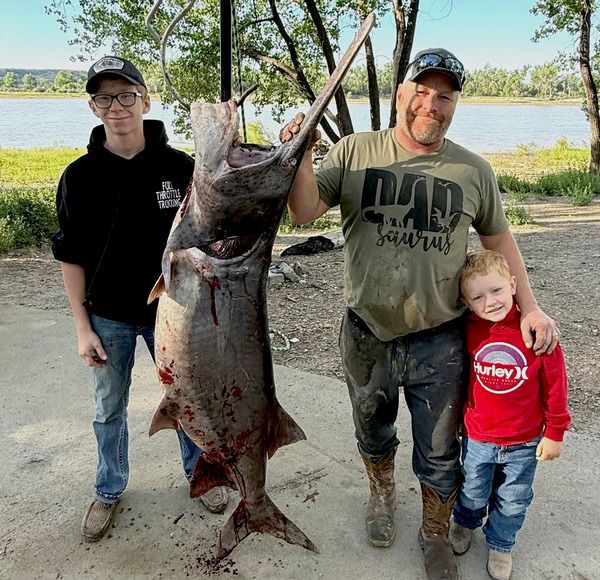
Swisse was paddlefishing at Seven Sisters Wildlife Management Area near Sidney on June 12 with his boys, Mason, 15, and Charles, 6, when he snagged the fish.
“At first I thought it was a small one,” he said. “Me and the two boys went to Seven Sisters that morning, and I cast into some slack water behind a sandbar. I cast and hooked instantly, and I started pulling and it came really easy over to shore. I couldn’t see it out of the water until I come back over the bank, and then I saw how big it was.”
Mason, who was also paddlefishing that day but has yet to harvest one, and Charles got to share in the excitement.
“They loved every second,” Swisse said.
The joy is evident in photos that show the three of them smiling with the paddlefish, which is a good half foot taller than Swisse from its tail to its rostrum.
Regional fisheries manager Mike Backes also was excited with Swisse’s catch, but more for scientific reasons.
“The fish is noteworthy considering its large size and the jaw tag being at large for 22 years,” Backes said.
Backes shared the story behind that jaw tag. The fish was originally caught on April 27, 2004 by North Dakota Fish & Game. Staff were drifting gill nets on the Missouri River about 3 miles upstream of the Highway 85 bridge at Williston. The purpose of the netting was installing jaw tags on paddlefish before the harvest season, which assists with estimating harvest rates and growth grates, and producing a population estimate.
When captured, the fish was 49 inches long from the fork in the tail to the eye and weighed 90 pounds. A jaw tag with number ND7570 was installed on the fish prior to its release.
Fast-forward to June 12, 2026, when ND7570 was caught again by Swisse. The fish was taken to the Intake Dam Fishing Access Site cleaning station, where FWP and partners also collect data. This time around, ND7570 was 52 inches long and weighed 117 pounds, gaining three inches and 27 pounds over 22 years. Backes explained that growth is slow and becomes secondary to energy the females must divert to ovary and egg development and spawning migrations.
But trying to estimate ND7570’s age is where it really gets interesting.
Unfortunately, FWP won’t know the answer until next spring. Since the fish was cleaned at Intake, a jaw section was also collected for aging. The age estimate will be completed by Dennis Scarnecchia with the University of Idaho by early next spring.
At minimum, Backes estimates ND7570 at 40-42 years old. He explained that female paddlefish do not make their first spawning migration out of North Dakota’s Sakakawea Reservoir until reaching age 18-20, and the fish was at large for 22 years. Females making their first spawning run vary in size but are rarely less than 45-50 pounds.
“This fish was 90 pounds when tagged, so I’m speculating another 10-20 years beyond the first year of being sexually mature,” Backes said. “This puts her at a reasonable lower-end age estimate of 52-62 years.”
Swisse had no idea the fish was potentially that old, but it didn’t take long to confirm that she was big.
“When we got to Intake, I backed up to the scale and popped open the tailgate, and the biologist said ‘wow’ right away, so then I knew,” he said.
Swisse is a diehard paddlefish angler, jokingly labeling himself a “regional expert.”
“I’ve been paddlefishing since I was, like, 17,” he said. “Before Covid I caught one every single year.”
He missed one season due to Covid, and the following year he didn’t harvest a fish.
“When I was a kid, I fell in love with paddlefishing, more for meeting people, and the camaraderie and camping and stuff,” he said.
Swisse recalls one summer in particular when Intake’s campground drew thousands of people, including Russian visitors, and live music filled the air.
“That was one of the best memories of my life,” he said.
Paddlefish used to congregate just below Intake Diversion Dam, which made it difficult for them to get upriver and drew lots of anglers, but completion of a bypass channel in 2022 helped to greatly disperse fish.
“You used be able to track the schools [of paddlefish], but when they put in the bypass channel at Intake, that changed everything,” he said.
That didn’t change Swisse’s love of paddlefishing, but he has seen the number of anglers in Montana drop.
“It’s heart-breaking to see the loss of interest in the sport, and you don’t see the quota met anymore like in North Dakota,” he said.
That may be due in part to the bypass channel and to low-runoff years like this, which tend to disrupt migration patterns and make finding fish more challenging.
Swisse is very appreciative of the opportunity to paddle-fish, and of the people who make it possible.
“When we were down at Intake that day weighing it, the biologist said the gnats were so bad you couldn’t even talk without them going in your mouth,” he said. “I couldn’t believe they were outside – it was so horrendous. All those people that put in all the hard work for us to paddle-fish, the biologists, everybody who cleans the fish – I can never give them guys enough thanks. They really do awesome.”
This was Swisse’s first paddlefish weighing over 100 pounds, and he doesn’t know if he’ll ever top it. But he and Mason aren’t the only anglers in the family; Trevor’s wife, Trisha, has harvested a fish the past two years. Her biggest, a respectable 57 pounds, is less than half the size of Trevor’s fish, but he’s no less excited for her.
The thrill of catching his fish is still fresh for him, and it happened at just the right time, as Swisse has been incredibly busy with a business start-up as a diesel mechanic.
“I was very lucky,” he said. “I haven’t been fishing since.”