Lawsuits Seek to Restore Protection for Migratory Birds

Outdoor commentary and legislative issues.
Goldfinch

By Glen Wunderlich
The use of the word “interesting” seems to be injected more into conversations recently as a substitute for more descriptive and more meaningful language. In most instances, I think we can do better than that, but when we are discussing how observations can hold one’s attention or curiosity, the term interesting can be quite appropriate. So, what follows may be just such tidbits derived from studies and personal observations of whitetail deer behavior – many of which stem from the June/July publication of Quality Deer Management Associations’ (QDMA) “Quality Whitetails” magazine.
Most turkey hunters will agree that the use of decoys will divert the attention of turkeys from hunters and directly toward the synthetic accomplice. While decoying is used almost exclusively as a successful strategy to bag gobblers, the same turkey decoys can be used to captivate the attention of whitetails’ innate propensity to be inquisitive.
One observation over the years is how whitetails will focus on ground blinds that have been erected shortly before a hunting season. Unlike turkeys, deer have a tendency to focus on blinds and subsequently will detect the slightest movement from within. However, that same blind will become relatively inconsequential, once a turkey decoy is placed only 25 to 30 yards directly in front of it.
On a recent hunt, I observed two whitetail bucks tune into a lone hen decoy to the point that they cautiously closed the distance to within inches of the decoy. With necks stretched as far as possible in an effort to detect scent, they became oblivious to my presence making for one interesting, uninterrupted video clip before scampering off into cover. Experienced hunters know the technique of “confidence decoys” and their use may be worth considering during deer hunting season.
No doubt, deer behavior can be fascinating to outdoors people and Kip Adams of QDMA points out some interesting (there I go again) aspects of the birth of fawns. Insofar as spring is when fawns are born, some understanding of how and why birthing activity takes place is provided for edification.
He writes, “After birth, fawns nurse and then hide alone. The doe sends them off to select their own bedding site. In do so, she ensures a predator can’t follow her scent to the fawn(s). The mother generally visits three to four times per day to feed and nurse them. She goes to the general area where she left them and calls. Fawns respond by standing and running to their mother. After approximately one month, fawns start spending much more of the day with their mothers.”
This behavior explains why in early spring, we don’t see fawns with their mothers. It also explains why their mothers are not at their sides and why humans often mistakenly assume fawns have been abandoned, when inadvertently discovered afield. It is also the reason why we are implored to leave them alone; it’s nature’s way!
Kip further explains that during the first few weeks after birth that fawns are unable to urinate or defecate on their own. Thus, while fawns are nursing, their mothers lick their genitals, causing fawns to do their “business.” Interestingly, the mother then consumes these excretions in an effort to minimize scent from predators’ noses. Simply wild!
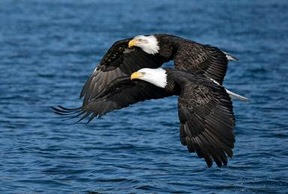
While no longer protected under the Federal Endangered Species Act, the bald eagle remains protected under the Bald and Golden Eagle Protection Act. Here in Michigan, the Mackinac Straits Raptor Watch takes place every day in Mackinaw City. The group conducts scientific studies of hawks and owls migrating through this region of northern Michigan and educates the public about the birds and their migration. They count northward-bound hawks in the spring and survey owls both spring and fall, recording and reporting the data for free professional and public access. Read more

The DNR uses many methods to monitor Michigan wildlife populations, and two of the more interesting wildlife surveys – involving a bird’s intricate aerial dance and snagging bear hair – are taking place across northern Michigan in May.
The American Woodcock Singing-Ground Survey is performed annually across much of the northern United States, giving wildlife agencies an idea of this migratory bird’s breeding populations.
Woodcock return to northern locations like Michigan – a national leader for the number of young woodcock produced each year – from their winter homes in southern Gulf Coast states to find a mate and breed. Spring, when their unique breeding behavior can be seen and heard in the evenings, is the perfect time to count them. Just after sunset, males can be found in their singing grounds, or grassy openings, making a nasal, insect-like call known as a “peent” every four to five seconds and performing their spiral display flights.The singing-ground survey is performed annually along more than a hundred 3.6-mile survey routes.
For the bear hair snare survey, locations across the northern Lower Peninsula are baited with bacon and donuts and surrounded by barbed wire. In order to reach the bait, a bear will cross the barbed wire and snag hairs, leaving a DNA sample behind. DNR staffers will visit 257 baited locations six times starting the week of May 27 to collect snagged bear hair and send it to the DNR Wildlife Disease Lab for analysis, which will assist with future bear population estimates.
Results from both surveys will help to determine harvest regulations for future hunting seasons. Read more about the woodcock and bear surveys.

One of the state’s most distinctive signs of a new season is on its way – the brightly colored monarch butterfly. A well-known and beloved butterfly species in North America, monarchs, unfortunately, have become a much less common sight in recent decades.
The eastern monarch butterfly population has declined by more than 80 percent over the last 20 years, primarily from habitat loss, both in their summer range – including Michigan – and in Mexico, where they spend the winter.
“Adult monarch butterflies require a variety of flowering plants for nectar,” said Hannah Schauer, wildlife communications coordinator with the DNR. “Grasslands provide a mix of plant species that pollinators, like the monarch, need – with both early- and late-blooming plants and those that flower mid-summer.” Read more
By Glen Wunderlich
Ever since my first wild turkey hunt in Michigan back in the ‘70s, the fascination has always evolved into a fair amount of anticipation leading to opening day. As has been the case over the years, I’ve opted for the late season, which runs just about the entire month of May. Much of the mystique of a novice is gone with experience and the advent of television shows featuring turkey hunting. A bit of complacency seems to have set in, however.
Morning finds me outdoors stocking wild bird feeding sites before sun rise, which also offers opportunities to listen for neighboring gobblers. A single trailcam was installed where a portable blind would be placed days before the opener. Only a couple of turkey hens had been spotted – one with a beard
– and, that was good enough to assume a Tom would show eventually. However, the afternoon before that first day of the season, I remembered I had yet to sight in my gobbler-getting shotgun. Four shots later it was centered on the target, but my only morning hunt produced one sighting on stand – a lone hen. The Toms have shut down their early morning gobbling from the roosts and seem to have changed routines, but plenty of opportunities remain.
Unseasonably dry weather conditions and lingering cold has put growing conditions behind quite a bit. We needed rain and we finally got a good dose. Predictably, spring finally sprung with wild asparagus and morel mushrooms pushing through the ground cover overnight. While I have no taste for the widely sought-after ‘shrooms, a neighbor didn’t hesitate, when I called to let her know I found a few. Her mesh bag was filled in short order.
On another note, the spring bird migration has brought in some of my favorite feathered friends to feed. Several Rufous-sided Towhees have become regular freeloaders the past several days and I’m hoping they’ll take up residence instead of moving on like usual. And, another of our most colorful flying spectacles – the Rose-breasted Grosbeak – finally arrived, as well, along with the dazzling Baltimore Orioles. Looks like it’s time to get the grape jelly out for them, too.
Another familiar harbinger of spring is our state bird: the American Robin. Although they are not seed eaters, their antics in search of insects and worms sure can be entertaining. This spring, one has built its nest on top of a security light controlled by a photocell attached to the fixture. The huge nest has totally blocked the electric eye and relegates me to manually operate the light; otherwise it would stay on.
What prompts birds to build nests where they do? Some of their real estate choices are real head-scratchers and that’s where the “Funky Nests in Funky Places” contest comes in. If you find a nest built in a quirky, even downright crazy spot, you may want to share a photo before the June 30th deadline. The contest is hosted by the Celebrate Urban Birds citizen-science project at the Cornell Lab of Ornithology. Entries can be photos, poems, stories, or artwork.
Participants don’t have to be bird or photography experts. All ages are welcome to participate as individuals or with a class, community center, or afterschool program. Entries are being accepted from anywhere in the world. You don’t have to be a participant in the citizen-science project either–just sign in as a guest.
Winners in each category will receive Celestron binoculars and other prizes are available for honorable mentions.
Find more information about how to locate nests, approach them without disturbing the birds, and enter the contest at www.funkynests.org.
The draft plan, called the Mid-America Monarch Conservation Strategy, builds on existing efforts of state, federal, and local agencies, as well as private organizations and individuals. It covers a 16-state region from Texas to the Upper Midwest, which encompasses the primary production and migratory habitat areas for eastern monarchs. Other eastern monarch states also are collaborating with the plan.
The plan identifies conservation goals and strategies for improving habitat for monarchs and other pollinators. Potential habitats include natural areas, agricultural lands, urban lands, and rights of way. Game and Parks, other state wildlife agencies, and partners will plant milkweed, which monarchs need to survive, as well as other blooming plant species, to benefit both monarchs and other pollinator species. Read more

Ithaca, NY— On May 5, Global Big Day birders tallied nearly 7 out of 10 species known to exist on the planet. That works out to record-shattering results: more than 6,900 bird species recorded by more than 28,000 participants.
During Global Big Day, a celebration of the world’s birds, participants report their observations to the eBird website (ebird.org) run by the Cornell Lab of Ornithology. “Big Day” is the term used for any attempt to see or hear as many bird species as possible in 24 hours.
“If you get people all around the world going out birding on the same day, we can find most of the species of birds and then really start to understand them,” says Chris Wood at the Cornell Lab. “And along the way, it’s a great way to expose people to birds and spark what for many people will become a lifelong passion.” Read more

The Michigan Department of Natural Resources is conducting two wildlife surveys across northern Michigan in May – the American Woodcock Singing-Ground Survey, which involves an intricate aerial dance of a migratory bird, and a bear hair snare survey, literally snagging bear hair on barbed wire.
“Wildlife surveys are one of the most enjoyable parts of our jobs,” said Dale Rabe, DNR wildlife field operations manager in Traverse City. “Being able to hear or see the wildlife we manage or, in the case of the bear survey, being able to find evidence of their presence is a pretty good time in the woods.”
Annually, the woodcock survey is performed across much the northern United States, giving wildlife agencies an idea of breeding populations. Woodcock migrate annually to southern Gulf Coast states from eastern Texas to Florida and return to northern latitudes, including Michigan, to find a mate and breed. Michigan is a national leader for the number of young woodcock that are produced each year.
Spring, when their unique breeding behavior can be seen and heard in the evenings, is the perfect time to count male woodcock.
“Male woodcock will be in their singing grounds, or grassy openings, just after sunset ‘peenting,’ and they’ll start their spiral display flights,” said Bruce Barlow, DNR wildlife biologist in Gladwin. “While they are on the ground, they will call a ‘peent’ every four to five seconds. You may have heard this nasal insect-like call before, but may have never realized it was a woodcock making that sound!” Read more

One of the principle benefits of mast orchards over food plots is that once established they require far less effort. However, maximizing the growth potential of your trees does require occasional regular maintenance, like fertilization. The best time to fertilize fruit trees is during the growing season in early spring after bud break and again in early June with the start of summer rains. Chestnut Hill Outdoors highly recommends that you use a quality time-release fertilizer properly balanced with minor elements.
With quick release fertilizers, beneficial elements are available to plants immediately, but only for as long as they remain in the same soil layers as the root system. This period varies with rainfall and temperature but typically isn’t long enough for plants to absorb and utilize all available nutrients. Time or slow release fertilizers have layers designed to melt away in sequence, gradually releasing active ingredients in somewhat the same way as time release medications. This allows your trees to utilize more elements over a longer period, and when they’re needed most. Minor elements are very important because they are often scarce or absent in certain soils, which can be a limiting factor for plant growth. Read more