Michigan: Iron Belle Trail Third-Round Grants Now Available

Proposals due Jan. 9

Iron Belle Trail logoThe Michigan Department of Natural Resources today announced that a third round of grant funding is available for communities and organizations working on sections of trail that will be part of Michigan’s two Iron Belle Trail routes. Proposals are due Jan. 9, 2017.

Communities or eligible non-profits located on the two trail routes are eligible for funding. Approximately $350,000 in grant funding is available and the maximum request is $30,000. A match is highly recommended. Read more

Michigan continues to battle chronic wasting disease

The discovery of an eighth free-ranging Michigan white-tailed deer with chronic wasting disease this summer was a disappointment to Michigan Department of Natural Resources wildlife officials.

However, DNR deer and elk specialist Chad Stewart said there was a little bit of good news associated with that discovery.

“DNA testing showed that the latest infected deer was related to four of the other previously identified infected deer,” Stewart said. “So far, all eight have been related to each other somehow, most very closely.

“The overall numbers are still very low, so we’re optimistic we can have some success in keeping this disease confined to a relatively small geographic area.” Read more

Contest Spotlights Birds and People Who Watch Them


Male House Finch by Janet Lewis, MichiganIthaca, NY—Anyone who watches birds or takes photos of them can enter this year’s BirdSpotter contest run by Project FeederWatch at the Cornell Lab of Ornithology. This is the 30th season for the citizen-science project which collects observations about feeder birds from November through early April. This milestone season and the contest are being sponsored by Wild Birds Unlimited. The photo contest is open to anyone, whether they participate in FeederWatch or not.

Read more

If You Imported/Exported Wildlife Into/Out of the United States, Take Action Now

On November 1, 2016 the U.S. Fish and Wildlife Service (FWS) published a notice in the Federal Register announcing that information related to records for the import and export of all wildlife specimens to and from the United States may be disclosed to Humane Society International (HSI), based on Freedom of Information Act (FOIA) requests made by HSI. The Notice informs submitters of such information of their ability to object to disclosure. The information potentially includes the identity of any U.S. and foreign importers and exporters of hunting trophies for the years 2002 through 2010, 2013 and 2014, and the declared value of the trophy. In response to four FOIA requests made in 2014 and 2015, FWS previously released some information but refused to disclose other information. FWS relied on three exemptions to the agency’s duty to disclose information in response to FOIA requests.

Earlier this year, HSI sued to obtain the withheld information. SCI intervened in the lawsuit to help defend the FWS’s decision to withhold the information. Subsequently, the FWS informed the court that it is obligated to notify the submitters of the requested information of the fact that their information is the subject of a FOIA request and that the FWS may decide to release the information.

The notice informs those who are the subject of HSI’s request that the FWS will presume that anyone who does not object within the time-period allotted for responses has no objection to the disclosure of his or her information. Submitters will have 21 days from the date of the publication of the notice in the Federal Register (i.e., today) to send their written responses to the FWS’s Office of Law Enforcement Freedom of Information office. Read more

Joint project in Ontonagon County, MI grows trees for the future

A cooperative seed collection effort in Ontonagon County will produce trees to be grown at Porcupine Mountains Wilderness State Park in the western Upper Peninsula –Michigan’s largest state park.

Recently, the Michigan Department of Natural Resources, the Ontonagon Area School agriculture class and White Pine Electric volunteers gathered on a beautiful fall afternoon to collect maple tree seeds and oak acorns at the Porcupine Mountains.Volunteers work to prepare collected maple seeds and oak acorns for planting.
The seeds and acorns will be used to grow seedlings to be planted in the Porcupine Mountains. Read more

Unwanted Beavers

OLYMPUS DIGITAL CAMERA

poplar tree felled by beavers

By Glen Wunderlich

On an early morning deer-scouting trek on my Shiawassee County property, I was prepared to cross the Osburn Drain via a makeshift bridge consisting of an aluminum ladder section and boards.  But, there was just enough water covering the boards to make me rethink my route.  “Wait a minute”, I thought.  We hadn’t had enough rain to raise the water level that much; something’s up.  The immediate proximity revealed the answer:  beavers!

Several poplar trees near the bank had been chiseled off about a foot from the ground – obviously the handy work of some of Michigan’s largest and most industrious rodents. 
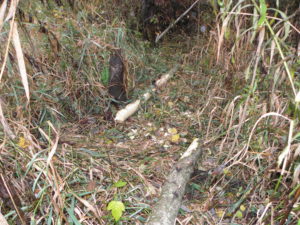
more poplars chiseled off

more poplars chiseled off

Hiking downstream to the road, where large concrete culverts form a bridge, I could hear the unfamiliar roar of water passing through.  On the south side the water level was well over the banks; to the north a relatively normal to low level was noted.  It was here that the beavers chose to flood the area to their liking.

Something had to be done before the water level got much higher or the road would be flooded and folks downstream would face ponds in place of their driveways.  Checking the trapping regulations, I discovered the season begins November 10th in our area.  Insofar as I’ve never attempted to trap beavers and had no such gear anyway, I thought even if I were to be successful, it might be too little too late.  So, I telephoned Chad Fedewa, our local wildlife biologist, in search of direction.

Chad was quite familiar with a plight such as mine and indicated that beavers are well established in our area, as evidenced by many such experiences over the past few years.  He couldn’t say that there is some type of influx of beavers recently and pointed to many documented encounters with the critters since the 1980s.

Since private property was involved, his solution was to issue a nuisance permit, which would allow the taking of up to 5 beavers before trapping season officially begins, but it was forbidden to keep the pelts per the permit; disposal required burying or a landfill.  Shooting them was not a legal option and was duly noted on the permit; only foothold, body-gripping, or conibear-type traps may be used or certain specific snaring devices.  Well, that’s just dandy! 

I then contacted a friend, who had offered to help earlier when the beavers made some half-hearted damage in the spring of this year and then vanished.  The trouble is that my friend has no experience trapping beavers and is a relative trapping rookie himself; he also had no such traps and would have to be educated in procedures, as well.  The situation seemed a bit too urgent for all of this, so I thought maybe a call to our county road commission and drain commission could get some action insofar as the road and bridge’s integrity was threatened.

Here’s what I learned:  Friday is not a good day to get anyone’s attention!  One office had no Friday hours and the other had a recording perfectly enabled to log my call.  By the end of the day, there was no return call.  My hope is that some action can be taken to break up the dam, but it’s beyond my personal capacity.  Besides that, without removing the beavers, it’s futile anyway, because in little time, the dam is reconstructed.

Meanwhile, the water rises.

Make Chestnut Hill’s Fruit Trees Part of Your Habitat Management Program


Managing your hunting land so that it provides the best possible nutrition and holds deer on your property throughout the hunting season can seem like an enormous project every year.That project can be much easier if your habitat plan included a mix of Chestnut Hill fruit trees. Chestnut Hill has lines of fruit trees ranging from ornamentals to commercial orchard foundation trees, and a big part of their research focuses on using fruit trees as long-lasting, high-quality wildlife food plots.

For deer hunters who manage their own property or lease, planting fruit trees can both increase the quality of nutrition available to deer and help hold them on your property throughout the season. Once established, the trees produce food every year at less cost than annual food plots – and for deer, a crop from fruit trees is like candy. Read more

Mexican Wolf Recovery Program Finds Evidence of Cross-Fostering Success


The Arizona Game and Fish Department and our Wolf Team partners have had success placing captive-born wolf pups with wild packs to raise as their own. The practice, known as cross-fostering, helps to bolster the genetic diversity of wild wolf packs. Read morePhoenix, AZ.— In their native habitat of the southwestern United States, the success of cross-fostered pups among the Mexican wolf population is being documented due to dedicated and collaborative efforts among several agencies and organizations, including the Arizona Game and Fish Department, the Chicago Zoological Society (CZS), the Endangered Wolf Center (EWC), and the U.S. Fish and Wildlife Service (USFWS). The organizations are working together to reintroduce the species to its native habitat in the American Southwest and Mexico.

In April 2016, five Mexican wolf pups were born at Brookfield Zoo in Illinois. As part of the Mexican Wolf Recovery Program, two of the pups were placed in the den of the Arizona-based Elk Horn Pack of wild wolves with the intention that the pack’s adults would raise the two with its own litter. In this process, known as “cross-fostering,” very young pups are moved from a captive litter to a wild litter of similar age so that the receiving pack raises the pups as their own. The technique, which has proven successful with wolves and other wildlife, shows promise to improve the genetic diversity of the wild wolf population.

Read more

Deer-Vehicle Collisions Peak During the Rut. Use These 8 Tips to Avoid Trouble

ATHENS, GA – As the peak of the rut approaches in most of the whitetail’s range, so does the peak of deer-vehicle collisions. The Quality Deer Management Association (QDMA) offers suggestions based on scientific research to help motorists avoid unwanted encounters with whitetails.
While the peak of the deer breeding season, or “rut,” varies in timing throughout North America, the majority of whitetails breed from late October through December, with a peak in November.
The peak in breeding also brings a peak in deer movement, and this puts more deer in roadways than at any other time of year. Numerous scientific studies have shown a strong correlation between breeding dates, deer movement, and deer-vehicle collisions (DVCs).

“Bucks are covering a lot of ground during the rut in search of does, they’re chasing many of those does, and until they are receptive, many of those does are running from the bucks,” said Kip Adams, QDMA’s Director of Education & Outreach and a certified wildlife biologist. “A lot of these deer are crossing roadways in the process, and that’s why we see a peak of deer-vehicle collisions in November.”

It is estimated that more than 1 million DVCs occur annually in the United States, resulting in approximately 200 human fatalities and nearly $2 billion in property damage. Here are some tips that can be effective at helping motorists avoid deer on highways. Read more

Conservation Groups File Notice of Intent to Sue Over Camp Perry Wind Turbine Project

Project Could Set Precedent for Wind Development on Great Lakes Shoreline
Washington – American Bird Conservancy (ABC) and Black Swamp Bird Observatory (BSBO) have filed a 60-day notice of intent to sue the Ohio Air National Guard (ANG) for violations of the Endangered Species Act and other federal laws in the course of planning to build a large wind turbine at its Camp Perry facility in Ottawa County, Ohio. Close to the shores of Lake Erie, the site lies within a major bird migration corridor and would be the first wind energy development on public land in this ecologically sensitive area.

In a letter sent yesterday by the Washington, D.C.-based public-interest law firm of Meyer Glitzenstein & Eubanks to the ANG and other federal officials, the two groups assert that ANG has unlawfully compromised and short-circuited the environmental review process for the Camp Perry wind facility. The letter states that the development of the project is taking place in violation of the Endangered Species Act (ESA), the Migratory Bird Treaty Act (MBTA), the Bald and Golden Eagle Protection Act (BGEPA), and the National Environmental Policy Act (NEPA). Read more

1 … 207 208 209 210 211 … 380