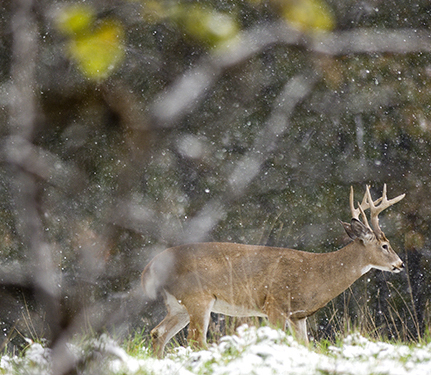
Liberty Hunt: Sept. 13-14 – open to youth and hunters with disabilities
Statewide on public and private lands.
Both antlered and antlerless deer may be harvested.
Hunters may harvest only ONE antlered deer and multiple antlerless deer (one per kill tag).
The Liberty Hunt is a statewide firearm deer season that takes place on public and private lands open to firearm deer hunting Sept. 13–14, 2025. Youth 16 years old or younger and individuals with qualifying disabilities can participate in this season.
Hunters 9 years old and younger must be licensed through the Mentored Hunting Program and accompanied by a qualified mentor.
Youth 10–16 years old can hunt with a bow, crossbow or firearm, regardless of license used.
For youth 10–16 years old, valid licenses include a single deer, deer combo or antlerless deer license.
Each Deer Drop-In Monday offers the chance to bring in a deer or lower jaw for aging, pick up free hunting swag* like patches, stickers, hand warmers, field-dressing gloves and more, and connect with DNR staff and fellow hunters and talk about the season. Harvested deer are welcome but certainly not required! We hope you’ll stop by and share your story with us.
Event dates – 10 a.m. to 3 p.m. the following Mondays:
Deer Drop-In Mondays are happening at locations across the state, and all hunters are invited to drop-in and say hello.
*Swag may vary by location, while supplies last.
Mandatory harvest reporting
Deer harvest reporting is mandatory. You can report your harvest online, in the Michigan DNR Hunt Fish app or call 517-284-9453 for assistance.
Mandatory harvest reporting for deer is in its fourth year. Deer hunters are required to report a successful harvest within 72 hours or before transferring possession of the deer to another person, a processer or taxidermist.
New this year, mandatory harvest reporting includes the question: Do you plan to get this deer tested for TB or CWD or to donate the meat?
If you’re not sure if you want to get your deer tested or donate the meat, selecting “yes” will streamline the process if you decide to do so later, but this does not commit you to taking any action.
A “yes” response to this question will prompt you to provide specific harvest location information that is necessary for disease monitoring.
In response to hunters’ increasing interest in submitting deer for disease testing, the DNR has worked to expand availability of CWD test kits across most of the state.
DNR focused head collection and CWD testing
In 2025, the DNR is conducting focused collection for CWD testing in the following counties. CWD testing is free for deer harvested in these counties when submitted through DNR drop boxes and staffed sample submission sites. All heads tested for CWD are also screened for bovine tuberculosis. Results are posted to the DNR lab results webpage.
Baraga
Chippewa
Dickinson
Houghton
Iosco
Keweenaw
Luce
Mackinac
Ogemaw
Ontonagon
Schoolcraft
Free self-sample shipping kit for CWD testing
Hunters in all other counties are eligible for free CWD testing by using a free lymph node shipping kit that includes overnight shipping. Hunters must extract lymph nodes themselves to submit to Michigan State University Veterinary Diagnostic Laboratory (MSU VDL) for CWD testing. Kits can be picked up from over 50 locations listed on the website.
DNR focused head collection and bTB testing
In 2025, focused collection and testing for bovine tuberculosis is occurring in the following counties. Less than 40% of bTB infected deer show signs of infection in the chest cavity and hunters in these counties are encouraged to submit a deer head for testing.
The epizootic hemorrhagic disease virus has been detected in deer from Calhoun, Cass, Eaton, Jackson, Van Buren and Washtenaw counties. As samples are submitted from additional counties, any further detections will be posted on the DNR’s EHD webpage.
Venison harvested in areas affected by EHD is safe for consumption. It’s not recommended to consume any animals that are visibly sick, but healthy deer harvested from areas where EHD has been present are still safe to eat.
Report sick or dead deer online
If you suspect you have found a deer that has contracted or died from EHD, please submit a Diseased Wildlife report through the DNR’s Eyes in the Field online system.
Sick and dead deer are often found in or around bodies of water. Due to a high fever and dehydration, deer infected with EHD often seek water to lower their body temperature and to rehydrate.
Visible symptoms of EHD in deer include appearing lethargic, disoriented, lame or unresponsive, though these can be symptoms of other deer maladies or injuries as well. Deer infected with EHD may show bloody discharge from the nose and mouth, a swollen or blue-tinged tongue and swelling of the eyelids and around the neck or head. EHD can only be confirmed through testing by a qualified laboratory.
Once EHD is confirmed in a county, it is not necessary to continue testing for the virus, but the DNR encourages continued reporting of suspected cases online to track the full extent of an outbreak.
Hunting regulations on your phone
The free Michigan DNR Hunt Fish app offers a convenient way for hunters, anglers and other outdoor enthusiasts to:
Buy hunting and fishing licenses and trail permits.
Report deer or fish harvests.
Look up hunting and trapping regulations.
Find their license history, including point and chance balances.
Check out maps with multiple layers, showing features such as shooting ranges and boat launches.
If you have any questions about the app, call the DNR licensing customer service staff at 517-284-6057 during normal business hours, 8 a.m. to 5 p.m. Monday through Friday.
Tree stand safety reminders
September is National Tree Stand Safety month and it’s the perfect time to brush up on what you need to know about hunting from a tree. A few things to remember:
Always maintain three points of contact (one hand and two feet or two hands and one foot) when climbing up to or down from the stand.
Wear a full-body harness that is properly attached above your head.
Ensure your tree stand is securely attached and stable before using it.
Use a haul line to get your hunting gear to and from the stand.