An inside look at recent U.P. moose capture-and-collaring effort
By ANDY HENION
Communications representative, Wildlife Division
Michigan Department of Natural Resources
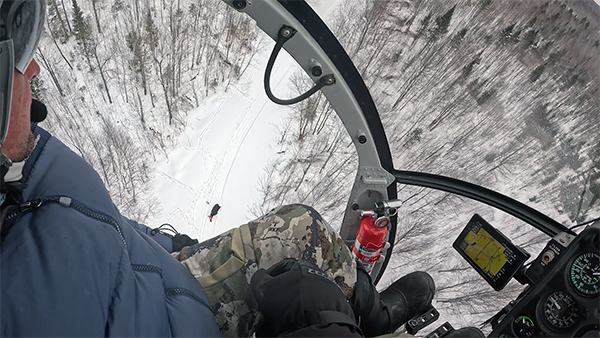
It’s an unusually warm February day in the western Upper Peninsula as a collaborative team of wildlife experts works to fit a radio collar around the neck of an immobilized moose and collect blood and fecal samples from the animal. Speed and skill are crucial. Too much stress or time under anesthesia puts the 700-pound bull at risk. A separate helicopter crew from Texas-based Heliwild had flushed the moose from the Iron County woods and shot it with a tranquilizer dart, a necessary but taxing procedure for the majestic creature. The 45-degree temperature produces another risk factor for an animal whose thick, heavy coat was designed for freezing cold.
“Great job everyone,” says Kristie Sitar, a veteran wildlife biologist with the Michigan Department of Natural Resources, as the crew exchanges high-fives.
This procedure was repeated several dozen times in mid-February as some 40 people from the DNR, Keweenaw Bay Indian Community, Northern Michigan University and Sault Ste. Marie Tribe of Chippewa Indians participated in an ongoing research project investigating moose survival in the Upper Peninsula.
Over four days, the collaborative group accomplished its goal of collaring 41 moose and recollaring two moose from a smaller effort last year. In all, 56 collared moose in the western U.P. are now providing researchers with valuable information on their health and movements.
“This was a successful capture event, and the entire team worked together incredibly well to reach our goal,” said Tyler Petroelje, northern Michigan wildlife research specialist for the DNR. “These moose, and the biological samples and collar data they provide, will be invaluable in helping us better understand survival and factors that are limiting population growth in the core moose herd.”
Minimizing risk
On the first morning, Feb. 14, fog delayed the start of captures by several hours. Air crews spent the afternoon searching for moose wallowing in the deep, heavy snow of the Marquette County forests.
Crews were able to capture, collar and release four moose that first day. Unfortunately, two other moose died in the recovery process after being administered the sedation-reversing drugs. Both moose – a mature cow and a young bull – appeared healthy and had normal vital signs throughout their respective procedures.
A team that included Petroelje and Dr. Scott Larsen, veterinarian for the DNR’s Wildlife Division, conducted field necropsies by floodlight on both moose late on Feb. 14. The animals’ tissues and organs were also later examined at the DNR’s Wildlife Disease Laboratory in Lansing.
Larsen said initial evaluation of the bull showed no signs of underlying disease, but the female moose had significant disease in her lungs and liver that likely complicated her immobilization and led to her death.
The capture team reviewed its protocols and found no significant issues. Still, to minimize risk, they took measures to further shorten the time each moose would be under anesthesia.
Over all four days, Feb. 14-17, the team would capture, collar and release 41 moose successfully. During the 2025 effort, all 20 moose captured were collared and released successfully.
“The work we do involves risks associated with wildlife capture, and we take great precautions to ensure those risks are minimized,” Petroelje said. “When we consider collaring any wildlife, we do so because the value of information gained is greater than those associated risks.”
Expanding research capacity
Data from the captures is providing insights into why the moose population in the core range of Baraga, Iron and Marquette counties has stagnated at about 300 animals, according to the DNR’s 2025 aerial survey.
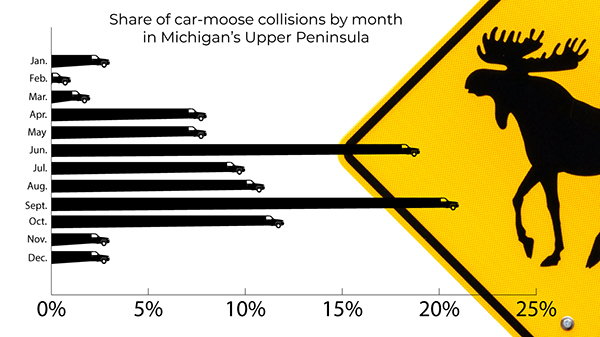
Is it disease? Predation? Vehicle collisions? Warming temperatures? Changing habitat? Or a combination of these and possibly other factors?
Getting enough moose collared in 2025 and 2026 was an important step in the long-term research project. Now, researchers from the DNR, KBIC and NMU are working together to interpret tracking data from the collars, along with corresponding drone surveys, to come up with evidence-based reasons for the stagnant moose population.
In less than three weeks, researchers have already collected 22,000 GPS locations from the newly collared moose. That’s in addition to the more than 200,000 GPS locations collected from the moose collared in 2025.
Project funding comes mostly from federal grants, tribal partnerships and university resources, with only about 1% coming from state hunting and fishing license fees.
Providing additional financial and land-access support are conservation groups, including the Nature Conservancy and Safari Club International Michigan Involvement Committee, federal land managers and commercial forest landowners.
The KBIC recently secured a $684,112 grant from the U.S. Bureau of Indian Affairs to support the project and KBIC staff salaries for two more years, expanding research capacity through 2028.
Erin Johnston, KBIC’s wildlife and habitat manager, played a key role in securing the grant and in the capture operation, assisting on two moose captures as part of an aerial team.
“Similar to last year, staff from DNR, KBIC and NMU seamlessly integrated into aerial and ground teams for another successful moose capture-and-collar event,” Johnston said. “Ground teams had more opportunity to handle moose this year. Although the warm temperatures caused delays in the aircraft flying in the morning, the sunshine was a welcome sight and sensation while we waited in anticipation to hear news from handling teams of successful capture, collar and release.”
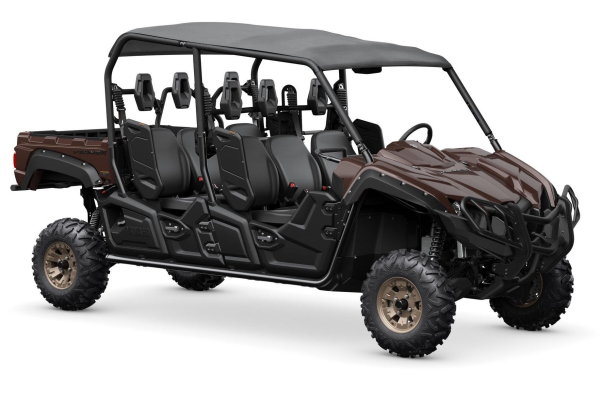
Kyle Seppanen, wildlife coordinator for the KBIC, served on a snowmobile-riding ground team nicknamed “Hemlock Nibbler” along with Jeff Lukowski of the DNR and Eric Clark of the Sault Tribe. That team assisted Sitar and fellow DNR wildlife biologist Clay Buchanan with successfully collaring the 700-pound bull in Iron County.
“It will be exciting to see what additional information we can gather now that we have 56 collared moose on the landscape,” said Seppanen, who assisted on seven captures. “Where are the moose going? What habitats are they using and when? As one of two drone operators on the project, I am looking forward to confirming births this spring and tracking calf survival throughout the remainder of the year.”
Nerve center
The project nerve center was a base operation run out of Van Riper State Park near Champion by Erin Largent, a DNR wildlife research technician and master’s degree student at NMU.
Largent was instrumental in just about every aspect of the initiative – from contacting landowners across the study area to secure permissions to access moose on private lands, to ordering all capture equipment and programming the GPS collars, to organizing snowmobiles, spotter planes and the helicopter moose-darting team.
At Van Riper, the base operations team – Largent, DNR wildlife technician Rachel Leggett and NMU master’s degree student Anthony Clyne – coordinated all airplane, helicopter and ground crews using real-time location data and sophisticated mapping software.
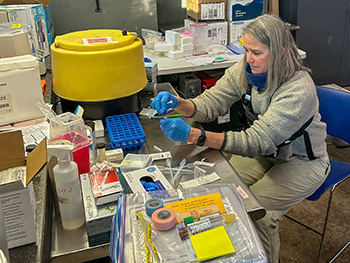
Another NMU student and DNR student assistant, Jackie Westra, served on a snowmobile ground crew and helped prepare blood, fecal, hair and tick samples for analysis.
“This large-scale moose research and conservation initiative is providing exceptional hands-on learning opportunities for NMU students,” said Diana Lafferty, associate professor of wildlife ecology at NMU and member of the capture team. “In short, our undergraduate and graduate students are not just learning and applying their academic and professional skills, they are also important members of our team and contribute in many meaningful ways to the success of this project.”

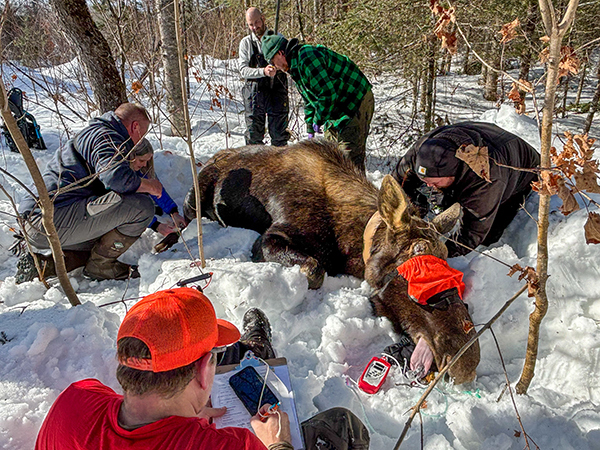
 The ground team finishes its work, injects the moose with a drug that reverses sedation and backs away. After a few anxious minutes, the massive animal awakens, rises unsteadily and ambles into the thick woods.
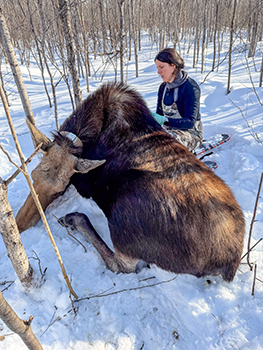 Crews were able to capture, collar and release four moose that first day. Unfortunately, two other moose died in the recovery process after being administered the sedation-reversing drugs. Both moose – a mature cow and a young bull – appeared healthy and had normal vital signs throughout their respective procedures.
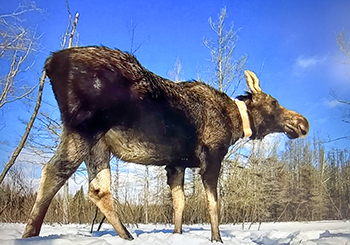 Is it disease? Predation? Vehicle collisions? Warming temperatures? Changing habitat? Or a combination of these and possibly other factors?
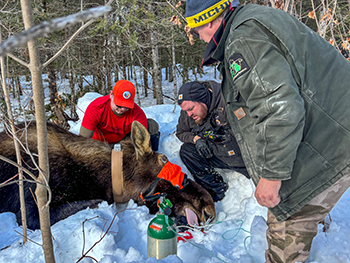 Kyle Seppanen, wildlife coordinator for the KBIC, served on a snowmobile-riding ground team nicknamed “Hemlock Nibbler” along with Jeff Lukowski of the DNR and Eric Clark of the Sault Tribe. That team assisted Sitar and fellow DNR wildlife biologist Clay Buchanan with successfully collaring the 700-pound bull in Iron County.
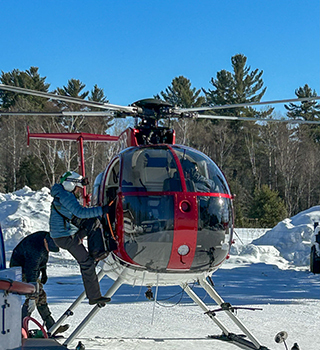 Another NMU student and DNR student assistant, Jackie Westra, served on a snowmobile ground crew and helped prepare blood, fecal, hair and tick samples for analysis.