Fledglings at Our Feeders
Article and Photos by Paul Konrad
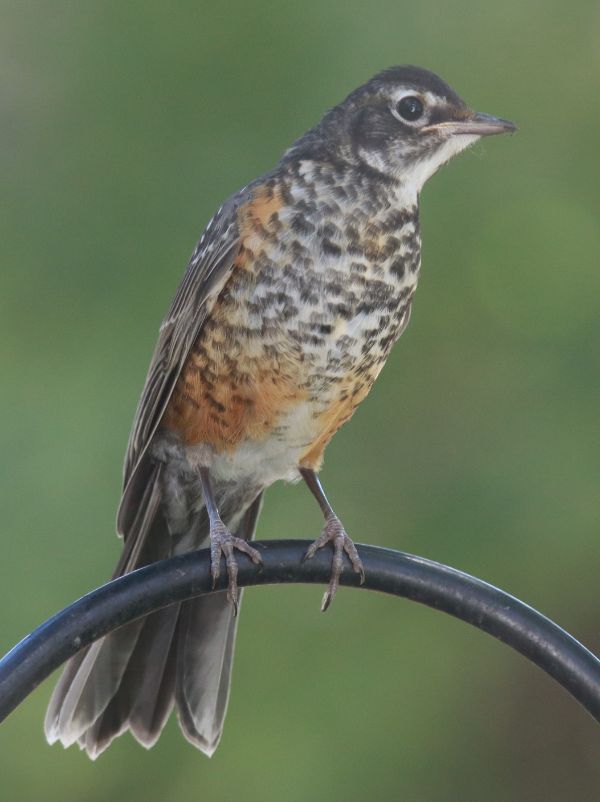
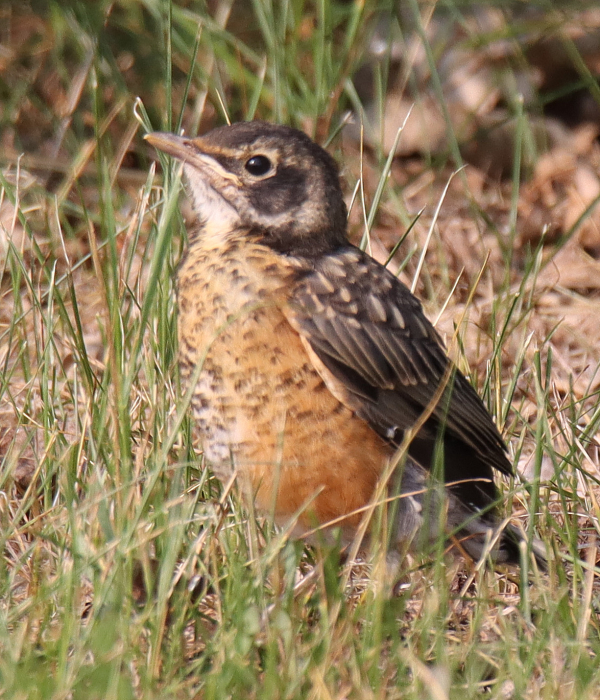
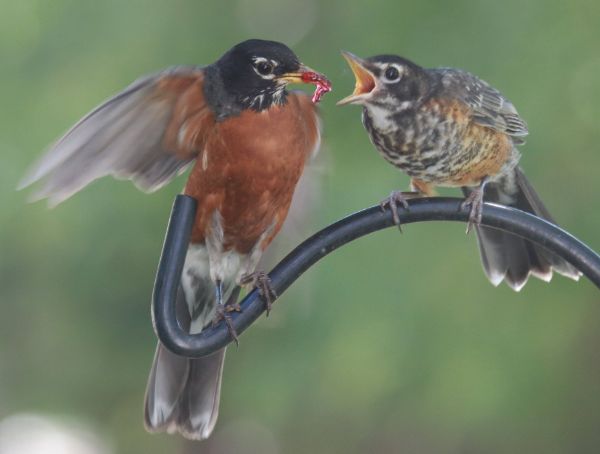
Recently fledged American Robins have dominated the feeding station during recent weeks, along with the adults that lead them to the grape jelly feeders (photos by Paul Konrad).
One of the most exciting things that can happen at a feeding station is for birds that visit your feeders during the nesting period to bring their fledglings to your feeders and surrounding tree branches. In addition to the chance to view the young birds at close quarters during this important developmental stage when they learn to fly and learn how to survive beyond the nest, it’s great to watch the interactions between fledglings and adults, and other birds. Most songbird fledglings rely on the adults to feed them and protect them, while the young birds watch and interact with adults and other birds at a feeding station, and beyond.
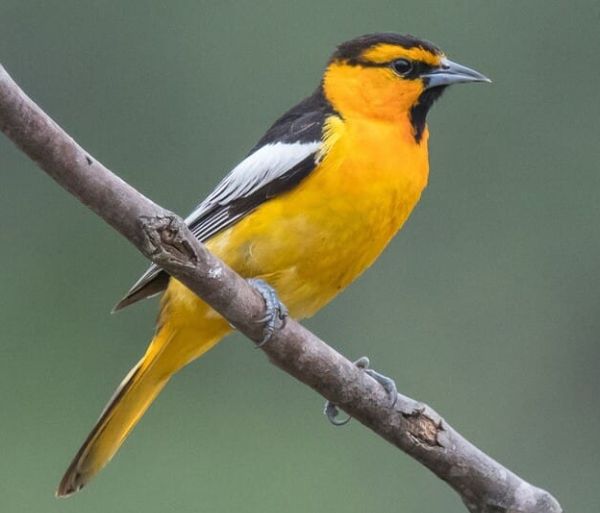
Best of all we can watch the fledglings quickly develop beyond the nest – not an easy thing to do beyond the “confines” of a feeding station with a window view. This is an especially bountiful year in the Northern Plains, and that may be the reason behind so many fledglings being produced in my neighborhood, and why my grape jelly feeders have been attracting a variety of fledglings. Family groups of American Robins and House Finches have now been joined by a Baltimore Oriole female feeding one or more of her recent fledglings that occasionally follow her to perch in branches in the ash tree adjacent to the feeding station. The male Baltimore was as active as the female in collecting jelly and insects attracted to the sweet food, but he suddenly disappeared after July 1st, leaving the female to care for the fledgling (or fledglings) during the final step of the post-fledging period.
Recently, a male Orchard Oriole has substantially increased the number of its visits to collect jelly and bugs, which indicates it is feeding nestlings nearby – and hopefully they will follow him to the jelly feeders when they leave the nest too. [As I write this, the male Orchard arrives on que to load up on jelly.] A few Orchard Oriole broods have spent time utilizing my feeders in the past – usually numbering 2 or 3 per brood that resemble the adult female with new yellow plumage. This season, only the male has been a regular visitor – so far. Some years I have 2 or 3 pairs of orioles nesting in the area, but this year it has been just 1 pair of each species.
Realistically, it has been the American Robins and House Finches that have provided the biggest thrills and levels of activity this summer.
These species have actually increased their interest in grape jelly the past few years. When they first began to try the sugar-based food and they had trouble trying to access jelly at the “circus feeder,” which requires a degree of acrobatic perching to access the jelly for the robins. Over time, a robin pair adapted to the feeder and this year individuals from 3 robin pairs have been collecting jelly to mix with earthworms and insects to take to nestlings. But I also have a small bowl of jelly on a platform feeder for easier access for birds and more jelly volume for when I’m away from my office and window view.
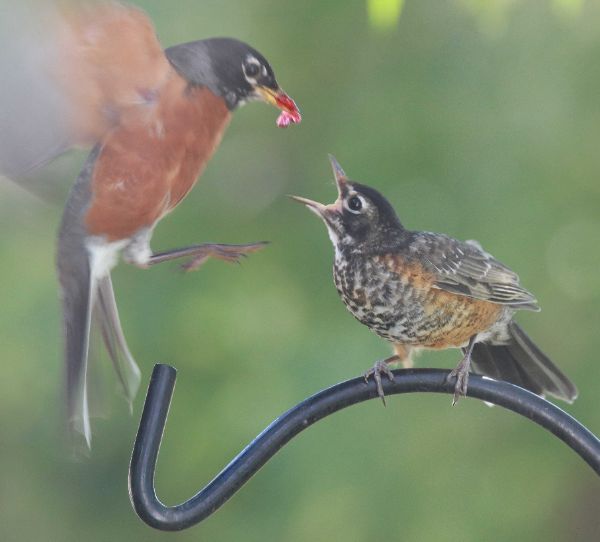
The past few weeks, young robins have been the stars of the show; first begging for food from an adult that would get jelly and feed it to the begging fledgling or fledglings perched nearby. Sometimes 2 or 3 fledglings were assembled, and it didn’t take too long before the young robins began feeding on their own, and drinking at the birdbath too. During this busy period at the feeders, one adult male robin became super territorial at the food source, especially toward other adult robins, but eventually toward fledglings too. This aggressive behavior only created a sneak in and hit-and-fly style of grabbing jelly before the inevitable chase. This robin’s territorial behavior extended to orioles and finches too, but not at the same level, and after about 5 days the aggression subsided, then evaporated.
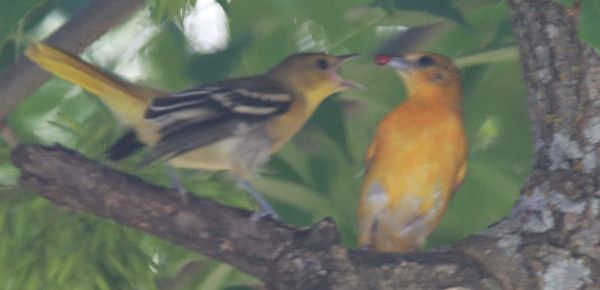
A documentary photo of the female Baltimore Oriole feeding a new fledgling perched in the ash tree adjacent to the feeding station.
While working at my desk Saturday, I noticed a reduced presence of the jelly eaters; and actually, I didn’t see the female Baltimore Oriole stop by at all, leading me to wonder if – I hate to say it – she and the fledgling or fledglings moved beyond their nesting range and my feeding station. Adult robins were far less obvious, although occasional well-developed fledglings stopped by to gorge. The male Orchard Oriole was still a more enthusiastic jelly belly, and House Finches actively persisted as jelly eaters, but it felt a bit like a turning point – and after a few days, that impression was even clearer.
How exciting to enjoy new fledglings as they arrive and thrive at my feeding station – more fledglings than ever before I would have to say! And the season can progress to include other fledglings like woodpeckers, goldfinches, and more orioles for short stops; some of which may originate a mile away, or in other areas as young birds branch out on their own. But just as the natural elements surrounding nature progress quickly – often weekly – the activities of birds at our feeding stations and adjacent landscaping features during this peak period of mid-July will continue to change and evolve in marvelous ways. I certainly hope you are enjoying your feeding station and the birds you benefit and enjoy seeing daily.
Share your backyard birding experiences and photos with The Birding Wire at editorstbw2@gmail.com