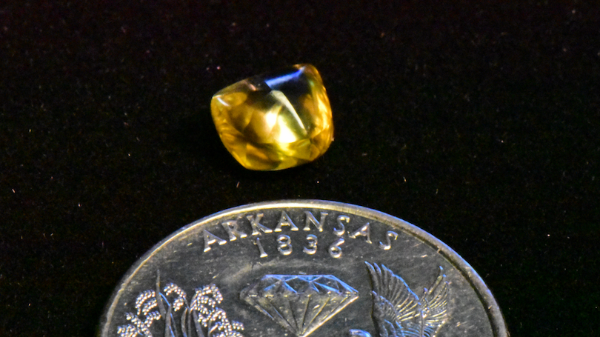
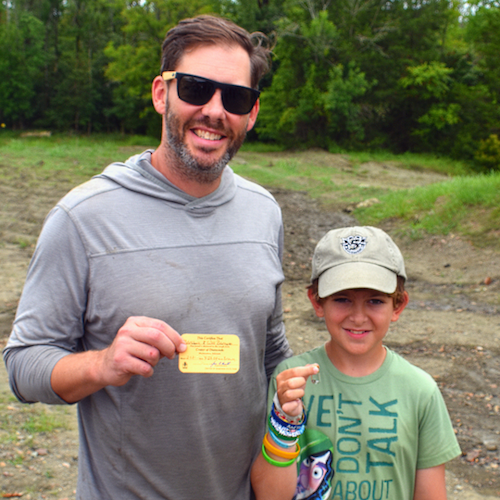
Barry G. Smith, of Germantown, Tennessee, recently visited Arkansas’ Crater of Diamonds State Park, where he discovered a stunning canary yellow diamond in the park’s ancient volcanic soil.
Smith arrived at the park on Sunday, August 16, with his wife and two granddaughters, Sage and Juniper. Planning a fun week of exploring Arkansas and Missouri, the Smiths chose Crater of Diamonds State Park as one of the exciting destinations to take the girls.
Not expecting anything more than a fun time, the family rented a wagon and basic kit from the park and began their diamond search. About 30 minutes later, Smith spotted something glimmering in the East Drain of the park’s 37.5-acre diamond search area. At first, he thought it was mica, a small, glittery mineral common in the search area. However, a closer look revealed something much larger.
Smith placed the find in his shirt pocket, thinking it might be quartz or maybe even a diamond, and continued digging with his grandkids until around noon. “It started to get so hot we couldn’t stand it, so we decided to head in around lunchtime,” he said.
Before going to lunch, Smith took his find to the Diamond Discovery Center to have it inspected. Park staff immediately oohed and aahed when Smith placed the shiny gem on the counter. After further inspection, staff confirmed that Smith had found a gorgeous 2.29-carat yellow diamond!
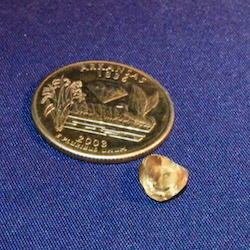
“I was dumbfounded when I first saw the diamond,” said Facility Supervisor Ralph Hall. “Its overall shape and color immediately reminded me of the Pearadin Schumacher American Dream Diamond found earlier this year.”
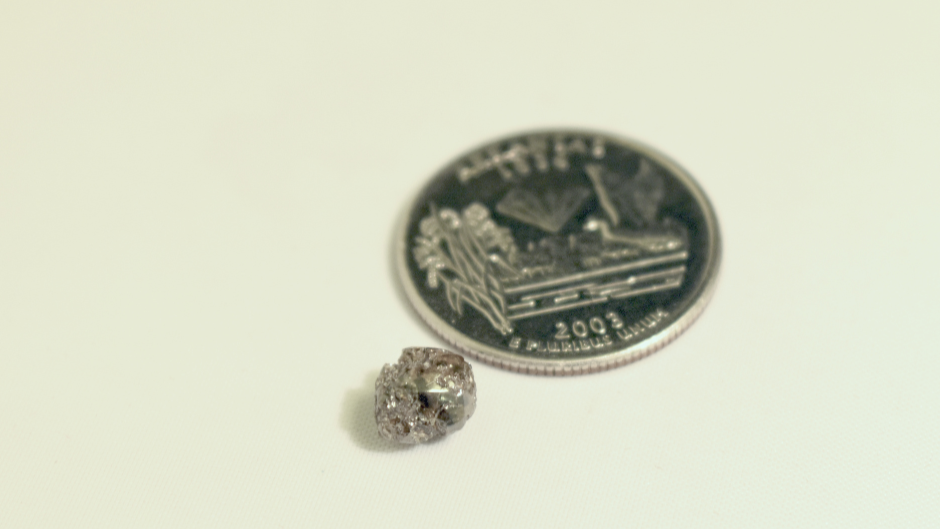
Diamonds from the Crater are white, brown, or yellow, with yellow being the least common. Yellow diamonds are created when nitrogen is absorbed into the crystal structure during formation. Nitrogen impurities absorb blue light and reflect yellow wavelengths, giving the diamond its yellow hue.
When asked if he was excited about his find, Smith replied with an enthusiastic, “Oh, absolutely!” He later added, “I never expected to find a diamond here. The potential was there, but you never come here expecting to find one.”
Park staff recommends closely watching temperatures before visiting, dressing in UV-protective layers, bringing plenty of drinking water, and taking regular breaks in the shade.
Many visitors choose to name the diamonds they find at Crater of Diamonds State Park. Smith has chosen to name his gem the Sage Juniper Diamond, after his granddaughters.
About the size of a black-eyed pea, the Sage Juniper Diamond is the third-largest Crater diamond found this year. As of this publication, 351 diamonds have been registered by park guests in 2026. An average of one to two diamonds is found at the park each day.