The first bear hunting period of 2026 kicks off Sept. 9 in the Upper Peninsula as thousands of bear hunters prepare to take to the field this fall.
The Michigan Department of Natural Resources is issuing 6,278 bear licenses for the 10 bear management units across the state in 2026. Bear hunting is allowed in the U.P and the northern half of the Lower Peninsula.
More than 72,500 people applied for a bear license or preference point this year. Licenses are awarded through an annual drawing that’s based on the number of points each hunter has earned. The number of points needed to obtain a bear license depends on the BMU and hunting period. It’s generally easier to get a bear license in the U.P. based on the higher density of bears.
Here’s more information about bear hunting in Michigan.
Here are the season dates for the three hunt periods in the Amasa, Baraga, Bergland, Carney, Gwinn and Newberry bear management units of the U.P.:
Hunt period 1: Sept. 9 – Oct. 21.
Hunt period 2: Sept. 14 – Oct. 26.
Hunt period 3: Sept. 25 – Oct. 26.
Drummond Island has one hunting period this year: Sept. 9 – Oct. 21.
Northern Lower Peninsula
Season dates for the one bear hunting period in the Baldwin, Gladwin and Red Oak units of the Lower Peninsula are Sept. 12-22 and the Oct. 2-8 archery-only period.
Bait or dogs?
In the Upper Peninsula, bait can be used to hunt bear Sept. 9 – Oct. 26. Dogs can be used Sept. 14 – Oct. 26.
In the Lower Peninsula, bait can be used to hunt bear Sept. 12-18 and Oct. 2-8. Dogs can be used Sept. 14-18. From Sept. 19-22, dogs must be used to hunt bear, although bait can be used during this time as well.
For hound hunting, you can use no more than eight dogs running as a pack. All dogs must be immunized and licensed. The license number or other form of identification must be affixed to their collars.
For baiting on public lands, you can use dead and downed trees, hollow stumps, rocks, soil and other natural materials to contain bear bait. You cannot use bait containers on public lands or Commercial Forest lands. You can use bait containers, such as metal barrels, on private lands only. Bait containers on private lands can only have holes that are either 1 inch or less in diameter or 22 inches or greater in diameter.
Safety first
If you are hunting bears with a firearm, you must wear a cap, hat, vest, jacket or rain gear of hunter orange. The hunter orange garments must be your outermost layer and be visible from all sides. Hunter orange includes camouflage that is not less than 50 percent hunter orange.
If you are hunting bears with archery equipment, you are exempt from the hunter orange requirement. However, the use of hunter orange is encouraged for safety purposes.
Bear registration
Within 72 hours of harvesting a bear, the hunter must take the unfrozen bear head and pelt, or the entire animal, to a bear registration station to be registered and sealed. The most up-to-date registration locations can be found in the 2026 bear hunting regulations summary.
Using the whole bear
In 2025, hunters harvested 1,960 black bears in Michigan – 1,528 in the U.P. and 432 in the Lower Peninsula. State law requires hunters to salvage all edible meat from a harvested bear. Edible meat for bear means the hind quarters, front quarters, loins and tenderloins.
You can discard edible bear meat if it is unfit for human consumption at the time you take possession of the harvested bear. Meat that is unfit for human consumption includes, but is not limited to, meat that was damaged by the method of taking, decayed, rotted or scavenged, or obviously infected or diseased.
Preventing trichinosis
Trichinellosis, also called trichinosis, is a disease that people can get by eating raw or undercooked meat from animals infected with the microscopic parasite trichinella. In the lower 48 states, cases have been detected in black bears. Animals infected with trichinella usually don’t appear to be sick, and the parasite is microscopic so it cannot be seen in infected meat with the naked eye.
You can prevent trichinosis by properly handling and cooking meat. Whole cuts and ground meat from wild game animals should be cooked to an internal temperature of 160 degrees Fahrenheit. A meat thermometer should be used because color is not a good indicator of doneness for game meat. After handling meat, wash hands thoroughly with warm, soapy water and disinfect all equipment and work surfaces. Learn more about trichinosis from the Centers for Disease Control and Prevention.
Bear patch
Michigan’s bear management cooperator patch program is coordinated by the Michigan Bear Hunters Association in partnership with the DNR. Anyone may purchase a patch for $7. Hunters who are 17 years old and younger and have a valid bear hunting license may receive a free patch.
Order a patch online or send your name and complete address and a check or money order payable to the Michigan Bear Hunters Association, or a legible copy of a youth’s valid bear hunting license, to MBHA, Bear Patch Program, 10510 Fairgrieve Road, Johannesburg, MI 49751.

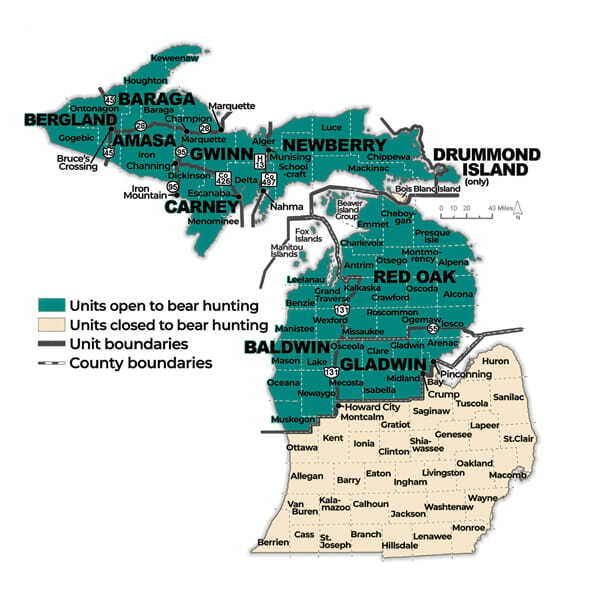 Upper Peninsula
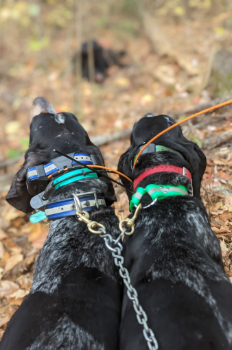 In the Upper Peninsula, bait can be used to hunt bear Sept. 9 – Oct. 26. Dogs can be used Sept. 14 – Oct. 26.
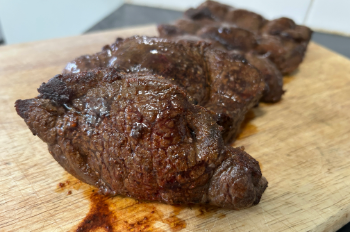 In 2025, hunters harvested 1,960 black bears in Michigan – 1,528 in the U.P. and 432 in the Lower Peninsula. State law requires hunters to salvage all edible meat from a harvested bear. Edible meat for bear means the hind quarters, front quarters, loins and tenderloins.
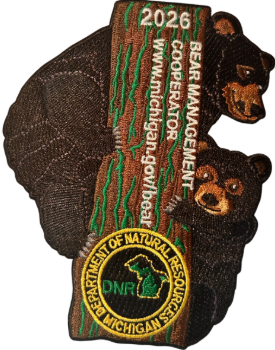 Michigan’s bear management cooperator patch program is coordinated by the Michigan Bear Hunters Association in partnership with the DNR. Anyone may purchase a patch for $7. Hunters who are 17 years old and younger and have a valid bear hunting license may receive a free patch.