By HEATHER JOHNSON DUROCHER Writer, Michigan Department of Natural Resources
We’re carefully walking single-file across a narrow, wood-planked bridge at the south end of Mirror Lake – steps from where we’re about to pitch our tents for the night – when Katie slows to a stop and looks out at the calm, aptly named body of water whose shores are lined with towering old-growth hemlock, white pine and a mix of hardwoods.
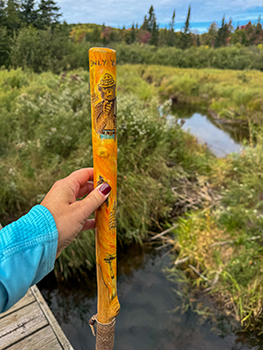
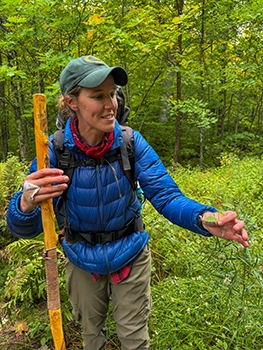
“You might hear a strange sound in the middle of the night,” she says, leaning slightly against her smooth, hand-carved Smokey Bear walking stick clutched in her right hand.
Before she can say more, I’m picturing mischievous raccoons scurrying and sniffing after dusk. Or possibly – hopefully not – a mama black bear, picking up a scent and investigating the half dozen tents our group of backpackers will use for sleep here in the backcountry, beneath a black velvet night sky dotted with stars.
But Katie’s explanation is unexpected: “You might hear the slap of a beaver’s tail on the water,” she says as we take in the scenic, seemingly untouched view before us, the just-starting-to-turn maple trees casting crimson reflections across the water’s still surface. “It can be pretty loud.”
Beaver tail-slapping, Katie goes on to share, is a classic alarm signal – a defensive warning used when a beaver detects a predator, another beaver or a human near its lodge or territory.
It’s yet another interesting nature tidbit shared during our three-day beginner backpacking trek at Porcupine Mountains Wilderness State Park in the western Upper Peninsula.
A couple of weeks after this late-September trip, I’ll tell my colleague Katie Urban – one of our two backpacking guides and the park interpreter at the Porkies – that these wildlife wonders and fascinating flora and fauna stories along the trail were big highlights of my hiking experience with her and six others.
I’ll ask her how intentional she is about sharing such details, which included pointing out the exact spot on the trail where barred owls like to hang out, the surprising “pop” of spotted jewel weed we came across and held between our fingers, and the oldest exposed rocks in the park (andesite and rhyolite, formed about 1.1 billion years ago) that rise up along certain sections of trail.
This all must be part of the backpacking experience, I figure, but she surprises me yet again with her answer about not putting much, if any, planning into this aspect of the trip.
“Oh, that is 100% park interpreter,” she laughs, saying it’s simply how she’s wired. “We just can’t help ourselves – that’s pure, 100% nerd energy. ‘While we are here, let me talk about this!’”
I’m grateful to have such knowledgeable backpacking guides in Urban and her co-guide Sarah Anderson, park interpreter at Tahquamenon Falls State Park on the eastern end of the U.P.
Together, they provide not only interesting information about the landscape – Anderson, for her part, gave us the inside scoop on the forest mushroom resembling a brain – but also everything we needed to know to feel confident about backcountry hiking and camping.
Come to find out, tackling such an adventure can challenge you in all the right ways.
“Backpacking is an activity that helps build self-confidence and our sense of self,” Anderson said as she reflected on this most recent backpacking trip offered through the Michigan Department of Natural Resources Outdoor Skills Academy. “Completing a trip feels like a huge accomplishment and a way to deeply reconnect with nature and friends. If you’re not afraid of getting a little dirty, are open to learning new things and challenging yourself, joining a class or tagging along with an experienced companion is a great way to find out if backpacking is for you.”
But I’m getting a little ahead of myself – let’s go back to how this epic weekend excursion got underway. Here’s more about this experience, what I learned along the way and why you might want to also explore being a first-time backcountry hiker and camper.
Backpacking 101: Don’t pack more than you need
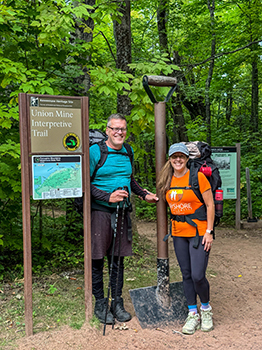
I’ve convinced my husband Joe to join me on this work assignment that’s got me giddy. I’ve long wanted to become a backcountry hiker and camper. He’s also expressed interest in this activity, and the trip happens to fall on the week of marking 27 years of marriage. Happy anniversary, honey! We’re heading into the wilderness together with a group of strangers!
The beginner backpacking trip at the Porkies is one of numerous offerings available through the DNR’s Outdoor Skills Academy. Whether you’re wanting to try something new in Michigan’s great outdoors and need help getting started, or you’re looking to brush up on your skills and learn tips and tricks from the pros, the Academy can help.
Day one of our trip at the Porkies starts early Friday afternoon and gives us plenty of time to be as prepared as possible. Before we even hit the trail, we went through, with our guides’ help, what we brought with us.
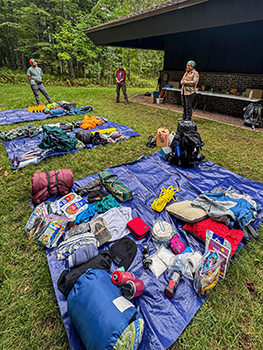
A list of required and recommended items was provided to us beforehand, and while I’m confident about most items we’ve packed – water bottles, headlamps, a compact camping cook kit, weather-appropriate clothing, broken-in hiking shoes, for example – I am worried about our older backpacks we’d bought years ago (and rarely used) and the yoga mats we’re thinking might suffice for sleeping pads.
In the kindest way possible, Urban nixes the yoga mats (“Nope, not even close,” she smiles, pointing to a blue tarp on the ground that she and Anderson have coined “the tarp of shame” and where we are to set all of our not-suitable-for-backpacking items).
Thankfully, plenty of gear, including inflatable, insulated sleeping mats, is available from the DNR for any of us to borrow. In addition to the sleeping pads, we end up borrowing a couple of backpacks Urban suggests we try as well as a two-person tent that, unlike ours, has a full rain flap. “You’re going to want this on your tent,” Urban explains, pointing out how our tent’s rain flap only covers the very top of the tent.
Another notable item that ends up on the “tarp of shame,” from one of our fellow hikers: a full-size hammer. There’s no need for this, our guides tell the group, because it weighs too much and we can use a rock instead for a task like pounding tent stakes into the ground.
After this exercise, we practice packing up and safely getting our packs on our backs (resting firmly on our hips, so as not to adversely affect shoulders and backs, is important). We also weigh our packs – they should be no more than 30-35 pounds, we’re told – and then we’re off for our first hike of the weekend, a short jaunt not far from the park’s visitor center.
This first evening, we pitch our tents and sleep close by, in the group-use site across from Lake Superior, after practicing setting up camp and going over ways to filter water that we’ll need in the backcountry. We also discuss plans for breakfast in the morning: hello, hot coffee, oatmeal and freeze-dried chorizo and eggs!
Miles of magic, deep in the woods
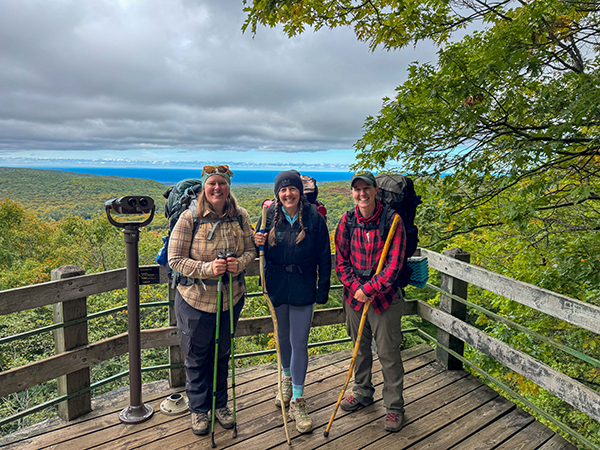
Throughout this trip, our group will hike just under 6 miles total, with most of these miles spread over Saturday afternoon and Sunday morning. Following a must-see stop at Lake of the Clouds to take in the iconic, panoramic views of the park, we head for South Mirror Lake Trailhead and begin our trek toward the interior.
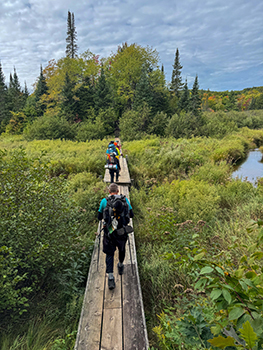
What I’m struck by the most is the peacefulness that washes over me with each step on the trail. It’s early fall, and the colors aren’t yet popping, so we’re treated to vibrant green in every direction. At one point, we reach a boardwalk that takes us over a winding creek, and we pause to take in the low-lying brush and tall grass waving in the warm wind.
We stop for lunch, sitting on tree trunks and downed logs to eat flour tortillas stuffed with tuna fish and chunks of cheese. Then we keep moving, passing a family of day-hikers and later a series of runners who we learn are taking part in an inaugural race. We enthusiastically cheer them on as they pass by.
Eventually, we reach our campsite for the night – an area nestled between a ridge and the lake – and we’re told to find a spot where we’d like to set up our tent. Joe and I choose a flat spot near the shoreline and get ourselves settled for the evening, though before we sleep Urban tells us we’ll be learning to “throw a bear bag.”
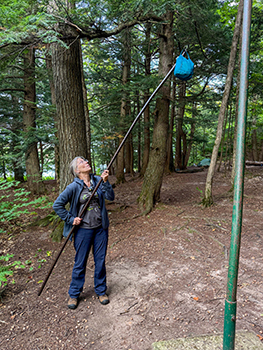
Black bears are among the wildlife calling the Porkies home, though with the right precautions we likely will not run into any. This means packing up any food or other scented items each night (even something like Chapstick) and placing it in a bag that we learn to hang from a site’s bear pole or tree branch that is 10 feet away from the tree and 10 feet off the ground.
We take turns practicing throwing rope over a designated tree branch and hooking a bag from the bear pole. Urban and Anderson are naturals at this, of course. It’s, well, harder than it looks for others, me included, but we get the hang of it eventually (no pun intended).
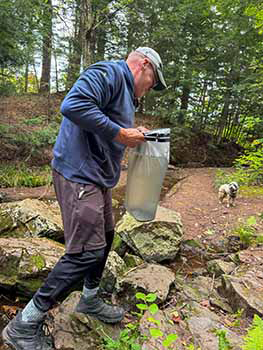
One of my favorite parts of the trip is learning how to safely gather water – a flowing body of water is the safest – and filtering it so we can drink it. Urban and Anderson have several different kinds of systems to share with us, and we take turns using each of them at a bubbling stream not far from our campsite.
Incomparable vistas, a first-timer’s ideal spot
With its 60,000 acres of old-growth forest, roaring waterfalls, Lake Superior shoreline, rivers, trails and ridges, it’s easy to see why the Porkies – Michigan’s largest state park – is a haven for backpacking.
In the past year, between Sept. 1, 2025, and Aug. 31, 2026, more than 7,400 people obtained backcountry permits at the Porkies, said Mike Knack, park manager. This includes approximately 3,700 backcountry campers and 3,700 people who stayed in the park’s cabins and yurts.
Park leaders will tell you the Porkies is an optimal spot for first-time backcountry campers.
“The Porkies is a great space because you can come and be alone and enjoy being in nature,” Urban said. “We have wilderness – we are a wilderness state park, and you have to be prepared for that space because it can be dangerous – but you’re not completely alone; you’re seeing other people on the trails. And even if you’re miles in the backcountry, [park staff] could still get to you. It’s a good transition park if you’re looking to go from camping for a few nights to something else like out West, where you’re putting in more miles and not really seeing people.”
Knack calls backpacking in the Porkies “a unique experience for the Midwest.”
“You have 114 miles of trails to choose from, and nights at cabins and yurts can be added to your itinerary,” he said. “And the variety of trail and campsite options include hiking and camping along the escarpment, at one of the inland lakes, along one of the Carp rivers or along the Lake Superior shoreline – all provide a different experience within the park. And the trees: No matter which season you are backpacking, you are always surrounded by the giant stands of old growth, white pine, hemlock and maple trees.”
On the final morning, when we made our way along South Mirror Lake Trail back to our parked vehicles, I told myself to savor each remaining step. I knew I wouldn’t soon forget this adventure – and I’m also looking forward to backpacking again, hopefully very soon.
Both beginner and intermediate backpacking trips are being planned for the coming year, though no dates have been set yet. Learn more about upcoming Outdoor Skills Academy classes, including future backpacking trips, at Michigan.gov/OutdoorSkills.
“For me, backpacking has been a great way to connect with people, grow my confidence, and reset my nervous system,” said Anderson, who is excited to guide future trips. “But I needed other people to show me the ropes when I was getting my start. I get immense satisfaction seeing other people build those skills that will allow them to create their own positive experiences in the future.”

 But Katie’s explanation is unexpected: “You might hear the slap of a beaver’s tail on the water,” she says as we take in the scenic, seemingly untouched view before us, the just-starting-to-turn maple trees casting crimson reflections across the water’s still surface. “It can be pretty loud.”
 This all must be part of the backpacking experience, I figure, but she surprises me yet again with her answer about not putting much, if any, planning into this aspect of the trip.
 But I’m getting a little ahead of myself – let’s go back to how this epic weekend excursion got underway. Here’s more about this experience, what I learned along the way and why you might want to also explore being a first-time backcountry hiker and camper.
 A list of required and recommended items was provided to us beforehand, and while I’m confident about most items we’ve packed – water bottles, headlamps, a compact camping cook kit, weather-appropriate clothing, broken-in hiking shoes, for example – I am worried about our older backpacks we’d bought years ago (and rarely used) and the yoga mats we’re thinking might suffice for sleeping pads.
 After this exercise, we practice packing up and safely getting our packs on our backs (resting firmly on our hips, so as not to adversely affect shoulders and backs, is important). We also weigh our packs – they should be no more than 30-35 pounds, we’re told – and then we’re off for our first hike of the weekend, a short jaunt not far from the park’s visitor center.
 We stop for lunch, sitting on tree trunks and downed logs to eat flour tortillas stuffed with tuna fish and chunks of cheese. Then we keep moving, passing a family of day-hikers and later a series of runners who we learn are taking part in an inaugural race. We enthusiastically cheer them on as they pass by.
 One of my favorite parts of the trip is learning how to safely gather water – a flowing body of water is the safest – and filtering it so we can drink it. Urban and Anderson have several different kinds of systems to share with us, and we take turns using each of them at a bubbling stream not far from our campsite.
 “You have 114 miles of trails to choose from, and nights at cabins and yurts can be added to your itinerary,” he said. “And the variety of trail and campsite options include hiking and camping along the escarpment, at one of the inland lakes, along one of the Carp rivers or along the Lake Superior shoreline – all provide a different experience within the park. And the trees: No matter which season you are backpacking, you are always surrounded by the giant stands of old growth, white pine, hemlock and maple trees.”