Michigan: Fish Kills May Be Common During Spring Thaws

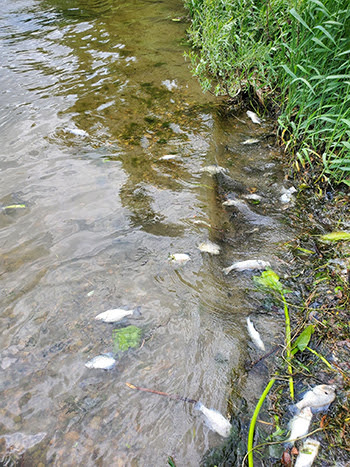
Fish kill: The public is welcome to report fish kills (a common sight during spring thaws) using the Eyes in the Field website; such reports are valuable to the DNR’s ability to manage the state’s aquatic resources.

After ice and snow cover melt on Michigan lakes this spring, it may be more likely for people to discover dead fish or other aquatic animals. While such sights can be startling, the Michigan Department of Natural Resources reminds everyone that it is normal, since winter conditions can cause fish and other creatures such as turtles, frogs, toads and crayfish to die.

“Winterkill is the most common type of fish kill,” said Gary Whelan, DNR Fisheries Division research manager. “As the season changes, it can be particularly common in shallow lakes, ponds, streams and canals. These kills are localized and typically do not affect the overall health of the fish populations or fishing quality.” Read more

Boating Infrastructure Grants to Award $20 Million to States

The U.S. Fish and Wildlife Service announced the agency’s Boating Infrastructure Grant (BIG) program will provide more than $20 million in grant funding for 19 states to construct, renovate and maintain marinas and other boating facilities for outdoor recreation.

Under the BIG program, more than $2.8 million will fund projects in 19 states under the BIG Tier 1 subprogram, and $17 million in grants will be awarded competitively for projects in 10 states under the BIG Tier 2 subprogram. Since its inception in 2000, the BIG program has awarded over $283 million to projects for large transient recreational boats, including funding the construction of more than 6,800 berths and other amenities benefiting boaters across most states and U.S. territories.

States receiving BIG grants include Alabama, Arizona, Arkansas, Florida, Georgia, Massachusetts, Michigan, Minnesota, Mississippi, Missouri, New Jersey, New York, North Carolina, Ohio, Oregon, Rhode Island, South Carolina, Texas, Virginia, Wisconsin, and U.S. Virgin Islands. Read more

91 Years and Still Backlash Free

Changes at Zebco, but the “bomb company” keeps on ticking

Zebco-Europe, the continental arm of one of the most venerable names in the tackle industry worldwide, has announced the closing next year of their long-time operation in Tostedt, Germany.

The company says the measure is a streamlining of European operations. Per North Data (northdata.com) Zebco-Europe GmbH had negative earnings from 2015 to 2020, though it had a boom year in 2021.

Zebco (then a part of Brunswick) bought the operation in 2011, and then was itself acquired by Rather Outdoors in 2021. Rather Outdoors has also acquired multiple other companies in the fishing industry in recent years, including Lew’s, Strike King, Fox, Matrix, Preston, Salmo and Fox Rage.

Rather is consolidating their European operation and moving the business to Belgium. The German operation will be closed and about 80 employees will lose their jobs in 2024, according to a recent letter from Paul Reeves, president of Zebco-Europe.

Unfortunately, the operation of several locations in several countries does not make economic sense due to the significantly higher costs. We have decided that the best way for Rather Outdoors to do business is to consolidate our operations in mainland Europe,” Reeves said in the letter.

A Brief History

Zebco was founded in 1932 as the Zero Hour Bomb Co. with a patent on cylindrical electric time bombs used in the oil-drilling business. In 1942, with that patent set to expire, they began making a then-revolutionary fishing reel designed by Texas watchmaker H.D. Hull—a casting reel that could not backlash. The closed-face spinning reel was born.

The reel was an instant hit, and by the middle 1950’s it was the most popular fishing reel in the nation. The company was acquired by Brunswick, parent of Mercury Marine and other outdoors businesses, in 1961. It moved into the Tulsa headquarters in 1966. By 1975, some 70 million of the reels had been sold. Today, the count is in excess of 250 million reels. Read more

Treat yourself and your boat to a Michigan harbor stay

One of Michigan’s best-kept vacation secrets is the 80-plus state-sponsored harbors that circle the Great Lakes State.

Many harbors offer seasonal slips and all harbors offer “transient” slips, available for boats more than 11 feet and open to those staying two weeks or less. On average, rates run around $1.60 per foot, which means a 20-foot pontoon is about $32 a night. Transient slips offer a great way to experience Michigan’s bigger waters and the marina lifestyle with modern restrooms, showers, grilling areas and other waterfront amenities. You’ll also have easy access to fishing runs, ferry watching, and sunrises and sunsets from your boat.

If you don’t want to bunk on your boat, find a harbor close to home so you can sleep in your own bed. Or take your boat along for your next Michigan beach town trip and make a slip reservation at a harbor nearby.

Reservations can be made at MiDNRReservations.com; select the Harbor tab. Some harbors take reservations directly (view map).

Nightcrawler Hunting

By Glen Wunderlich

Charter Member Professional Outdoor Media Association (POMA)

With trout fishing season around the corner, it was time for me to walk softly and to carry a tired flashlight.  The particularly heavy rains of spring were impetus enough for me to get out in the dark and collect some bait:  nightcrawlers.

My innate cheapness led me back to my childhood, when best friend, Jack Shepherd, and I would hunt for nightcrawlers ahead of some lake fishing for whatever was hungry.  Back in the 50s, I never heard of buying bait and never had two nickels to rub together anyway.   Wasting a week’s allowance on something that a little time and skill could produce was out of the question.

Fortunately, Jack’s father was wise in the ways of do-it-yourself projects.  He taught us how to build kites, make rubber band guns, whistles from tin can lids and blades of quack grass and hand-crafted shingle rockets that were “shot” into space.  Finding nightcrawlers was as easy as a stalk in the dark; catching them was another skillful matter.

The best time was after a rain, when the big crawlers would naturally surface in the dark.  Here’s where the challenge begins.  Nightcrawlers will typically come out, but not usually all the way.  Half of the worm will remain firmly planted in the ground, while the other half protrudes while looking for friends to cozy up to.

That “tired” flashlight would locate – but, not spook – the critters, before we got into position to make our play.  We’d see where the crawler was attached to terra firma and quickly pinch it to the ground.  Then, with a steady and somewhat gentle pull on the head of the worm, we’d persuade them to give up – usually after their muscles tired.  About half of them routinely out-quicked us. 

Here are a few tips for wannabe worm getters.  Headlamps work great to free both hands, but modern LED units are too bright and will send worms into the earth in the blink of an eye; their recoil mechanism is that quick!  A dim light or red lens is best. A hand-held flashlight can work, but two hands free are better.

Commercially produced worm bedding made of recycled newspapers, when moistened, makes for good storage in commercially available worm boxes.  Garden soil, coffee grounds or decomposed leaves in a container with holes for air will also provide a means of storage.  However, worms must remain cool, so hide them in the refrigerator when women aren’t looking.  You might want to use that spare refrigerator in the garage or basement, because ambitious worms seem to want to explore their surroundings at times.

Oh, there are other methods to get worms such as electrocuting them, grunting them (look it up) or, irritating their skin with dish soap or bleach, but worms will not withstand much punishment before expiring.  Dead worms are bad in storage; find them and eliminate them from any collection.

There is a certain satisfaction derived from this do-it-yourself worm hunting that cannot be matched by purchasing bait.  If you are sneaky enough, you can enjoy a night out like never before.

Sturgeon for Tomorrow seeking volunteers to protect sturgeon along Black River

Volunteers are needed in Cheboygan County now through early June to stand guard as mature lake sturgeon head upstream to their spawning sites along the Black River.

The Black Lake Chapter of Sturgeon for  is working in partnership with the Michigan Department of Natural Resources and various tribes to protect the fish from being illegally harvested during the six-week spawning season.

Sgt. Mark DePew, who leads DNR Law Enforcement Division’s efforts on the river, said, “This program, that protects this iconic species when they are most vulnerable, is a model of how agencies and the public can cooperate to get needed work accomplished.”

The lake sturgeon, which can weigh up to 200 pounds and live to be 100 years old, is listed as a threatened species in Michigan, with any sport fishing being closely regulated.

Black Lake Sturgeon

“For over 20 years, the annual Sturgeon Guarding Program has proven that people serving as sturgeon guards watching over the river have virtually eliminated poaching, while helping to ensure the protection and reproductive success of the species,” said, Mary Paulson the program’s volunteer coordinator. “It’s a unique and rewarding experience to witness these majestic fish swimming up the Black River, and to be a key player in safeguarding one of Michigan’s most valuable natural resources.” Read more

Michigan: Sturgeon for Tomorrow seeking volunteers to protect sturgeon along Black River

Volunteers are needed in Cheboygan County now through early June to stand guard as mature lake sturgeon head upstream to their spawning sites along the Black River.

The Black Lake Chapter of Sturgeon for Tomorrow is working in partnership with the Michigan Department of Natural Resources and various tribes to protect the fish from being illegally harvested during the six-week spawning season.

Sgt. Mark DePew, who leads DNR Law Enforcement Division’s efforts on the river, said, “This program, that protects this iconic species when they are most vulnerable, is a model of how agencies and the public can cooperate to get needed work accomplished.”

The lake sturgeon, which can weigh up to 200 pounds and live to be 100 years old, is listed as a threatened species in Michigan, with any sport fishing being closely regulated.

“For over 20 years, the annual Sturgeon Guarding Program has proven that people serving as sturgeon guards watching over the river have virtually eliminated poaching, while helping to ensure the protection and reproductive success of the species,” said, Mary Paulson the program’s volunteer coordinator. “It’s a unique and rewarding experience to witness these majestic fish swimming up the Black River, and to be a key player in safeguarding one of Michigan’s most valuable natural resources.” Read more

Michigan: Large Trout Stocked in SE Michigan’s Huron River, Spring Mill Pond

Broodstock trout: Michigan DNR Fisheries hatchery staff release adult broodstock trout into the Huron River at Proud Lake Recreation Area.

Anyone fishing the Huron River at Proud Lake Recreation Area or Spring Mill Pond at Island Lake Recreation Area may soon benefit from late-March trout-stocking efforts at these southeast Michigan destinations.

Michigan Department of Natural Resources crews stocked approximately 3,000 adult trout – fish that were retired broodstock from the state’s fish hatcheries.

  • The Huron River, downstream of the Proud Lake Dam, in Oakland County, received approximately 1,200 brown trout and 1,200 rainbow trout, all ranging in sizes from 14 inches to 19 inches.
  • Spring Mill Pond, in Livingston County, received approximately 220 brown trout and 400 rainbow trout, also ranging in size from 14 inches to 19 inches.
  • The DNR also stocked a total of 1,550 yearling rainbow trout at the sites: 900 in the Huron River and 650 in Spring Mill Pond. Anglers should be aware that some portion of these yearlings will be smaller at first than the minimum size limit of 8 inches.

Special regulations apply for anglers interested in targeting these trout: Read more

Thousands of large trout stocked in southeast Michigan’s Huron River and Spring Mill Pond

Anyone fishing the Huron River at Proud Lake Recreation Area or Spring Mill Pond at Island Lake Recreation Area may soon benefit from late-March trout-stocking efforts at these southeast Michigan destinations.

Michigan Department of Natural Resources crews stocked approximately 3,000 adult trout – fish that were retired broodstock from the state’s fish hatcheries.

  • The Huron River, downstream of the Proud Lake Dam, in Oakland County, received approximately 1,200 brown trout and 1,200 rainbow trout, all ranging in sizes from 14 inches to 19 inches.
  • Spring Mill Pond, in Livingston County, received approximately 220 brown trout and 400 rainbow trout, also ranging in size from 14 inches to 19 inches.
  • The DNR also stocked a total of 1,550 yearling rainbow trout at the sites: 900 in the Huron River and 650 in Spring Mill Pond. Anglers should be aware that some portion of these yearlings will be smaller at first than the minimum size limit of 8 inches.

Special regulations apply for anglers interested in targeting these trout: Read more

FOXPRO Releases Innovative Bowfishing Lights

The FOXPRO Mudcutter Light Kit is the most advanced and user-friendly LED bowfishing light system on the market. The Mudcutter Light Kit allows bowfisherman to customize the light intensity and hue, ranging between 2000K to 6000K, which can be done via the wireless remote control or the hard-wired rheostat.

Depending on water conditions, whether murky or clear, different hues of white light will penetrate better. The Mudcutter is as easy as pressing the on/off button and using the gradual light color change buttons to select your desired hue and the brightness up and down buttons to select your desired light intensity. Instant full white, full amber, and full mixed buttons are also provided for your convenience.

Mudcutter lights are designed to operate two banks from 1 remote. So if an additional kit is purchased, they can both be operated independently from the same remote. Mudcutter lights run on a battery (12V DCOnly) or generator (110V AC / 120V AC). The Mudcutter Light Kit is backed by a 2-year warranty and FOXPRO’s unmatched customer support.

FOXPRO’s new Bowfire was designed to be the most advanced and user-friendly bowfishing light on the market. With its patented 3 colors in one led selection, switching colors has never been easier! Why the need to switch colors quickly? Depending on water conditions, whether murky or clear, different hues of white light will work and penetrate better. With competitor lights, you will need to unscrew the LED modules to change the hue.

The Bowfire is as easy as turning the selector switch to quickly adapt to changing water conditions. The Bowfire gives you 2 on/off methods. The first is a constant on/off for constant light. The second is a momentary on/off, which works better for light-sensitive fish. And the dimmer controls allow you to control the intensity of the light for the best brightness for water conditions. The spot-to-flood feature allows you to adjust the light beam, so whether you are bowfishing from the banks, or on a boat where extended range is needed for fish further away, the Bowfire has you covered. High capacity Lithium Ion battery and charger included for extended run times. The FOXPRO Bowfire is backed by a 3-year LED replacement warranty, a 1-year tail cap and accessories warranty, and FOXPRO’s unmatched customer support. Read more

1 35 36 37 38 39 140