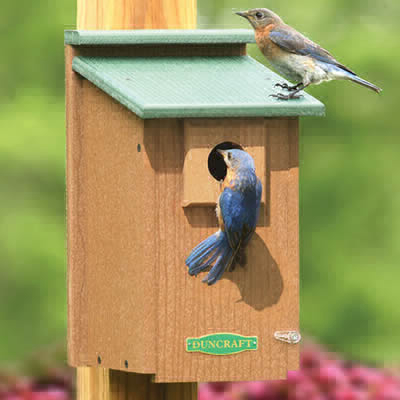
The Duncraft Eco-Friendly Bluebird House is a good example of a standard-sized nest box for cavity nesting songbirds.
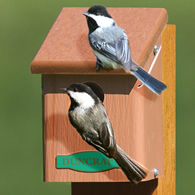
The Duncraft Eco Chickadee Bird House.
The advent of March signals it is time to prepare our nest boxes for the variety of cavity nesting birds ranging from wrens and bluebirds to screech owls and Wood Ducks. Whether or not the weather in your area shows it or not, it’s time to clean and repair our bird houses for the nesting season, as well as plan for new additions. If you want to install new nest boxes, the time is right to get started, or in northern climes, you may want to follow through on building a new one, make a purchase. Then consider if where to position nest boxes to attract the birds you prefer?
Installing and monitoring a bird house is fun, but it’s also an important part of benefitting birds. By providing an “artificial cavity” – a nest box – you are helping cavity nesting birds, which is a great conservation service. Of course, nest boxes don’t come in one size to fit all birds, nor will one location necessarily fit the habitat requirements of all cavity nesting birds. Indeed, there are a number of topics to be aware of when planning for a bird house in your yard – or another location in your area. First, nest boxes and bird houses are simply the same product by a different name.
Cavity-nesting Birds – Not all birds use nest boxes, but 88 species of North American birds do nest in cavities and will use nest boxes, ranging from chickadees to Barred Owls. Read more
New name for a familiar pest: Gypsy moth is now spongy moth
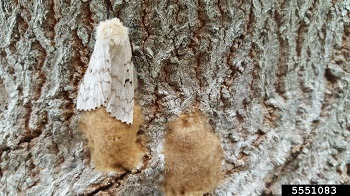
The Entomological Society of America Wednesday announced a new common name for the Lymantria dispar moth. The invasive moth most familiar in its voracious, leaf-eating caterpillar stage will now be known as “spongy moth.”
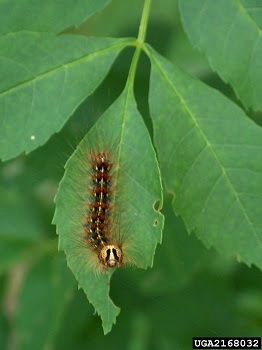
Formerly referred to as “gypsy moth,” the hairy, yellow-faced caterpillar with pairs of red and blue spots down its back was big news in 2021 when a population explosion in Michigan caused leaf loss in oaks and other trees in infested areas.
Spongy moth is now the approved common name in the ESA Common Names of Insects and Related Organisms List. The old name was removed from this list in July 2021 because it contained a derogatory term for Romani people. The move is part of the society’s Better Common Names Project.
The program – cooperatively implemented by the Michigan departments of Agriculture and Rural Development; Environment, Great Lakes, and Energy; and Natural Resources – addresses prevention, detection, eradication and control of aquatic (water-based) and terrestrial (land-based) invasive species in Michigan through four key objectives:
Preventing the introduction of new invasive species.
Strengthening the statewide invasive species early detection and response network.
Limiting the spread of recently confirmed invasive species.
Managing and controlling widespread, established invasive species.
This year’s grantees have offered $541,500 in matching funds and services to support these projects, leveraging a total investment of $4,141,500.
Improving prevention and management
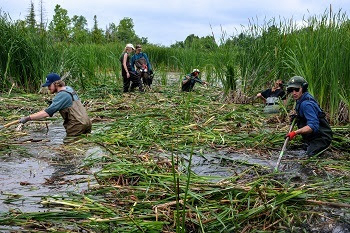
This year’s grants will provide funding for a range of efforts targeting aquatic invasive species: Read more
SWANSBORO, N.C. –– High Speed Gear® embarks on a new product line up designed for K9 and working dog handlers. The Bonito 15’ Tracking Lead is the first product in the new series.
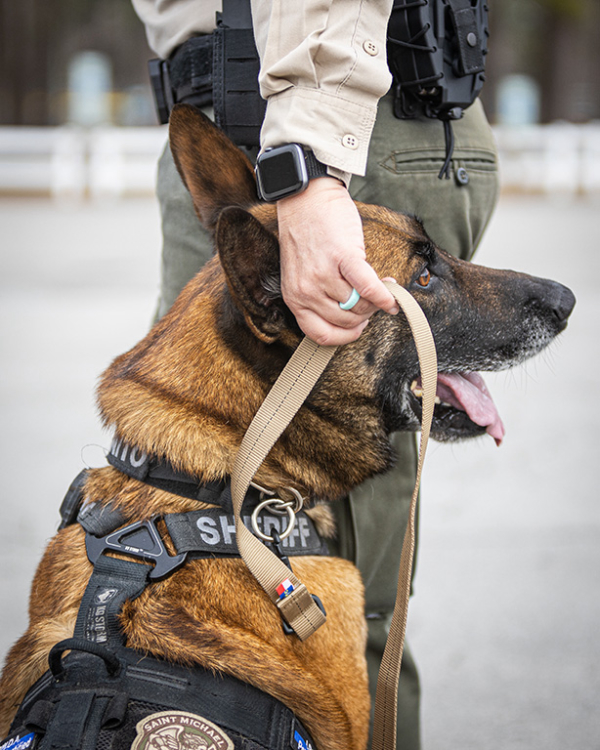
For over 23 years, High Speed Gear® has been developing and providing mission-essential tactical gear to first responders, military personnel, and government agencies, and is now able to offer equipment for those four-legged heroes. The Bonito 15’ Tracking Lead is designed specifically for K9 and working dog handlers. The lead is constructed with Mil-Spec tubular nylon using Schoeller™ Nanosphere™ coating. The new Tracking Lead is water and fur resistant; the handle is double bar-tacked for durability, and it’s equipped with a steel snap-hook with military-grade coating. The Tracking Lead is made in the USA and extends a total of 15 feet in length.
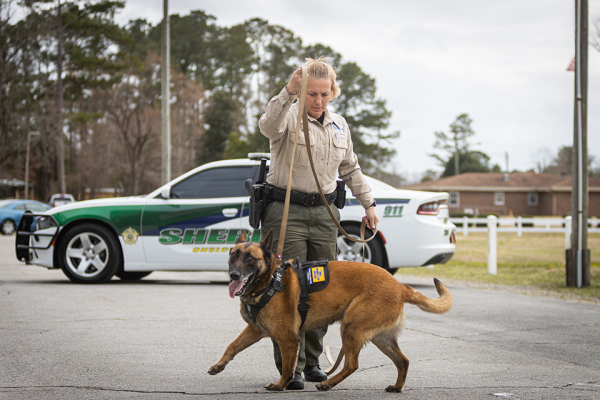
“A local Onslow County K9 Sergeant, Dawn Jauernik and her K9 Bonito inspired our team to design and offer the new K9 product line up to our customer base,” explained Shelbie O’Brien, HSGI® Sales Manager . “We’re proud supporters of law enforcement, and we know just how impactful the K9 units can be on a law enforcement agency so it was the perfect next step in product offerings from High Speed Gear.” Read more
Charter Member Professional Outdoor Media Association (POMA)
As winter draws to a close, we get teased by Mother Nature, as she doles out a few mild days to us weary wildlife watchers. As a lifelong birder, it is always exciting to notice the early arrival of some of our fair-weather feathered friends. Some of them – like some of us – seem to be pushing things a bit, however.
Their northern journey from parts unknown has not only begun, it has ended for a few early birds; however, they won’t be getting any worms just yet. A male red wing blackbird and two common grackles have beat the rush to Shiawassee County and found their way to a remote feeder of mine deep in the woods already. As for female red wing blackbirds, we won’t be seeing them this early; they inexplicably remain in their southern reaches, while the males scope out new home sites.
On the other side of the coin are some of the toughest little creatures known to mankind: the American Tree Sparrows.
Tree Sparrow
They actually travel south to Michigan for the winter to feed on indigenous weed seeds and those supplied in feeders. American Tree Sparrows breed in the far North and are rarely seen south of northern Canada in summer.
Another tiny, winter visitor of ours is the dark-eyed Junco that has yet to head to its breeding grounds in the Western mountains and Canada. A recent estimate set the junco’s total population at approximately 630 million individuals.
Interestingly, the oldest recorded Dark-eyed Junco was at least 11 years, 4 months old when it was recaptured and rereleased during banding operations in West Virginia in 2001; it had been banded in the same state in 1991!
Wild turkeys, although non-migrating, are also in a transition phase. During spring, wild turkeys transition from the slow moving, gregarious mixed flocks of winter and start to disperse, as reproductive activity ramps up. That movement of wild turkeys, both male and female, during the spring transition period represents one of the most active stages of the birds’ lives.
This past week after not having laid eyes on a single turkey for months, they returned in a big way. Strung out in single file for well over one hundred yards in a nearby field was a group of returning turkeys in the snow-covered habitat. Where they were since last fall is anyone’s guess, but one thing I know for sure: Some of them were members of our local gang last year. The giveaway was one disadvantaged hen that walked with a noticeable limp among the birds. They didn’t forget where the feeding stations were, either, and made stops at my neighbor’s station and even my remote fast food feeder.
These game birds will now disperse. Dispersal is commonly defined as the movement of individual birds away from the area they were born to a different location.
Although this wintering location has been a mystery to me, it’s comforting to know they have, in fact, returned to their fair-weather range – even if fair weather remains but a promise for now.
left to right–NWTF Regional Biologist Ryan Boyer, Michigan DNR’s Director of the Office of Public Lands Scott Whitcomb and NWTF CEO Becky Humphries, photo credit: Lexi Kelly
For more information, contact Pete Muller at (803) 637-7698 or pmuller@nwtf.net
NWTF Presents Michigan DNR with National Conservation Award
EDGEFIELD, S.C.—The Michigan Department of Natural Resources received national recognition from the National Wild Turkey Federation for its collaborative conservation delivery throughout the state.
“In Michigan, we’re blessed with an abundance of natural resources and wild places you don’t come across every day, providing the backdrop for hunting, fishing and all types of outdoor recreation and relaxation,” said Scott Whitcomb, director of the DNR’s Office of Public Lands. “This award recognizes sound, strategic stewardship of 4.6 million acres of state-managed land in Michigan, an achievement that would not be possible without conservation partners like the National Wild Turkey Federation. I’m honored to accept the award on behalf of the DNR and the passionate sportsmen and women who contribute to and benefit from this effort.” Read more
MISSOULA, Mont. — Ten years after the successful restoration of elk to their historic Virginia range, the Virginia Department of Wildlife Resources (DWR) is accepting applications for its first elk hunting season through March 30, 2022.
“Instituting the first-ever managed elk hunt a mere decade after restoration is an indicator that the state’s elk herd is growing, sustainable and healthy. In short, it marks a conservation milestone for Virginia,” said Mark Baker, RMEF board of directors chair. “We salute and congratulate DWR on successfully executing its elk management plan, and for establishing a hunt that will generate significant funding to ensure the future of elk in Virginia.”
In addition to providing both funding and volunteer support that led to Virginia’s initial elk restoration in 2012, RMEF also made key contributions to successful restorations in Kentucky, Missouri, North Carolina, Tennessee, West Virginia and Wisconsin. Read more
The Florida Fish and Wildlife Conservation Commission (FWC) has been notified by the National Veterinary Services Laboratory of confirmed cases of Highly Pathogenic Avian Influenza (HPAI) strain: H5 2.3.4.4 in a lesser scaup, black vultures and other avian species. There is a low risk of HPAI transmission to humans and, to date, there have been no known human infections in North America.
The FWC is currently investigating bird mortalities in Brevard, Indian River and Volusia counties believed to be caused by HPAI. This strain has been documented in the United States since 2021 and was detected in hunter-harvested blue-winged teal in Palm Beach County in January 2022.
To prevent the spread of HPAI, the public should avoid handling sick or dead wildlife, prohibit the contact of domestic birds with wild birds, and report wild bird mortalities to FWC so deaths can be investigated. Please be advised that because HPAI is not treatable and is easily transmitted in wild birds, some wildlife rehabbers may not be accepting these animals at this time. Read more
Bozeman, Montana- The Wild Sheep Foundation (WSF) thanked its partners for completing a new water catchment guzzler installation on Nevada’s Desert National Wildlife Refuge.
Nevada is the driest state in the nation. Before the January 29 project date, this region had gone more than 270 days without precipitation (either rain or snow). The Desert National Wildlife Refuge is home to diverse flora and fauna, including desert bighorn sheep. Man-made water catchment guzzler sites provide critically-needed water for desert bighorn sheep and a host of other desert-dwelling wildlife species.
“This is good boots-on-the-ground conservation work,” said Kevin Hurley, WSF’s Vice President for Conservation. “From need assessment, planning, funding, and execution, it’s true collaborative conservation in action. All this region needs now is rain.”
The water catchment guzzler was entirely constructed on-site by volunteers and consists of a 3,200 square-foot collection apron, four 2,300-gallon water storage tanks, and a metal drinker basin. All materials and personnel were airlifted onto the site by helicopter. Read more
In 1887, Theodore Roosevelt returned from his Elkhorn Ranch in the Dakota Territory with an idea. He would assemble a group of like-minded, influential men to turn the tide in favor of conserving our nation’s resources, which, at the time, was vanishing quickly. This is how he did it.
Roosevelt photographed in a New York studio in the mid- to late-1880s, with his favorite Model 1876 .45-75 rifle. Theodore Roosevelt National Park located in North Dakota is shown in the background. It was established in honor of the landscape’s influence on Roosevelt who, as a young man, hunted and ranched in the Little Missouri Badlands.
Like any good coach, Theodore Roosevelt hand-picked an all-star team that comprised the very first members of the Boone and Crockett Club. With these men, Roosevelt shared his vision to achieve unprecedented milestones in conservation, and then he allowed the team to carry out the plan. The great achievements of the Club—the creation of national parks, wildlife refuges, national forests, fish and game laws, etc—were not Roosevelt’s ideas alone. Rather, he served as a sounding board for those ideas and encouraged his fellow Boone and Crockett members to act upon them. Then, while serving as president of the United States from 1901-1909, Roosevelt became the best ally the Club ever had. His influence on lawmakers, connections to Club members, and strategic legislative mind built our country’s conservation legacy that still exists today.
The Early Years
At a young age, Roosevelt developed a fire in his belly that would never be doused. Born with severe asthma, he was, for a while, a scrawny little kid. Instead of allowing the affliction to slow him down, it only served to fuel the fire. By his early teenage years, he took up weightlifting and gymnastics, embracing the “strenuous life” that would come to define him. In 1872, on his fourteenth birthday, he got a shotgun. Eight years later, he graduated from Harvard and was married to his first wife Alice Hathaway Lee. By 1881, Roosevelt was elected to the New York State Assembly. He was 23 years old. Read more