Hijacked by anti-hunters, the term ‘trophy hunting’ has taken on a negative connotation in society – it’s time to take it back. Here’s a start to reframing the trophy-hunting discussion with non-hunters.
Defining a Trophy
When news anchors and the general public throw the term ‘trophy hunting’ around, they’re usually speaking in a very broad sense that assaults their emotions and is an affront to almost everything that modern, regulated hunters and hunting represents. The term is a misnomer, but they don’t even realize it.
A trophy is a very personal thing. For some just killing an animal to eat is reward enough. For others, a mature animal that is more wary is the goal. Still, for others, a very specific animal, or at least one meeting very high standards, is the ultimate goal.
This is all dependent upon the person, their skill level and experience in hunting (see infographic: “Evolution of a Hunter”), as well as understanding of the species they’re targeting. A trophy is a crowning achievement for an individual. Period.
What it’s not
The popular myth of trophy hunting is that it’s simply hubristic killing by hunters for display upon a wall – which is only done for a head, hide or horns. The underlying belief is that the rest of the animal is left where it died and goes to waste.
This is the perception anti-hunters have created, and which they are framing hunters every chance they get. From “Cecil” the lion in Zimbabwe, Africa, to the proposed black-bear hunt under protest in Florida, anti-hunting activists and organizations cry ‘trophy hunt’ to convey what they believe is the senseless killing of animals – without regard to the associated science, management and ecosystem-wide benefits.
It’s an effective tactic that resonates with the public quickly. Those two words immediately generate an affront to the public’s sensibilities, and creates another hurdle we have to overcome to maintain scientific, and not emotional, management of our flora and fauna.
What it is
The fact is, what animal-rights’ activists portray is not just an affront to the public’s sensibilities, the waste of an animal is a disgrace to the sensibilities of a hunter, as well. When it comes to a ‘trophy hunt,’ two points often overlooked by outraged activists, the media and the public include: A hunting season is not state-sanctioned slaughter. Every state has wanton waste laws that mandate the harvest and use of meat, hides or other body parts to ensure that the animal is not just wasted, and that the number of individuals taken is in accord with the supporting habitat and predator-prey balance of the area.
A ‘trophy’ animal and its use as table fare are not mutually exclusive. An animal can be a specimen worthy of both taxidermy and the table.
A trophy hunter is simply someone who has placed self-imposed restrictions upon themselves that go above and beyond what’s dictated by the state. They are more selective, and will pass on younger animals, often those barely reaching the minimum standard, in a deeply personal pursuit to further challenge their skills and learn as much as possible about the prey they pursue. Read more
Department of Natural Resources wildlife staff members recently took to the sky in small aircraft to observe and count ducks, geese and swans on southeast Michigan’s waterways. They observed 157,028 ducks, 33,468 geese and 5,896 swans in the 2016 survey.
In the 2015 survey, observers counted 173,386 ducks, 20,350 geese and 4,365 swans. Goose and swan observations increased in 2016, while duck observations were down about 9 percent.
“The ducks were spread out this year with the mild winter and all the open water,” said Joe Robison, field operations manager for the DNR Wildlife Division’s Southeast Region. “We did not count as many ducks in this year’s survey, but we believe that duck abundance is similar to last year.”
Since 1991, the state of Michigan has cooperated with other states, the U. S. Fish and Wildlife Service, Canadian provinces and the Canadian Wildlife Service in conducting aerial surveys of wintering ducks and geese. This survey is commonly referred to as the Mid-Winter Waterfowl Survey. Read more
So-called “candy crops” like oats, winter peas, or brassicas (beets, rapes, turnips, etc.) are highly attractive and palatable to deer, and are great choices for hunting plots. Jason Campbell photo.
Planning your first wildlife food plot? Follow a few key steps for food plot success.
By Josh Lantz
Few hunters have degrees in horticulture. So when the average deer hunter decides it’s time to up his or her game by putting in a food plot, the process can seem overwhelming.
It doesn’t have to be that way. Follow a few key steps for food plot success. Read more
The GrowingDeer.tv team is busy with what is probably the number one way to make most hunting properties more attractive to deer and turkey. Watch as they prepare to manage timber and native grass using prescribed fire. Plus: the team shares their new practice techniques for bow hunting turkeys. Stay tuned to the end for new details about the Spring Field Day event on April 1 – 2 at The Proving Grounds. For more information or to register go to this link: http://www.growingdeer.tv/view/jsk0Read more
MONTPELIER, Vt. –Vermont Fish & Wildlife says if you are feeding birds that it’s important to clean those feeders on a regular basis so your feathered visitors don’t become sick.”Feeding birds in the winter is a source of great enjoyment for bird enthusiasts, but it can also cause diseases to spread quickly among wild birds,” says John Buck, the state’s lead biologist on migratory birds. “It is critical to clean those birdfeeders at least once a month in order to prevent a buildup of harmful pathogens.”
Bacteria, viruses, fungi, and parasites can cause diseases such as aspergillosis, salmonella, avian pox, trichomoniasis, andconjunctivitis. Species commonly affected by bird feeder diseases are redpolls, pine siskins, goldfinches, sparrows, and cardinals.
Buck recommends using a solution of one part bleach to nine parts hot water to kill bacteria. Hot water with unscented dish detergent also does an excellent job. Wear rubber gloves to avoid any contamination. Be sure to clean inside and outside surfaces. Bottle brushes work well in tube feeders. Read more
Idaho Fish and Game, with assistance from USDA Wildlife Services, has completed wolf control actions in northern Idaho’s Lolo elk zone to improve elk survival in the area.Predation impacts to elk calf and cow survival is the primary factor limiting recovery of the Lolo elk population.
Using a helicopter, Wildlife Services agents killed 20 wolves during the operation, which started last week. The operation is consistent with Fish and Game’s Elk Management Plan and Lolo Predation Management Plan.
The control operation was paid for using Fish and Game license dollars transferred to the Idaho Wolf Depredation Control Board, created by the Idaho Legislature in 2014. Read more
Bayer sponsoring special section bringing attention to importance of pollinatorsKansas City, Mo. – Feb. 10, 2016 – Pheasants Forever & Quail Forever is excited to announce a new exhibitor area at the 2016 National Pheasant Fest & Quail Classic devoted exclusively to the connection between honey bees, monarch butterflies, pheasants, quail and quality habitat. Sponsored by Bayer, “The Bee Hive” promotes businesses and organizations who are striving to improve the quality and quantity of diverse grassland habitat for pollinators throughout the United States.
“For the first several weeks of their life, pheasant and quail chicks survive on a diet that’s almost exclusively protein-rich insects. Whether we call it brood habitat or pollinator habitat, it’s the same mix of grasses and flowers critical to honey bees, insects, pheasants and quail,” explained Rick Young, Pheasants Forever & Quail Forever’s vice president of field operations, a certified wildlife biologist, beekeeper, and honey producer. “As we strive to make every acre the highest quality habitat possible, the benefits exponentially increase not only for pheasants and quail, but for pollinators, monarchs, and a wide array of wildlife species.” Read more
Just as many donors to HSUS have no idea how their money is being used—or misused—a number of companies have partnerships with HSUS and likely have no idea who they’ve gotten in bed with. We’ve encouraged supporters to contact a number of companies in the past to inform them about HSUS, and we’ve had clear success in getting companies to sever ties with HSUS.
Many of our readers don’t want to support companies that support HSUS. Here’s a list of the companies supporting HSUS. We’ll keep it updated with both current and former supporters. We’ll keep reaching out to current supporters—and we’ll need your help, as always. Stay tuned.
The Department of Natural Resources just finished its 2016 elk survey after nine days of flying in northern Michigan.
“Every other year, we conduct the survey by counting elk from an airplane,” said DNR Field Operations Manager Brian Mastenbrook. “Because elk are so large and typically found in groups, they are a great animal to count by airplane. An airplane allows us to cover large areas much quicker than any other method, and it gives us a confident estimate of elk.”
Two airplanes flew transects, or grids, over the entire elk range, which is in the northeast Lower Peninsula from Indian River east to Onaway, south to Atlanta and back west to Gaylord. The planes covered 88 transects – each 2 miles wide by 6 miles long – flying more than 5,000 miles.
“This is an extremely effective survey that provides great input for our management recommendations,” said Mastenbrook. “We’ve used this survey to generate population estimates since 2008.”
In recent survey years, population estimates of elk were 1,040 (2012) and 668 (2014).
A total of 1,002 individual elk were counted during the 2016 survey, giving a population estimate of 1,371 elk. The number of animals seen during an aerial survey is always an underestimate, because not all can be seen from the airplane. Although winter is the best time for an aerial survey because elk stand out against the white snow and leaves are off the trees, they still can be missed among dense conifer trees, which do not drop their needles annually. Therefore, to provide a more accurate estimate of elk, a correction factor is used. The correction factor, developed by running experimental trials on radio-collared elk, is now the standard practice among wildlife managers across the nation.
Mastenbrook said part of managing an animal’s population is having clear goals, and today’s elk management goals are to balance the population with the available habitat, or food and cover required; use hunting as the primary method of population control; and improve the public’s understanding of elk. He said the elk population goal is 500 to 900 animals in order to reduce crop damage, disease concerns and forest regeneration, while maximizing recreational opportunities. Read more
When my neighbor telephoned me a few weeks ago, there was urgency in his voice. “You should see all the deer! And, there’s a really big buck out there.” We watched together as the whitetails milled about, heads down with only one mission: eating.
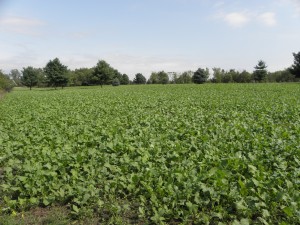
Amid the brassica plot of a couple acres were a good mix of does and bucks – many of which we had never encountered during hunting season based on the headgear being displayed. Dozens of hungry deer in survivor mode had somehow passed the word that the all-you-can-eat smorgasbord was open for business. After a short visit, I had already set my sights on next season’s wide rack.
Even though we had experienced record-breaking warmth in December, a fair amount of deer routinely frequented the lush green landscape for the turnip and rape leaves. However, it now appeared as though all the deer in Shiawassee County decided to take part in the buffet bonanza.
Winter had finally arrived with high temperatures in the 20s with little snow present. However, about two inches of ice blanketed the low-growing clover and alfalfa plants, making them inaccessible. Turnips, on the other hand, protruded to please the crowd; our pact to plant turnips each year was reinforced by the sight of the feeding frenzy.
Bait piles – even small ones – have been outlawed in the Chronic Wasting Disease (CWD) management zone in which we live. Food plots are a legal exception and remain a legitimate means to draw and hold deer on a property, however.
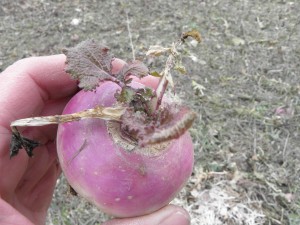
Turnips are in a group of annual plants called brassicas, which includes radishes, turnips, cauliflower, rape and kale and are extremely high in protein and highly digestible to deer.
Brassica Plot a Month after Planting
Protein content can range from 15 to 20 percent in both the leaves and the roots. They remain highly digestible to deer throughout the growing season and beyond and fill a nutrition gap when the going gets tough.
Turnips grow on a wide range of soils but do best on well-drained, fertile soils in full sun with a pH of 6.5 to 6.8.
Purple Top Turnip
Even though turnips are relatively easy to grow, the first step is to obtain a soil sample, which will indicate soil requirements before blindly throwing money at the project. Lime is used to increase the pH level and should be given a few months to break down before planting.
Preparing the seed bed will require a small tractor, an ATV, or at least a rototiller to churn up and level the soil. Spraying with glyphosate is a good means to control weeds, and if ignored, some fast-growing weeds will stunt the growth of desirable plants to the extent of failure.
Seed can then be broadcast with a hand-spreader and pushed into the ground with a cultipacker. Turnip seed is very small and should not be buried more than about 1/8 to 1/4 inch. It’s also easy to apply too much seed, and in this case more is not better, because too many plants will mean tiny, overcrowded specimens with little yield.
Fertilize at or before planting with about 300 pounds of 19-19-19 per acre to get the plants up and running but soil testing will provide a more accurate recipe for fertilizer and lime needs. After that, sit back and enjoy the show.
A great resource is Ed Spinazzola’s paperback, Ultimate Deer Food Plots or just click on the Quality Deer Management Association’s web site at www.qdma.com, where more detailed information can be found.

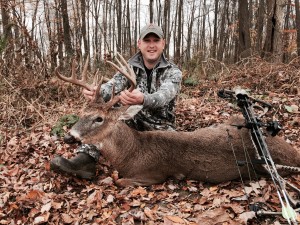 A ‘trophy’ animal and its use as table fare are not mutually exclusive. An animal can be a specimen worthy of both taxidermy and the table.
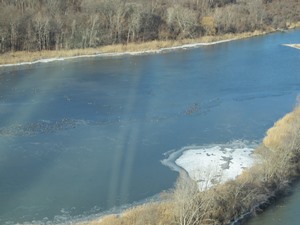 Department of Natural Resources wildlife staff members recently took to the sky in small aircraft to observe and count ducks, geese and swans on southeast Michigan’s waterways. They observed 157,028 ducks, 33,468 geese and 5,896 swans in the 2016 survey.


 This from humanewatch.org
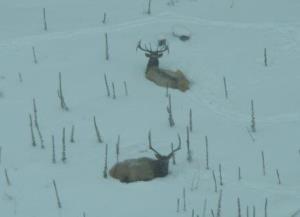 The Department of Natural Resources just finished its 2016 elk survey after nine days of flying in northern Michigan.