Derya Arms (South Derya Corp.), an international firearms manufacturer with production operations in Jacksonville, Florida and Konya, Türkiye, today introduced the EX1300, a break-action over/under shotgun offered in 12 gauge, 20 gauge and .410 bore. All three models carry the same $699 MSRP and are shipping now through Derya’s authorized dealer network nationwide.
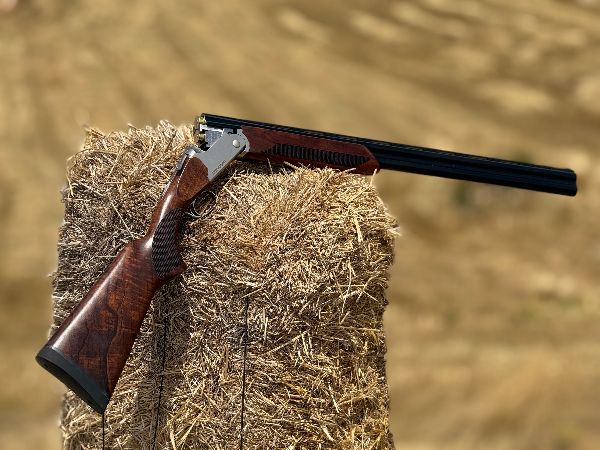
The EX1300 is built on a monolithic steel receiver finished in nickel, paired with deep black chrome barrels and a hand-selected Turkish walnut stock and forend. Steel automatic ejectors throw fired hulls the moment the action opens. A single selective trigger and a tang-mounted safety with an integrated barrel selector let the shooter choose which barrel fires first. Centered top-lever and tang controls and a stock with no cast-on or cast-off make the gun equally at home in either hand.
The launch expands Derya’s traditional sporting line alongside the EX1400 side-by-side. Where the company is best known in the United States for tactical shotguns and pistols, the EX series is built for hunters, clays shooters and anyone who wants a walnut-and-steel double without choosing between gauges or stretching the budget.
Most American shooters know Derya for tactical shotguns, pistols, and rifles. The EX1300 is the other side of what we build: a walnut-and-steel over/under with ejectors and a full choke set, in the three gauges hunters and clays shooters actually ask for, all at one price. Pick your gauge, not your budget.
— Dustin Jones, Vice President, Derya Arms
THREE GAUGES, ONE PRICE
EX1300 12 Gauge, 28-inch barrels. The all-rounder for waterfowl, upland and sporting clays. Chambers 2¾-inch and 3-inch shells.
EX1300 20 Gauge, 26-inch barrels. Shorter barrels and a 43-inch overall length make it quick in the hands for a full day in upland cover.
EX1300 .410 Bore, 28-inch barrels. Soft-shooting and well-mannered for small game, youth and new shooters, with the same fit and finish as the larger gauges.
Every EX1300 ships with three flush-fitting Mobilchoke tubes — Full, Modified and Improved Cylinder — and arrives in a protective Derya bag. All three models are California, Maryland and Massachusetts compliant and are backed by Derya’s limited lifetime warranty to the original owner. Across the line the gun weighs 6.64 pounds, with a 14.3-inch length of pull and a fixed bead front sight. The 12-gauge and .410 measure 45 inches overall; the 20-gauge measures 43 inches.
AVAILABILITY AND ORDERING
The EX1300 is available now through authorized Derya dealers nationwide. Item numbers and UPCs are EX1300.12.28 (12 gauge, 28-inch barrels, UPC 810216300562), EX1300.20.26 (20 gauge, 26-inch barrels, UPC 810216300579) and EX1300.410.28 (.410 bore, 28-inch barrels, UPC 810216300586).
Product page: https://derya.us/ex1300/
Dealer locator: https://derya.us/dealer-locator/ Read more