Aimpoint 3X-C Magnifiers

The new Aimpoint 3X-C Magnifier, which debuted at SHOT Show 2016, is now available from authorized Aimpoint dealers. Read more
Outdoor commentary and legislative issues.

The new Aimpoint 3X-C Magnifier, which debuted at SHOT Show 2016, is now available from authorized Aimpoint dealers. Read more
By Glen Wunderlich
It was a snowy scene in the Upper Peninsula’s Iron County 30 years ago, when I pulled the trigger on a wall-hanger buck. I had never taken anything worthy of a mount before then, and if I knew then what I know today, I would have gone about the process of field dressing quite differently.
My mistake centered on ignorance of how to prepare an animal for taxidermy – mostly because I never even considered anything other than getting the beast cooled off and into the truck. After slicing the animal through the ribs, as always, I later learned that the hide was ruined for a shoulder mount and I had to pay for another cape.
Here are some tips from professional taxidermist, Nick Saade of Lansing, who shares his wisdom so you may have the best results with your prize.
Head and neck shots are to be avoided. If you have time to make a good shot and already know you have a trophy in your sights and may choose to mount it, a shot at the heart and/or lungs is best. A good taxidermist can hide many mistakes, but is not a magician.
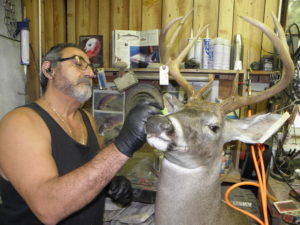
Taxidermist, Nick Saade, with a Michigan buck
If you can avoid dragging the animal, do so. A rope around the neck is a bad idea and so is dragging by the rear legs. Be prepared with a sled or alternate method of moving the animal. If you must drag the deer, attempt to keep the head and neck areas off the ground during the process. And, never hang an animal by the neck. Stuff toilet paper or paper towels in the nostrils and mouth to prevent blood stains.
Skin the animal right away and keep it cool. Do not cut into the ribs and cut about 4 inches behind the shoulders and roll the hide up toward the head. If you are not experienced, it’s best to keep the head intact and let your taxidermist do the intricate skinning around the face. Get it to the taxidermist as soon as possible.
If you cannot bring the animal to your taxidermist immediately, freeze the hide without using salt. Obviously, this is not always possible, but it is the preferred method.
If you are in a remote area, salting the hide will lock in the hair so it doesn’t “slip” and ruin the cape, but not just any salt is good; only non-iodized salt or Kosher salt is to be used. Fleshing will be more difficult as a result later, but is doable.
Keep it dry. Wipe out any excess blood and do not use any plastic bags for storage.
Taxidermist Nick Saade keeps a few extra capes in stock, in the event damage is beyond repair and will cost $100 on average. However, if your trophy is much larger than average, a replacement cape can add as much as $300 to $400 to the job.

Good time critters

Nick recreates a dramatic Michigan State football win over Michigan in 2015 with ground squirrels

Animal magnetism

Pipe dream or nightmare
Unlike taxidermists that only dabble in the business, Nick’s full-time business is taxidermy. He strives to get all jobs done within four months, which allows for a fair amount of drying time at a most reasonable cost of $400 for shoulder mounts. I have found Nick to be quite imaginative with his displays of all mammals, fish, and birds and he can be reached at his shop at 517-485-3669.
This from humanewatch.org…
Civil discourse begins to crumble when people who do not see eye-to-eye cease to civilly communicate with each other and resort to acts of aggression (see current Presidential election!). This notion was on full display last week, when several animal rights activists harassed families seeking one of the quintessential experiences in New York City: riding a horse-drawn carriage through Central Park.
Leading this animal rights goon squad was Eddie Sullivan, a bulky activist who, like The Hulk, you apparently wouldn’t like when he’s angry. Sullivan, along with several other activists, have reportedly badgered and insulted tourists as they try to board the carriages, shouting insults like “typical f***ing ***hole tourists” in front of families with young children, as well as threatening to “make sure people won’t get into the carriage.”
But things went further than just the typical verbal intimidation, as Mr. Sullivan is seen on video approaching one of the carriage drivers, yelling at him and then proceeding to shove him hard into the carriage knocking the 55-year-old man off balance and causing one woman to yell “I have a baby, do you mind.” Sullivan was later charged with misdemeanor assault.
But families in New York City have not been the only victims of this verbal intimidation from animal rights groups.
Another example of this verbal intimidation is the case of a young Spanish boy with cancer Read more
On October 20, Director of US Fish & Wildlife Service (USFWS) Dan Ashe announced the decision regulating the import of sport-hunted lion trophies under the Endangered Species Act (ESA) from South Africa. The United States will not allow the import of lion trophies taken from captive lion populations in South Africa. However, wild and wild-managed lions from South Africa will receive import permits.
Safari Club International and the hunting community has been waiting for a decision on which range nations would be approved to import lion hunting trophies to the United States since USFWS listed the African lion under the ESA in December 2015.
As for other lion-range countries, Ashe says USFWS is still reviewing permit applications for those areas. The four African nations, Mozambique, Namibia, Zambia, and Zimbabwe, will only receive permits to import sport hunted lion trophies if USFWS receives sufficient evidence of the long term benefits to their wild lion populations. USFWS along with CITES has recognized the importance hunting plays in conservation. Ashe stated USFWS determined, “that sport hunting of wild and wild-managed lions does contribute to the long-term conservation of the species in South Africa,” and continued to explain that, “lions are not in trouble because of responsible sport hunting.”
This conclusion is a blow to the anti-hunting rhetoric put forward by organizations such as the Humane Society of the United States and International Fund for Animal Welfare. The USFWS’s conclusion contradicts the assertions made by these anti-hunting organizations. The on the ground facts and the science simply did not support their position.
Not only does hunting enhance the survival of many species but also enhances the communities that support hunting on their land. Communities benefit from trophy hunting through hunting concession payments or other hunter investments, which typically support improved community services like water infrastructure, schools and health clinics; gaining jobs as guides, game guards, wildlife managers and other hunting-related employment; and gaining access to meat.
SCI will continue to work with wildlife authority agencies, in conjunction with professional hunting associations, to provide a clear link between the hunting of lions and the enhancement of the species. Scientific principles, not the emotionalism of anti-hunters, should provide the foundation for the management of wildlife and habitat. Read Dan Ashe’s announcement on the Huffington Post here.
By — Etta Pettijohn
Last Monday U.S. Judge Jennifer Zipps, in the District of Arizona, approved an agreement reached last April between environmental groups, the states of Utah and Arizona, and the FWS, to complete a recovery plan by the end of November 2017. The agreement sets parameters for management of the reintroduction program, including where they should be allowed to roam, and to establish population targets.
The New Mexico Game and Fish Department (NMGF) declined to join the settlement, although it did intervene in the lawsuit, after the FWS released pups into the wild, despite the NMGF declining the issuance of a permit to do so. Read more

(MANSFIELD, TEXAS) – Out here, you’re the first responder. When things happen, 12 Survivors offers first aid solutions with the Mini First Aid Rollup Kit (TS42002B) and the Mini Medic First Aid Kit (TS42003B). Used to treat a variety of injuries, these small kits pack powerful medical attention when doctors are miles away. Designed for easy, compact carrying, both kits are easily packable for camping and hiking, and can be stored in a vehicle for emergency situations.
The 80-piece 12 Survivors Mini First Aid Rollup Kit includes adhesive bandages, dressing gauze, antiseptic wipes, tweezers, adhesive tape, emergency blanket, medical manual and more. Intended as a starter kit, the seven interior zipper pockets keep supplies separated and organized for easy access while providing ample room for additional survival gear and full customization. MOLLE straps and two buckles with a Velcro closure add to the kit’s versatility.
Even more compact, the 12 Survivors Mini Medic First Aid Kit features 61 pieces for critical medical care. The Mini Medic First Aid Kit contains 50 adhesive bandages, 1 non-woven adhesive bandage, 2 knuckle adhesive bandages, 2 butterfly adhesive bandages, 3 antiseptic wipes, 1 pair of tweezers, and 1 trifold pouch, all housed in a trifold nylon carrying case, making for a snug fit in backpack side pockets. Read more

Gone are the days of greasy fingers and excessive straining while removing the hide during game processing
Decatur, AL — Viking Solutions®, the industry leader in post-hunt trophy care accessories, introduces the Super Hide Puller, which was designed to make your post-hunt game care easier and faster than ever before. As simple as the task is, removing the hide from an animal for meat processing can be the most physically difficult part of the entire field-to-fork process. That’s no longer the case.
The new feature-rich design of the Super Hide Puller utilizes the tested and proven finger-puzzle principle of “the harder you pull, the tighter it grips” to make pulling the hide off most any animal much simpler and faster. Read more

With fall hunting seasons under way in Michigan, the Department of Natural Resources reminds hunters and outdoor enthusiasts that Mi-HUNT – a cutting-edge, web-based, interactive mapping application – can help them plan their next hunting or outdoor adventure. Mi-HUNT is available at mi.gov/mihunt.
Mi-HUNT allows users to view and navigate through all public lands open to hunting and trapping in Michigan. It is easily accessible through the web browser on smartphones, tablets or computers and provides the most up-to-date information, customizable to fit each individual’s outdoor interests and trip-planning needs.
The interactive layers of Mi-HUNT allow the user to view:

Princeton, FL – TWN Industries Inc., the leading Water Transfer Printing supplier is happy to announce its new BullGator Camouflage hydro dipping film. BullGator Camo is a unique naturally occurring non-stick and leaf pattern that has both micro and macro elements. It is taken directly from one of the world’s meanest and only remaining prehistoric predators, the American Alligator. Read more

The Michigan Department of Natural Resources and several partners released more than 7,800 juvenile lake sturgeon into various public waters across the state this summer and fall in an effort to rehabilitate this culturally significant fish species.
The juvenile fish were collected from the wild last spring and reared in streamside facilities until they reached at least seven inches or larger in size. Most fish were tagged prior to being released into their respective rivers to allow future evaluations of stocked fish. Read more