Anderson, well known for manufacturing lower receivers, is expanding into the handgun market.
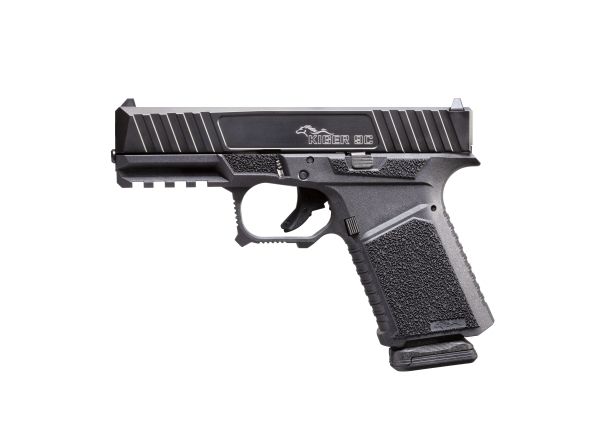
HEBRON, KY – Anderson Manufacturing, the leading producer of AR-15 lower receivers, has put decades of experience in precision firearms manufacturing into their first handgun, the new, 100% American-made Anderson Kiger 9c. Inspired by the wild mustangs of southeast Oregon, the Kiger is an independent, bold and powerful take on a compact, 15+1 capacity, 9mm semi-auto pistol.
Built on an original polymer frame, with over-molded front and rear slide rails, the Anderson KIGER-9c is a striker-fired handgun with strong lines from its serrated stainless steel, DLC-coated slide and barrel to its aggressive grip texturing and extended beavertail. Thumb and forefinger texturing has also been mirrored on each side of the frame and the trigger guard undercut for enhanced handling and ergonomics. A short, crisp trigger pull allows for confident, quick and accurate shots on target while an integrated, beveled magazine well with improved channel allows for reliable magazine changes. Under the barrel, a forward Picatinny rail provides easy mounting of weapon lights and accessories.
Designed for modern versatility, the Anderson KIGER-9c is compatible with most GLOCK 19 Gen3™ aftermarket components, providing unlimited opportunities to customize the KIGER-9c to fit the needs of any gun owner. Its popular and familiar profile also affords the shooter a discreet, every day carry while maintaining 15+1 rounds in one compact package. Read more