XDM Elite 10MM
By Jim Shepherd
The first night I “rolled” a feral pig from a Jeep during “a hot pursuit” across an Oklahoma pasture, I was hooked on two things: the full-tilt, vehicle-mounted “depredation hunt” and the 10mm caliber I was using.
That was several years and a few hogs ago. Today, jouncing across a dark field chasing porkers wouldn’t be such a good idea. My eyes nor my aim are what they once were.
In good light, I’m a respectable. In poor light…it’s the old blind squirrel finding a nut. Aged squirrels shooting nuts from moving vehicles are not a bright idea.
The 10mm has never lost its allure for me. It falls in the sweet spot between punch (to the target) and punishment (to the shooter). Sufficient to take game or fend off attackers, without blurring vision or punishing arthritic joints. I still enjoy magnum calibers, but not nearly as much as when my synovial membranes were in better condition.
When I got an offer from Springfield Armory to try their new XD-M Elite in 10mm, I happily accepted. It is officially being announced in this morning’s news section.
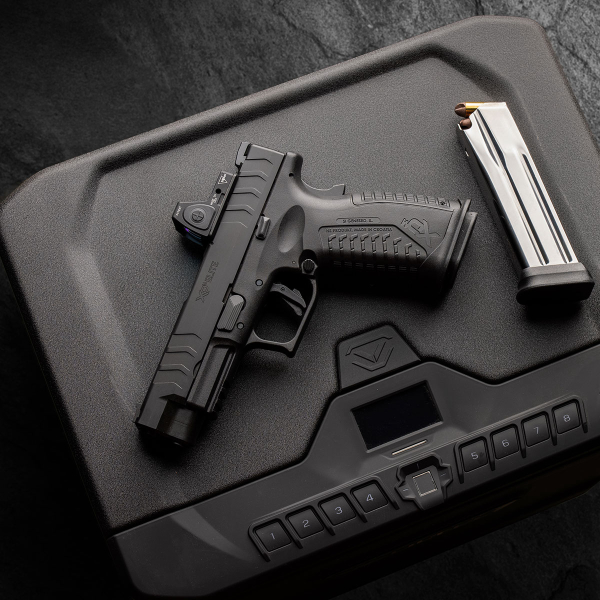
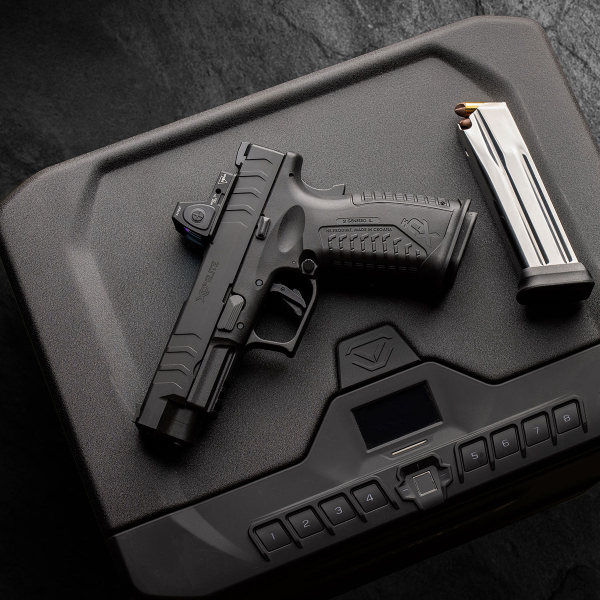
When it arrived, a Hex Dragonfly reflex sight was already mounted. The Dragonfly is a 3.5 MOA red dot that runs on pistols, rifles or shotguns. And the optical sights I once considered a “competition luxury” are essential for me today, especially with handguns.
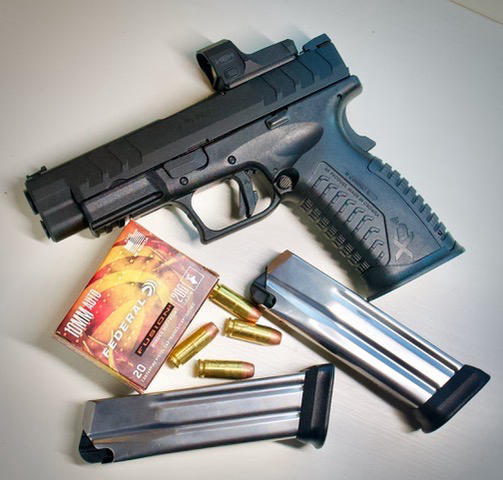
Eyes, joints and age aside, I like shooting guns in advance of them being announced. Few have seen them, even fewer have shot them, and no one’s written about those experience. I prefer my a clean slate shooting over notes chiding that “you weren’t the only person to mention the XYZ has a 4.5” hammer-forged barrel”.
What’s not so fun is sourcing ammunition. 10mm ammunition, in loads I felt necessary for a decent evaluation, proved especially tough. I don’t believe it representative of a major caliber gun’s to test it using “down powered” practice ammo. To know how a gun presents, fires, recoils ,and recovers in the real world, you need to be shooting comparable, full-house, loads.
After all, 10mm pistols aren’t primarily for punching paper targets. They’re working guns.
That means searching short inventories – and paying 2022 prices, provided you can find ammo. I had some 10mm, but don’t believe hand loads developed for a 10mm revolver two decades ago to be a representative test. A new gun is designed around today’s components, not decades old loads.
Searching locally I found and bought (“only” $1.97/round) enough to enable me to test nominal function and accuracy.
Running Federal Fusion 200-grain loads, the gun functioned flawlessly and accurately.
With this combination I wouldn’t hesitate to load both extended mags (the XD-M Elite mag is extended- holding 16 rounds, despite a 15 capacity “window”) and heading out to deal with a problem, feral or otherwise.
The release offers the specifics on the new XD-M Elite, so I’m not going to rehash those here.
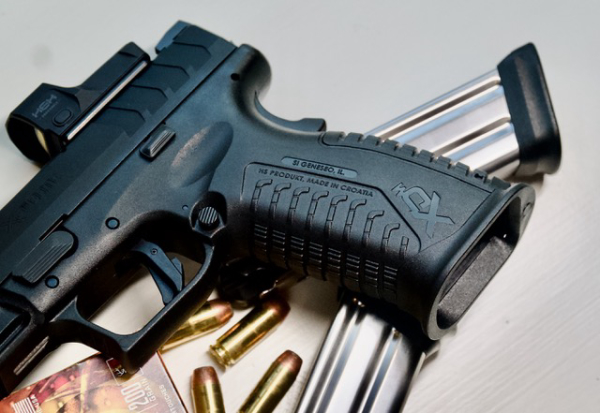
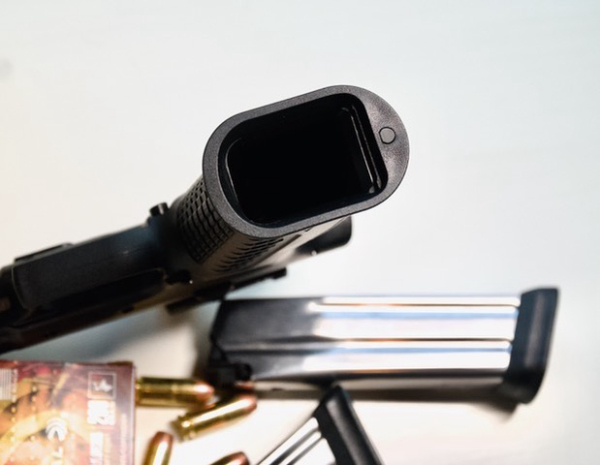
What the specs don’t convey is that it is a full handful of gun. The medium grip panel was just shy of too-large for my hands. But “big” doesn’t connote unmanageable. Switching from the medium to thinnest of the adjustable backstraps made it considerably better.
With its full-size, the smaller panel and a 32-ounce weight, the XD-M Elite feels more “right-sized” for 10mm than “oversized” for my medium-sized hands.
It came up quickly from low ready, presented well, and the Hex Wasp made finding the target simple, even in an intentionally low light setting on the range. Follow ups would be no problem.
The unexpected? The flared magwell fairly gobbles up reloads. Nice feature.
Springfield’s Hex Wasp represents a $249 addition (MSRP) if added to the basic gun (MSRP $653) afterward. With the Wasp, the MSRP is $837. (NOTE: both prices are MSRPs, we’ve seen the Hex Wasp offered online for $220-225).
The sights are fiber optic up front with a “tactical rack U-dot” rear on both. Both models come with adjustable backstraps, two 16-round extended magazines, and a logoed gun case.
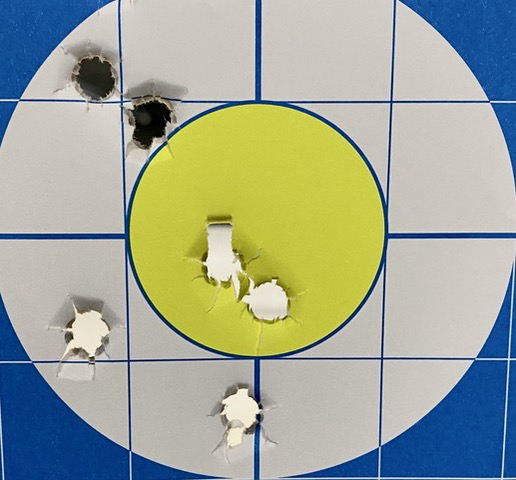
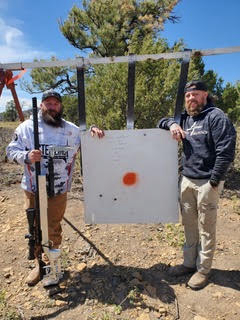
It shot straight, with mild recoil and rapid recovery in my (limited) double tap drills. The best results (shown in the photo) came at the longest distance: 21.3 yards. No bullseye records felt threatened, but the rounds hit inside my “acceptable” standard when shooting offhand. Shooting from a rest, I wouldn’t hesitate to step the distances up substantially.
Springfield’s XD-M Elite 10mm wouldn’t be my first (or second) choice for concealed carry. That doesn’t mean I would hesitate to put it in an outside-the-waistband holster or chest rig and head into the wild.