MUSKEGON, Mich. – If the redhead is the duck that steals the room, the canvasback is the one the room was built for.
Waterfowlers have been calling it the “king of ducks” for generations, and the bird does little to argue otherwise. The drake wears a chestnut head over a jet-black chest, with a back so pale it looks like weathered sailcloth, which is where the canvasback name comes from. Then there’s the profile, that long, sloping wedge of a forehead running straight into the bill. No other duck on the water looks quite like it, and hunters can usually pick one out from a long way off.
The canvasback carries itself like royalty, too. It’s the biggest of our common divers and one of the fastest ducks in the sky, and it shows up on the big water when it’s good and ready. The redheads are already here. The canvasbacks arrive fashionably late, and in a hurry.
Where the King Is Born
Canvasbacks are a prairie bird at heart. The bulk of the continent’s population nests across the prairie pothole region, in the deep, permanent marshes scattered through Alberta, Saskatchewan, and Manitoba and down into Montana, the Dakotas, and western Minnesota. The aspen parklands along the northern edge of the prairies produce plenty of birds, too, and smaller numbers push farther north into the boreal forest, the Northwest Territories, and the interior flats of Alaska.
Unlike the puddle ducks that will nest in an upland field, a canvasback hen builds her nest right over the water, woven into stands of cattail and bulrush. She’s loyal to home, too. Hens tend to come back to the same breeding marshes where they hatched.
And remember the redhead’s habit of dropping eggs in other ducks’ nests? Canvasback nests are one of its favorite targets. Plenty of canvasback hens end up raising a redhead or two, whether they signed up for it or not.
Two Strong Years Running
The breeding grounds have been kind to canvasbacks lately. The U.S. Fish and Wildlife Service’s 2025 Waterfowl Population Status Report put the breeding population at 690,000 birds, a 22 percent jump from 2024 and 17 percent above the long-term average.
This year’s survey kept the momentum going. The 2026 numbers, released in September, put canvasbacks 32 percent above their long-term average. That’s one of the best showings of any duck in the survey, and it came in a year when mallards slipped to a 33-year low. Two straight years of gains is good news for anyone who sets out a diver spread.
Named for Its Favorite Meal
The bird’s scientific name, Aythya valisineria, comes from wild celery, the underwater plant whose tubers canvasbacks dive for in huge numbers. That diet shaped their reputation at the table. In the 1800s, celery-fed canvasbacks from the Chesapeake Bay were the toast of fine restaurants up and down the East Coast and fetched premium prices. More than a few hunters will still tell you there’s no better-eating duck in North America.
Down the Flyways, Fashionably Late
Canvasbacks hold out up north until the weather forces their hand. Once the marshes start to freeze, usually late October into November, they pull out in big V-shaped flights and head for the big water.
A huge share of them funnel into the Upper Mississippi River first. The river pools near La Crosse, Wisconsin, and Keokuk, Iowa, are some of the most important canvasback staging areas on the continent, where the birds load up on wild celery and other underwater plants before moving on. The Detroit River and Lake St. Clair do the same job farther east.
From there, banding work by the U.S. Geological Survey traced two main routes. One heads east across the Great Lakes and down to the Mid-Atlantic, where the Chesapeake Bay and the sounds of North Carolina hold the Atlantic Flyway’s wintering birds. The other runs south down the Mississippi to the lower valley, the Louisiana marshes, the Gulf Coast, and east Texas. Out west, Pacific Flyway canvasbacks winter around San Francisco Bay and California’s Central Valley, with others pushing on into Mexico.
Canvasbacks are creatures of habit, coming back to the same wintering areas year after year. Wherever they settle, they want open water and company, and that’s the hunter’s opening. A good-sized spread set out on big water is exactly what a flight of tired canvasbacks is looking for.
Built for the Biggest Diver on the Water
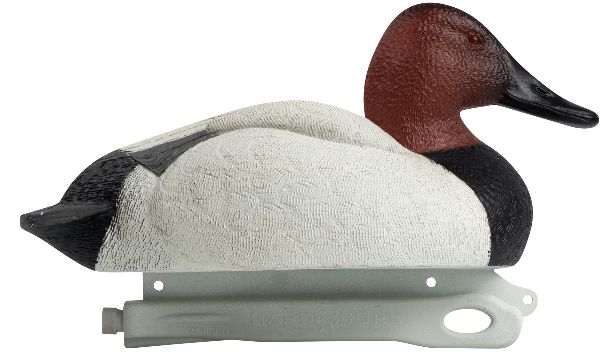
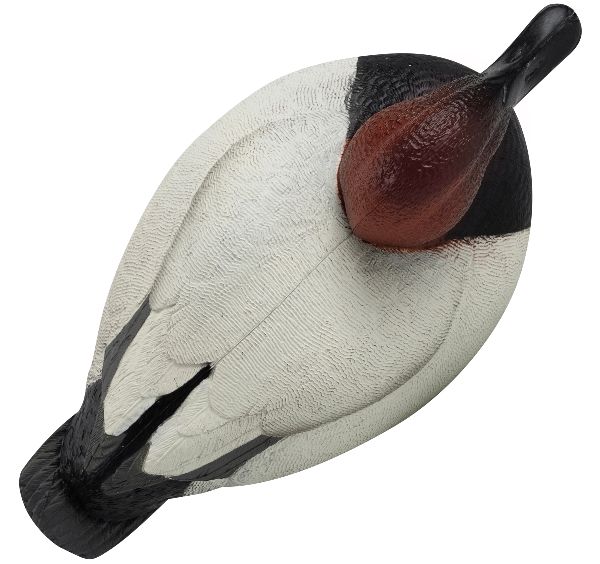
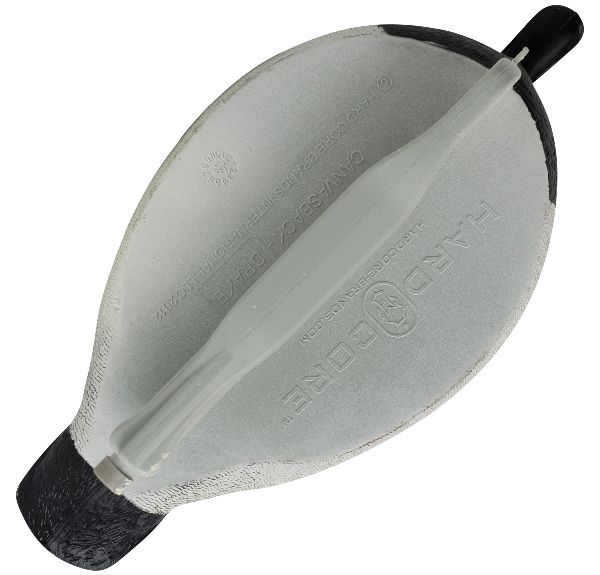
Hardcore’s Rugged Series Canvasback Duck Decoys are sized for that job. Measuring 16.5″ L x 7.5″ W, they’re oversized on purpose, so the spread can be seen from a long way out on the open water canvasbacks favor.
“Canvasbacks are working big water, and they’re making decisions from a long way off,” said Doug Veldhuizen, Hardcore Merchandise Manager. “If they can’t see your spread, it doesn’t matter how good it looks up close. We built these bigger so they get noticed early.”
Foam-Filled and Ready to Ride the Chop
Like the redheads, the Rugged Series Canvasback Decoy is a foam-filled, one-piece build. It’s solid instead of hollow, so it rides steady in wind and chop and keeps its shape through a season of hard use. The WhaleTail™ Keel catches even a gentle current and turns it into natural swimming motion, which helps on the calmer days, too.
“You’re often setting canvasback decoys in rough conditions on open water,” Veldhuizen said. “A foam-filled decoy sits right, holds up when it gets banged around, and won’t sink on you if it takes a hit.”
Paint Fit for a King
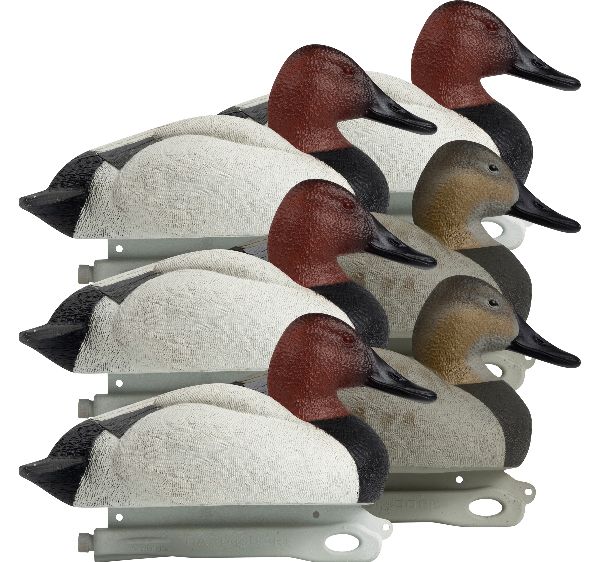
A canvasback drake is all contrast, and the decoy must sell that from a distance. Hardcore’s true-to-life drake and hen paint schemes carry that high-contrast pattern onto the water: the bright white back, the black chest, the chestnut head with that famous sloped profile.
“That white back is what catches a canvasback’s eye from way out,” Veldhuizen said. “We wanted the drakes to pop the way live birds do, and with four drakes and two hens in every pack, the spread has the right look right out of the box.”
Canvasbacks have been worth the wait for well over a century. With a spread that’s built to be seen, the king might just come to you.
Rugged Series Canvasback Duck Decoys FEATURES:
- Foam-Filled One-Piece Decoys
- Over-Size Decoys
- True-To-Life Drake and Hen Paint Schemes
- WhaleTail™ Keel Creates Lifelike Movement With Little Current
- 6-Pack Includes: 4 Drakes & 2 Hens
- 16.5? L x 7.5? W
MSRP $119.99



 XS ACRO Optic Plate for Glock Gen6