Montana Group Hopes to End Trapping
A group called Trap Free Montana Public Lands is attempting to gather signatures to end trapping on Montana’s public land, which accounts for some 35 percent of total land in the state. Typical arguments are here…
Outdoor commentary and legislative issues.
A group called Trap Free Montana Public Lands is attempting to gather signatures to end trapping on Montana’s public land, which accounts for some 35 percent of total land in the state. Typical arguments are here…
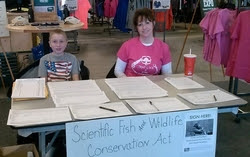
GW: Although a good step forward, those interested in transparency will meet a dead end unless Senate leader Reid allows the bill to move forward. Hats off to these lawmakers in any event.
MISSOULA, Mont.–The bipartisan Open Book on Equal Access to Justice Act passed the House Judiciary Committee on Feb. 5 by a voice vote. This is a show of strong support for the bill, H.R. 2919, by Reps. Cynthia Lummis (R-WY) and Steve Cohen (D-TN).
“Lawsuits are still controversial and the disagreements still run deep on lawsuits in conservation, but we now have clear, bipartisan agreement that transparency is the first step toward solutions,” said Lowell Baier, president emeritus of the Boone and Crockett Club. “This bill ensures public disclosure of the facts: who files these lawsuits, why, and how much public money is spent on them.” Read more
Independent scientific peer review report available for public review
Following receipt of an independent scientific peer review, the U.S. Fish and Wildlife Service is reopening the comment period on its proposal to list the Mexican wolf as an endangered subspecies and remove the gray wolf from the Endangered Species List. The Service is making that report available for public review, and, beginning Monday, February 10, interested stakeholders will have an additional 45 days to provide information that may be helpful to the Service in making a final determination on the proposal. Read more
This from www.HumaneWatch.org…
The Humane Society of the United States held a fundraising benefit last Thursday at the fancy Club Colette in posh Palm Beach. We had been educating residents, via a mailing and a TV ad, that HSUS gives only 1% of its budget to pet shelters, that it gets a “C-minus” grade from the independent watchdog CharityWatch, and that it is in federal court facing a racketeering lawsuit.
We decided it would be best to show up in person to the event, too. Read more

GW: If only an animal-rights activist would ever agree on the definition of recovery…
PHOENIX — During its annual year-end population survey, the Mexican Wolf Interagency Field Team (IFT) counted a minimum of 83 Mexican wolves in the wild in Arizona and New Mexico at the end of 2013. This number demonstrates a 10 percent increase in the known population of Mexican wolves in the wild compared to the 2012 minimum population count of 75 wolves. Read more
Northern Canada’s Hudson Bay region has been noted as the area of the most threatened Polar bear population, but new evidence shows estimates as much as 67 percent higher than suggested. Details here…
An Alaska scientist, Charles Monnett, whose observations of drowned polar bears helped galvanize the global warming movement has been forced out of his position as part of a settlement with a federal agency. Turns out he made things up and left other fact out of his argument to support an animal-rights agenda. More here…
Hat tip to John Lott.
GW: Another liberal who doesn’t get it…
Just two weeks into Nebraska’s inaugural Mountain Lion hunting season, a bill has been introduced to stop the hunt.
The bill, LB 671 sponsored by Senator Ernie Chambers (D-Omaha), would ban mountain lion hunting, threatening not only livestock but public safety also. Senator Chambers has also announced his intentions to oppose every proposal of the Nebraska Game and Parks Commission until the mountain lion season is abolished.
In 1995, Nebraska added mountain lions to the state’s game list in order to protect the steadily growing population. Over the past 20 years, the population levels have risen enough to sustain a limited harvest using a controlled quota system. In 2013, the Nebraska Game and Parks Commission established its first ever mountain lion season which commenced this month. Read more
GW: It had to happen. What goes up must come down. But, what are the answers to land development, diseases, predators, etc? Time to find out…
Declining deer herds and other threats to North America’s deer-hunting heritage will be the focus of the first-ever North American Whitetail Summit being convened by QDMA, March 3-6, at Big Cedar Lodge in Branson, Missouri.
“Whitetail numbers are down throughout much of their range due to many factors including EHD, predators, and even over-harvest,” said QDMA CEO and wildlife biologist Brian Murphy. “In some areas, herds are below what the habitat can support and what provides a quality hunting experience. This is a serious issue with significant long-term implications for the future of deer hunting.” Read more

GW: Another example of how hunting helps…
Tucson, AZ – From the outside looking in, a non-hunter might find it hard to comprehend. What needs to be understood is that hunters have a deep care and passion for the animals they pursue to ensure that a healthy population of that resource remains.
Hunters commit a large amount of resources and time to help promote species of game to sustainable levels to be able to pursue them for hunting.
The impact of hunters on the African lion has become a hot button issue, to say the least, over the past few years. What should be a discussion based on science has turned into an emotionally charged topic. Read more
Washington, D.C. – With the passage of the Omnibus spending package that keeps the U.S. government funded until September 30, 2014, America’s hunters and ranchers received a welcome surprise that eliminates government restrictions on the hunting of U.S. populations of scimitar-horned oryx, dama gazelle, and addax (three antelope species). The legislative fix, first written by Safari Club International’s Washington, D.C. staff, reinstates a 2005 U.S. Fish and Wildlife Service regulation that facilitates U.S. conservation of these species. Read more