Time To Stop Pruning Oaks

Spring weather seems to be here a bit early this year and according to the Department of Natural Resources, that means it’s time to finish pruning oak trees to prevent the spread of oak wilt.

The best way to prevent the spread of oak wilt is to not prune any oaks between the end of March and the beginning of October. However, with the recent warm weather conditions, property owners should finish pruning oaks by the middle of March. Read more

Relaxing Michigan’s Coyote Regulations

By Glen Wunderlich

When a Shelby Township, MI woman let her Pomeranian mix dog outside before retiring for the night, it would be the last time she would see her family pet alive. In another incident in Wauwatosa, Wisconsin, a miniature Schnauser spent his last minutes on a leash in front of his home. And, in the sanctuary of a fenced-in backyard in Hacienda Heights, California, a Papillion mix family pet met its fate. The common denominator? Coyote attacks.

As coyote numbers have increased, so have deadly encounters in urban settings. Because of the secretive nature of coyotes, many folks are oblivious to their existence until we hear of such horrific acts of terror.

In an ongoing study of predators in Michigan’s Upper Peninsula by Mississippi State University, 142 fawns were radio-collared and coyotes were found to be responsible for 26 of 53 deaths – as many as bobcats, wolves, bears, and bald eagles combined.

Coyotes are found throughout Michigan in both rural and urban areas.  With an increase in complaints from the public regarding coyotes, the Department of Natural Resources (DNR) believes that an expansion of the opportunities to take coyotes may help reduce these concerns.

The DNR has recommended several coyote hunting regulation changes to the Natural Resources Commission, including year-round hunting opportunities and implementation of a Michigan United Conservation Clubs (MUCC) and Michigan Trappers and Predator Callers Association resolution to allow the use of #3 and #4 buckshot at night for coyotes.

The DNR held discussions with internal staff and many external stakeholders to develop recommendations to amend our state’s Wildlife Conservation Order.  The amendment would include expanding the coyote season statewide, year round, along with clarifying nighttime hunting of furbearers, and to expand the time frame in which nighttime hunting with artificial lights may occur.  The Department is also giving a recommendation to expand allowable ammunition for taking all furbearers which may be hunted at night to include both 3 and number 4 buckshot.

Michigan’s current coyote regulations include daytime coyote hunting from July 15th to April 15th which is a liberal season with a few minor restrictions on the methods of take, devices, and ammunition. The current season for nighttime coyote hunting is from October 15th to March 31st.  However, the nighttime coyote hunting season is a restricted season with limited methods of take, devices and ammunition.  Individuals must possess a fur-harvester or resident base license.  Throughout the entire year, individuals may take a coyote on private property if the coyote is causing or about to cause damage.

Several other proposed resolutions by MUCC that would not become MUCC policy unless adopted at its Annual Convention are as follows:

Coyote Bounty (Straits Area Sportsmens Club) | Reverse MUCC’s opposition to bounties and institute a coyote bounty.

Nighttime Predator Hunting with Centerfire Firearms (Chris Kettler, Michigan Trappers and Predator Callers Association) | Remove restriction on using centerfire firearms for nighttime predator hunting.

Any type of coyote control is difficult but removing some of the encumbrances to willing sportsmen may be the best option available to wildlife managers.  It’s past time that we quit protecting the varmints that are helping to reduce our declining deer herd.

Squirrel Hunting for the Birds

GW: Today, Alabama’s Dave Rainer takes us on a decidedly different kind of squirrel hunt.

Boy, did I go on a fantastic squirrel hunt last weekend in the Grampian Hills outside Camden, Alabama. Our hunting party bagged a grand total of two squirrels.

Say what? Two squirrels are barely enough to make a small pot of squirrel and dumplings.

What made it such an enjoyable, eye-opening hunt was the method by which the squirrels were taken – red-tailed hawks.

That’s right, the Alabama Hawking Association (AHA) held its annual meet last weekend, and its members brought a variety of hawks to the event with red-tailed hawks the most common bird of prey.

The meet attracted falconers (the generic term for those who hunt with raptors) not only from Alabama but all around the Southeast. One participant escaped the Michigan snow to travel to Alabama.

The 70-plus participants in the meet were divided into manageable groups and turned loose on property donated for the hunts.

I accompanied a group of falconers from around the Southeast from Georgia to Mississippi to Tennessee, although the Tennessean (Jeff Fincher) had roots in Eutaw, Alabama.

The hunting method involved heading into the woods and shaking vines and saplings to get a squirrel to reveal its location. At that point, the handler for the bird designated for that hunt released the raptor.

Larry Mullis’ red-tailed hawk, named Dixie, soars through the treetops to find a perch suitable for attacking a gray squirrel’s hideout (Above). After several attempts, Dixie pinned the squirrel, hidden inside a patch of Spanish moss, to the oak tree. All photos by Dave Rainer with permission.

On the first hunt of the morning, Larry Mullis of Eastman, Georgia, released Dixie, his year-old female red-tailed hawk after a squirrel was seen scurrying up a tall oak.

With eyesight so acute that the most common analogy used is it could read newspaper headlines at a quarter of a mile, the bird started a methodical stalk of the gray squirrel. Dixie flew from limb to limb in the surrounding tree until she was in an advantageous attack position. The falconers call it “laddering.”

With a leap from her perch, Dixie sailed toward the squirrel’s hideout Read more

Tracking wildlife is a fun, educational winter activity

At this point in the winter, many Michiganders might start feeling a little cooped up.

One way to beat cabin fever – and get mind and body active – is to become a nature detective and learn more about the wildlife in your own backyard or neighborhood.

While it can be fun year-round, looking for clues to wildlife activity is especially interesting in the winter when animal tracks are easily visible in the snow.

“Tracks can tell a story,” said Hannah Schauer, wildlife education technician for the Michigan Department of Natural Resources. “If you find a trail of footprints, you may want to follow it to get a glimpse inside the animal’s life.”

Deer, rabbits, squirrels and foxes are just a few examples of animals whose tracks you may come across.

Schauer recommends a few tools that can help in the quest for tracks, including a good field guide.

Imprints from bird feathers are seen in the snow where animal tracks end.“There is a variety of wildlife tracking and identification guidebooks available – find one that you like and have it handy on a hike to help you determine whose tracks you have spotted,” she said.

Other helpful items to carry along are a camera, a ruler, a key or coins to put next to the track for size reference when taking a photo, a notepad and pencil for sketching tracks and making notes on other observations about the animal’s trail, and binoculars. Read more

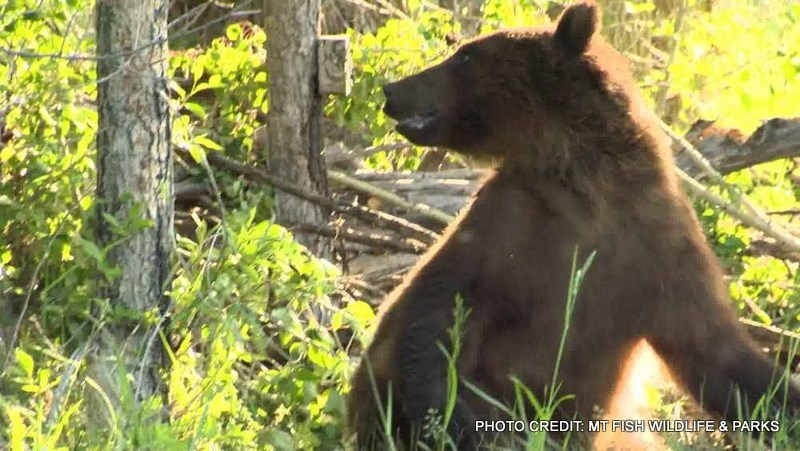
Statement of the Boone and Crockett Club on Yellowstone Grizzly Delisting

MISSOULA, Mont. – We welcome today’s U.S. Fish and Wildlife Service proposal to return the Yellowstone grizzly bear to state management as a recovered species. Restoring the bear to this point is a high achievement of state, federal, and tribal experts working together since the 1980s, and we commend especially the Interagency Grizzly Bear Committee for a job well done.

The strong biological evidence that Yellowstone grizzly bears are recovered clearly justifies today’s proposal, and we will join in the process of reviewing the proposal for certainty that recovery will hold before a final delisting decision is made.

We will work closely with other conservation leaders to insist on continued interagency cooperation that sustains a stable grizzly population, manages conflicts between bears and people, and employs ethical, scientifically-regulated hunting to the extent that it serves management goals and promotes respect for the grizzly and its conservation.

Fish and Wildlife Conservation Leaders Call for $1.3 Billion Annual Investment for States

A 21st Century Vision for Investing in and Connecting People to Nature

March 2, 2016 (Washington, DC) – A group of energy, business and conservation leaders today released their recommendations on how to avert the growing endangered species crisis in this country. The Blue Ribbon Panel on Sustaining America’s Diverse Fish & Wildlife Resources determined that utilizing a portion of revenues from energy and mineral development on federal lands and waters to fund state-based conservation could address conservation needs for thousands of species. An annual investment of $1.3 billion from these development revenues into the currently unfunded Wildlife Restoration Program would allow state fish and wildlife agencies to proactively manage these species, reducing taxpayer costs and the regulatory red tape that comes when species are listed under the federal Endangered Species Act.

Read more

U.P. Focus: Panel discussion on U.P. emerald ash borer quarantine extension airs this weekend

GW:  The only good thing about these destroyers of our indigenous ash hardwoods is that they’ve supplied many with a readily available supply of firewood.

The Michigan Department of Natural Resources has announced broadcasts of WNMU-TV13’s “Media Meet” discussion on a recent quarantine extension in the Upper Peninsula for the emerald ash borer airs this weekend.

The program with DNR staff and host Bill Hart focuses on what landowners with ash trees can doA photo shows the metallic green-colored emerald ash borer. now as the infestation moves across the region, information on how the beetle was introduced to Michigan and what the outcomes have been. The program will initially air at 6:30 p.m. EST Saturday, March 5 and be rebroadcast at 2:30 p.m. Sunday, March 6. Read more

The Link to Conservation through Sportsmen

MISSOULA, Mont. – With the bipartisan passage of HR 2406, the Sportsmen’s Heritage and Recreational Enhancement (SHARE) Act, in the House of Representatives today, the Boone and Crockett Club reflects on the importance of conservation legislation.  Notable conservation legislation includes:

  • Yellowstone Protection Act of 1894
  • Organic Act of 1897, establishing national forests
  • Lacey Act of 1900, end of commercial market hunting
  • National Wildlife Refuge System Act of 1903
  • Migratory Bird Act of 1913
  • Agriculture Adjustment Act of 1933, the first Farm Bill
  • Duck Stamp Act of 1934, wetland and waterfowl conservation funding
  • Pittman-Robertson Act of 1934, conservation funding
  • Wilderness Act of 1964
  • Wild and Scenic Rivers Act of 1968
  • Endangered Species Act of 1973
  • Healthy Forest Restoration Act of 2003
  • Sportsman Heritage Act of 2011
  • Making Public Lands Public of 2013


The Club and many other conservation groups support the SHARE Act for its pro-sportsmen’s titles that will help ensure outdoor hunting traditions are preserved, protected and promoted. Read more

Michigan NRC Commends SCI Foundation on White-tailed Deer Research


Washington, DC – Joseph Hosmer, President, Safari Club International Foundation (SCI Foundation), announced that The Michigan Natural Resource Commission adopted a resolution on February 11, 2016, commending years of research supported by SCI Foundation showing that white-tailed deer survival in Michigan’s Upper Peninsula (UP) region is dependent on suitable wintering habitat. As a result of these findings, the state is now moving to improve the UP’s winter deer habitat to increase deer survival.
In 2014, Michigan created the Upper Peninsula Habitat Work Group (UPHWG), a collection of wildlife experts, natural resource professionals, private landowners and sportsmen to apply SCI Foundation’s research findings to habitat management. Drawing upon nearly a decade of research, the UPHWG is now tasked with updating forest management plans to ensure high quality winter habitat conditions are available to deer. Read more
1 211 212 213 214 215 371