
Ohio Wildlife Offenders Sentenced in Theft/Poaching Case in Northwest Ohio
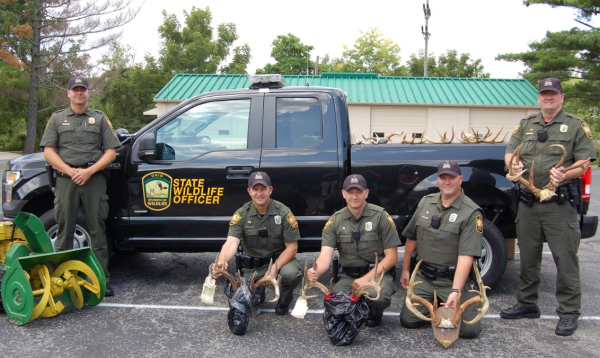
FINDLAY, OH – Two Lucas County residents were recently convicted in Henry County Common Pleas Court following a two-year poaching and theft investigation by the Ohio Department of Natural Resources (ODNR), Division of Wildlife.

Edward Polansky, 28, of Holland, and Rodney Polansky, 33, of Toledo, were convicted of engaging in a pattern of corrupt activity, a felony in the 1st degree, and failure to comply with an order of a police officer, a felony in the 3rd degree.

The investigation began in the fall of 2015, when the ODNR Division of Wildlife received multiple theft reports from hunters who had their vehicles broken into while hunting on public lands in Williams, Fulton, Henry, and Lucas counties. Also, during this time the ODNR Division of Wildlife received several deer poaching complaints that were later connected to the Polanskys as a result of the investigation.

A break in the case came in December of 2016, when a hunter witnessed the Polanskys break into his vehicle. This led to the Polanskys arrest and the execution of multiple search warrants by the ODNR Division of Wildlife. The search warrants recovered numerous stolen items including firearms and other hunting related equipment, a snow blower stolen from the ODNR Division of Wildlife, and several illegally taken and possessed deer antlers. In total, 28 victims reported 177 items stolen over a two-year period.

Edward and Rodney Polansky were sentenced to four years in prison, to be served consecutively, and five years of post-release control. Both men lost their hunting, fishing, and trapping privileges for ten years. All evidence was forfeited to the state and items belonging to the victims were returned. The men were ordered to split the payment of $30,823.56 in restitution, to be paid to the victims for damages and loss of property, and to the state for six deer taken or possessed unlawfully. A total of $3,006.44 in court costs was also ordered to be paid. Read more
RMEF, SAF Oppose Yellowstone Grizzly Ruling

MISSOULA, Mont.—The Rocky Mountain Elk Foundation and Sportsmen’s Alliance Foundation disagree with a judge’s decision to vacate the delisting of the Greater Yellowstone grizzly population by the U.S. Fish and Wildlife Service. The ruling places the population back on the endangered species list.

“We are highly disappointed with this decision,” said Kyle Weaver, RMEF president and CEO. “Once again we see that extreme environmental groups continue to clog up the delisting process at a time when we should be celebrating the recovery of grizzlies in the region. Scientists gathered data and population numbers that show grizzlies in the region surpassed all recovery criteria and are recovered. This ruling bolsters the case for Congress to update the Endangered Species Act.”
This follows a 2007 decision by the Department of Interior (DOI) to delist Yellowstone grizzlies, a decision that was also litigated by environmental groups and overturned by the federal courts.
“Despite this ruling, the basic facts remain the same: grizzly bears in the Yellowstone area have recovered, and no longer meet the definition of threatened or endangered under the ESA and should be rightfully returned to state management,” said Evan Heusinkveld, Sportsmen’s Alliance Foundation president and CEO. “This ruling is just another example of why we need comprehensive reforms to the way we manage ESA-listed species in this country. We are evaluating all of our legal options to appeal this ruling.”
The DOI announced the removal of Yellowstone area grizzlies, numbering more than 700, from the endangered species list in 2017 based on sound science and millions of hunter dollars spent on researching and studying the bears. Idaho and Wyoming later announced intentions to hold conservative management hunts in the fall of 2018. Those hunts will not take place.
Environmental groups claimed the grizzly population in the Yellowstone region would be decimated if delisted and placed under state management. They made the same claims for the Northern Rocky Mountain wolf population which is 200 to 400 percent above minimum recovery goals, depending on the state.
“State-based management of wildlife is a key facet of the North American Wildlife Conservation Model. That is why the most healthy and robust wildlife populations in the world are found in North America. Grizzlies, like elk, wolves, deer and all other wildlife, should be managed by the states for their overall betterment. This ruling thoroughly frustrates that process,” added Weaver.
About the Rocky Mountain Elk Foundation:
Founded over 30 years ago, fueled by hunters and a membership of more than 227,000 strong, RMEF has conserved more than 7.3 million acres for elk and other wildlife. RMEF also works to open and improve public access, fund and advocate for science-based resource management, and ensure the future of America’s hunting heritage. Discover why “Hunting Is Conservation™” at www.rmef.org, elknetwork.com or 800-CALL ELK.
About the Sportsmen’s Alliance:
The Sportsmen’s Alliance and its Foundation protect and defend America’s wildlife conservation programs and the pursuits – hunting, fishing and trapping – that generate the money to pay for them. Stay connected to Sportsmen’s Alliance: Online, Facebook, Twitter and Instagram.

Michigan: ‘Smart ship’ technology making waves in Michigan waters

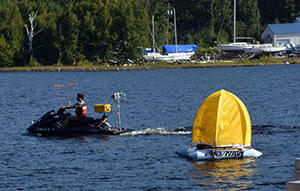
In case you missed it, “Showcasing the DNR” dived into the topic of “smart ship” technologies with a recent story about the new Marine Autonomy Research Site in Lake Superior. The site, near Michigan Technological University in Houghton and managed by the university, will serve as the world’s first freshwater location for testing unmanned (autonomous) surface and underwater vessels for operation in Great Lakes and U.S. coastal waters.

The Michigan Office of the Great Lakes – an office within the DNR – assisted with development of the testing site, a hub for the development of futuristic, state-of-the-art smart ship technologies.

University researchers envision unmanned surface and underwater vessels being used to augment manned research ships to transport remote-sensing technology, collect sonar and video imagery, deploy under frozen Great Lakes waters to gather winter samples and venture to sites unsafe for humans.

Other testing could involve autonomous underwater vehicles monitoring structures such as pipelines for their integrity, identifying shipwrecks or recovering evidence when working with the Michigan State Police. Read more

Michigan: 2018 deer hunting forecast predicts successful season

For many years, the DNR has provided a forecast of the upcoming deer seasons. In the 2018 Michigan Deer Hunting Prospects report, the DNR anticipates a successful year for many deer hunters, with indicators showing deer numbers to be up over last year. Biologists are expecting the number of deer taken to increase slightly from last year’s numbers, which were up more than 10 percent from the previous year across the state. Specific regional information is included within the forecast.

The DNR encourages hunters to familiarize themselves with current regulations before hitting the field. Deer regulations can be found at michigan.gov/deer. Other important resources include this year’s Hunting Digest and Antlerless Deer Digest – both available to download at michigan.gov/dnrdigests. Read more

Sauer S100 Pantera Precision Rifle in 6.5 Creedmoor

New SAUER S100 Pantera Precision Rifle Now Shipping in 6.5 Creedmoor

San Antonio, Texas – J. P. Sauer & Sohn, Germany’s oldest gunmaker, is now shipping its S100 Pantera compact precision rifle chambered in 6.5 Creedmoor. Distributed by Blaser USA Inc., the S100 Pantera is a highly efficient yet elegant platform for long-range shooting featuring a heavy fluted 20-inch barrel. The adjustable cheek piece on the stock in combination with the recoil pad, which is adjustable sideways and in height, makes the rifle a perfect fit for any shooter. The sculpted pistol grip provides an additional and extremely natural shooting position for first round hits at long range.

The Pantera also has a Cerakote coating on the barrel surface and action while an ultra-rugged special coating protects the underlying laminate wood stock. All SAUER 100 rifles feature a crisp, user adjustable single-stage trigger, three-position safety, cold hammer-forged SAUER barrel, and smooth action bolt. These rifles are designed for accuracy, delivering a guaranteed five-shot sub-MOA performance.

In addition to 6.5 Creedmoor, the SAUER S100 Pantera is currently available in .223 Rem, .243 Win, .308 Win, .30-06 Springfield, and .300 Win Mag with 6.5 PRC to follow.

MSRP: $1,599.99 Read more

Savage Rascals: Pint-Sized Performance

New Savage Rascals Raise the Bar in Pint-Sized Performance

WESTFIELD, Massachusetts – – Savage is pleased to take micro rimfire rifle performance to new heights with the new Rascal FV-SR (Suppressor Ready), Rascal Target and Rascal Target XP. Shipments of these firearms have been delivered to dealers.

The Rascal FV-SR enhances accuracy with a heavy barrel featuring a threaded (1/2-28) muzzle. Like the original Rascal, the single-shot rifle cocks by lifting the bolt and unloads easily—without pulling the trigger. The design also builds superior shooting skills thanks to full-size rifle features, including a peep sight, tough synthetic stock and Savage’s user-adjustable Accu-Trigger system. The two new suppressor-ready Rascal models are available in pink or black.

The new Rascal Target is built for accuracy and adaptability, thanks to a precision hardwood stock, heavy 16 1/8-inch barrel, one-piece Picatinny rail and threaded (1/2-28) muzzle. Like the Rascal FV-SR, the Rascal Target offers full-size rifle features, including Savage’s user-adjustable AccuTrigger system and suppressor-ready barrels. Collectively, the platform offers far better safety, functionality and accuracy than competing designs.

The Rascal Target XP offers all the Rascal Target amenities in a ready-to-shoot package that comes with a mounted and boresighted 4x32mm scope, as well as a bipod sling swivel stud mount. A left-hand model of this configuration is also available. Read more

New Glocks Gen 5

SMYRNA, Ga. – GLOCK, Inc. expands the 5th Generation of GLOCK pistols with the addition of two modular optic ready platforms. The GLOCK 17 Gen5 MOS and GLOCK 19 Gen5 MOS come optic ready right from the factory and enable users to mount their preferred reflex sights to their pistol in order to improve their target acquisition.

The G17 Gen5 MOS and G19 Gen5 MOS complete the evolution of perfection for the 9X19 family of Gen5 pistols

“The MOS platform offers a convenient way for users to mount reflex sights without costly alterations to an original GLOCK slide,” said GLOCK, Inc. VP Josh Dorsey. “The resulting combination of optical sighting and the unparalleled accuracy and reliability of the new generation of GLOCK pistols set a new standard for this class of pistol.”

These Gen5 models are precision-machined to provide a mounting system for all popular optic sights. With multiple adapter plates, you can quickly and easily mount electronic sights to the rear of the slide. The Gen5 MOS family of pistols also feature front serrations for easier and quicker manipulations. This includes the addition of front serrations on the G34 Gen5 MOS which was first introduced to the market in January, 2018.

The G17 Gen5 MOS and the G19 Gen5 MOS will be available for purchase starting October 5th, 2018 at participating dealers.

Treestand Safety

By Glen Wunderlich

In 1997, the Michigan DNR changed hunting rules to allow firearm hunters to hunt from raised platforms. Since that time, the accident rate from falls has climbed and is now the leading cause of injury to hunters every year.  Not unlike people that do not wear seat belts while operating vehicles, accidental falls while hunting are largely preventable.  Whether it’s laziness, a lack of safety-related education, or the cost of safety equipment, each excuse pales in comparison to a life-threatening, paralyzing – or worse yet – a life-ending fall.  

Here are some tips.

·         If you tend to use the same tree and stand year after year and just leave it up, understand that live trees continue to grow.  As a result, fasteners, chains, and straps can become stressed, even though they may appear to be in good order.  It’s a simple and inexpensive matter to add a fresh ratchet strap or two.

·         When setting up a stand initially, it’s important to use a lineman’s belt and lifeline with a proper knot when climbing or descending.  Because most accidents occur while climbing, or stepping onto a stand, or descending, the lineman’s belt and lifeline allow a person to remain in contact with a tree at all times.  Plus, the hands-free aspect of the system facilitates stand installation and takedown safely.

·         Learning how to tie and use a Prusik knot is crucial to safety when climbing.  It is a friction hitch commonly used in rope rescue, mountaineering, climbing, canyoneering, and more. Prusik loop material should be approximately 60 percent to 80 percent of the standing (or static) line diameter. If the hitch is too small, the hitch will be tight, making it difficult to free and then move the loop. If the diameter is too large, the hitch will not tighten up enough to grip and will slip.

·         Flexibility is important. A cord that is too stiff will not allow the hitch to tighten enough to grip the standing line. In life safety applications such as rescue and belays, many authorities recommend the use of two tandem triple wrap Prusik hitches. Many authorities suggest using 8mm cord for 1/2? rope and 7mm cord for 7/16? ropes.

§  Ensure you do not exceed the stand manufacturer’s maximum height or weight settings.

§  Select a healthy, straight tree for your tree stand.  There are still some standing ash trees in the woods that may topple at any time.  Make sure to be able to identify them and avoid them.

§  Set up the stand with another person.

§  Let someone know where you are setting up your stand ahead of time.

§  Bring an emergency signal device, such as a cell phone or a whistle.

§  Use a full-body safety harness at all times, and remain connected to the tree from the time you leave the ground to the time you return to the ground.

§  Consider using a padded universal shooting rail for added safety and for a reliable shooting rest for firearms or crossbows.

§  Use a haul line to raise and lower equipment.  Never carry anything as you climb and make sure firearms are unloaded.

§  Familiarize yourself with your gear before you go.  The morning of opening day is poor time to learn.

§  Only use stands certified by the Treestand Manufacturers Association (TMA).


If any of this is too much to be concerned with, just hunt from the ground.

Remington’s V3 Compact Shotgun

Ilion, NY – Remington’s advanced, patented gas-operated system is now available with a shorter length of pull for smaller statured shooters

The V3 blends Remington’s legendary pointability with the reliability of the revolutionary VersaPort® gas system in a compact lightweight platform. A match only made in America. The Remington V3 flawlessly cycles all 2 ¾ to 3-inch 12 gauge loads while reducing recoil to a level previously unheard of in autoloaders.

Unlike other gas operated semi-automatic shotguns, the V3 VersaPort gas system is located directly in front of the receiver. This results in a properly designed forend for ideal ergonomics and centers the weight between the shooter’s hands – delivering superior balance and swing performance.

At the heart of the V3 autoloading shotgun is the patented VersaPort gas piston system, an extremely-reliable, semi-automatic operating system consisting of gas ports and gas pistons for enhanced load versatility, while softening recoil and reducing maintenance. The VersaPort gas system self-regulates gas pressure based on the length of the shell, for reliable cycling no matter the load. From the lightest of target loads to the heaviest of magnum loads, the V3 is as comfortable on the sporting clays range as it is in the duck blind. Read more

National Park Service Finalizes Rule Change to Benefit Bow Hunters

GW:  The rule change may not seem like a big deal; however, it’s always much more difficult to regain rights after having lost them.  It just didn’t make much sense as indicated, but look at the hoops to be navigated to comply and then to overturn.  Dang good work!

Earlier this week, the National Park Service (NPS) issued a final rule that will now provide archery hunters with better access to public lands that surround the National Park System.

Prior to the rule change, hunters could only transport archery equipment through National Parks if their bow or crossbow remained in a motor vehicle or other form of mechanical transport. As a result, bowhunters have been limited in their ability to cross National Parks (where hunting is generally not allowed) on foot or horseback to gain access to adjacent lands where hunting is legal – such as those managed by the Bureau of Land Management (BLM) and U.S. Forest Service (USFS).

Concerns about traversing NPS lands have been particularly relevant since Congress passed the law to allow individuals to carry firearms in National Parks in 2009. While these expanded allowances gave firearm hunters the opportunity to cross NPS properties to access adjacent huntable lands, the same privileges were not afforded to bowhunters. Due to the misguided interpretation of the law, access to certain parcels of BLM, USFS and even private land was made available to one type of hunter but not another.

In a press release announcing the rule change, NPS also noted that, “Some roads maintained by the National Park Service bisect private property, making it necessary to enter park land in order to cross the street from one section of private land to another. When other means of approach are otherwise impractical or impossible, those transporting bows and crossbows across national park lands will now have equal access.”

While the rule change provides much needed relief for archery hunters, those crossing NPS lands should remember that possessing bows and crossbows on Park Service property is subject to applicable state laws and is not allowed if the individual is otherwise prohibited by law from possessing a bow or crossbow. In addition, bows and crossbows carried across National Parks may not be “ready for immediate use.”

1 … 1,141 1,142 1,143 1,144 1,145 … 2,101