Cleanup tips for winter storm-damaged branches, injured trees

High winds and heavy snowfall from winter storms over the last week have left some Michigan homeowners with injured trees or broken branches. Safety is a big concern when dealing with storm cleanup, especially in freezing cold temperatures.

After a storm, first assess whether there are broken tree limbs located near power lines or lying on your home. These should be dealt with by professionals. Experts should also handle any hanging branches and split limbs you can’t reach from the ground. Stay away from debris tangled in power lines and immediately notify your utility company.

After hazardous limbs are addressed, proper pruning and care of your injured trees are important for safety and for the long-term health of the trees. This can be accomplished when work conditions are safer in spring.

If your trees have only weathered minor damage, the winter pruning tips offered in this “Showcasing the DNR” story can help ensure the health of your trees. For other common situations, see the following tips:

  • Get expert help for climbing or chainsaw work. Licensed arborists are tree care professionals trained to assess storm-damaged trees; they have the experience needed to determine how much of a tree can or should be saved. Always ask for proof of licensing, insurance and work references. Find more information about hiring an arborist from ISA-Michigan, Michigan’s chapter of the International Society of Arboriculture.
  • Keep pests in mind when disposing of wood. Wood left behind after trees are damaged by storms may harbor insects or diseases harmful to forests. Moving debris out of the local area can spread pests.
  • Recycle or re-use woody storm debris. Check the national Don’t Move Firewood campaign for recommendations on seasoning and using local firewood.

Helpful resources

Questions? Email

.

Live Winter Finch Feeder Cams

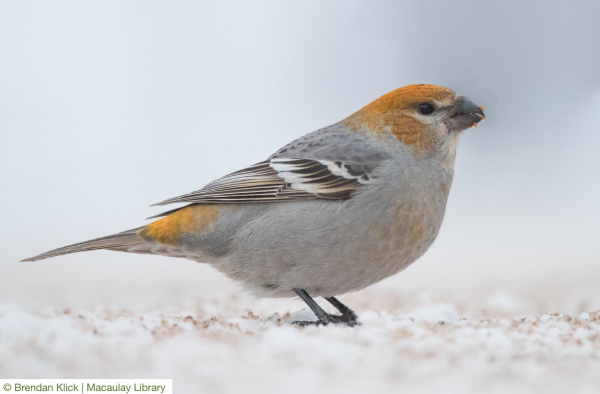
A live cam screenshot of a female Pine Grosbeak visiting a winter feeding site.

A new Winter Finch Feeder Camera is now streaming live from an impressive feeding station in far northern Maine, in the town of Woodland to be more exact. Sponsored by the Finch Research Network and Aspen Song Bird Food the action takes place in the backyard of Bill Sheehan where you can see Evening Grosbeaks, Pine Grosbeaks, Black-capped Chickadees, and other birds frequenting a variety of feeder styles. Aspen Song Bird Food generously provided the camera and sent 1½ tons of sunflower seeds, which should keep the winter finches and other birds coming into view.

To see a live view of the feeders and the birds that visit, check in to Northern Maine Birds – YouTube periodically to see what birds are active.

At the same time, you can see similar birds and others at the Ontario FeederWatch Cam at feeders in the yard of Tammie and Ben Hache in Manitouwage, Ontario at Ontario FeederWatch Cam | Cornell Lab Bird Cams Cornell Lab Bird Cams (allaboutbirds.org)

There are also a number of interesting videos you can view of winter finches and other birds visiting feeders, including a great one from the Ontario FeederWatch Cam at Colorful Finches of Canada’s Boreal Forest Share The Bounty Of The Ontario FeederWatch Cam – YouTube

The New BirdSpotter Photo Contest

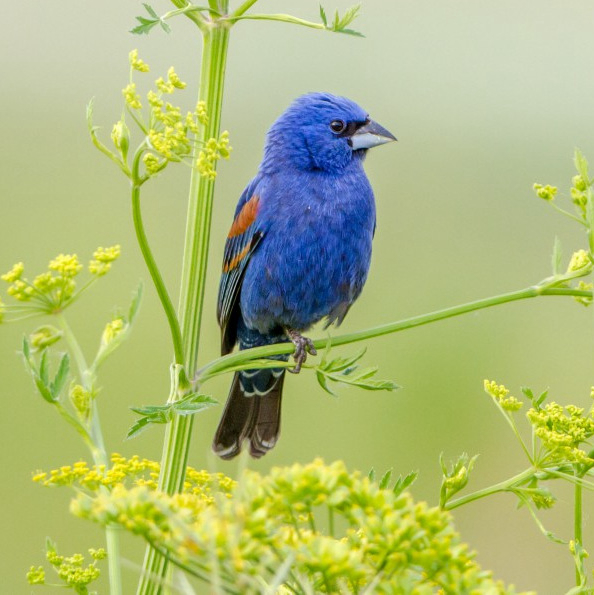
A tranquil setting combined with dramatic color variations made this past BirdSpotter winning photo of a Blue Grosbeak a favorite (photo by Mike Timmons).

Every birder is invited to submit their best bird photo to compete for prizes worth hundreds of dollars in the new BirdSpotter Photo Contest, now through February 5th. Sponsored by Wild Birds Unlimited and the Cornell Lab of Ornithology, members of their staff will select 10 finalist bird photographs, which will be posted on the BirdSpotter Voting webpage for birders to vote for their favorite finalists. Online voting will continue from February 13 to March 12, and winners will be announced shortly thereafter. Each birder is invited to enter a single photo, so pick your best.

Wild Birds Unlimited (WBU) and The Cornell Lab will award the following prizes, based on the voting results: First Place, a $300 WBU gift certificate, Second Place, a $200 WBU gift certificate, Third Place, a $100 Wild Birds Unlimited gift certificate; plus each of the photographers who took the 10 finalist bird photos will be invited to choose one Bird Academy online course Free of charge. For more information about the new BirdSpotter Photo Contest, see WBU Birdspotter entries (allaboutbirds.org) – and Good Luck!

Boreal Feeder Birds & Winter Finches

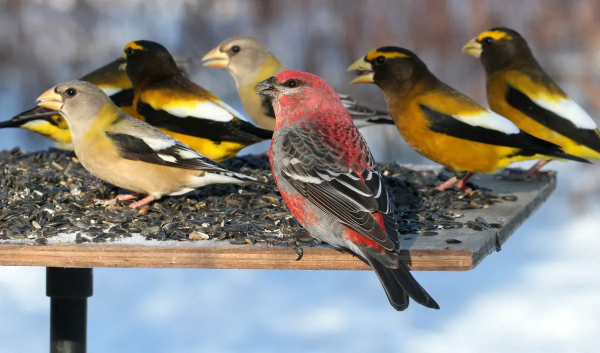
An adult male Pine Grosbeak stands out among a flock of Evening Grosbeaks on a simple platform feeder stocked with black oil sunflower seeds (photos by Ryan Brady).
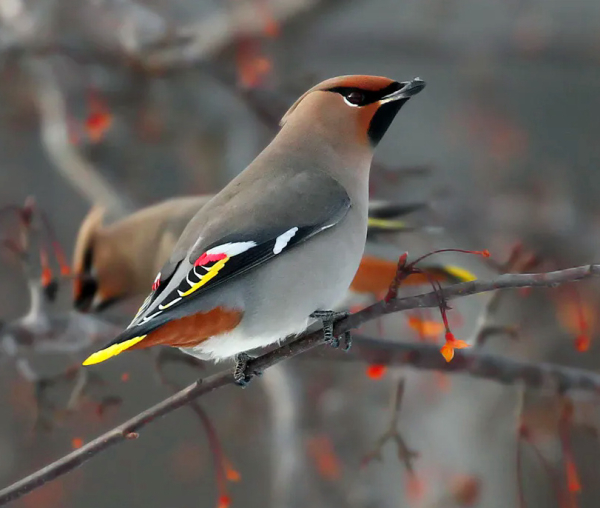
Early observations indicate more Bohemian Waxwings are moving south this winter.

During winter we birders anticipate the arrival of northern visitors to our yards and feeding stations, birds that bring increased activity and color to our yards. Among the most anticipated are the variety of finches ranging from Pine Grosbeaks and Evening Grosbeaks to Common Redpolls and Pine Siskins. There are the Red and White-winged Crossbills too, as well as such favorite boreal birds as Red-breasted Nuthatches, Blue Jays, and Bohemian Waxwings.

Movements of these birds south are not as regular as we witness with so many migratory species; instead, these birds remain in the northern forests as long as there are abundant foods, including pine and birch seeds. Some years few if any boreal birds and winter finches venture south, but during years when trees in the boreal forest produce few seeds, the “winter finches” fly south in search of foods, which includes our well-stocked feeders with nutritious seeds.

Whether these interesting boreal birds would appear in northern states and southern provinces tended to be something of a guessing game, until the turn of the century. That’s when a group of volunteers – dedicated birders and biologists – began studying the annual seed production among the principal forest trees that produce seeds that finches feed on: Primarily white spruce, black spruce, tamarack, white pine, red pine, birches, oaks, and beech trees.

The current organizer and author of the Winter Finch Forecast is Tyler Hoar, who lives in the heart of the northern forest in Ontario. He was recently interviewed by Audubon magazine to share some interesting insights into how the annual forecast is conducted. To read his interview, you can refer to This Year’s Bonanza of Boreal Birds Once Again Bears Out the Winter Finch Forecast | Audubon Read more

Savage Arms Introduces 1911 Government Model Pistols

WESTFIELD, Massachusetts –– Savage Arms is proud to announce the latest addition to its handgun line-up, the Savage 1911 Government Style Models. Built for tough use and unmatched accuracy, Savage’s 1911s bring modern technology to a time-tested platform and deliver reliability, accuracy and performance that will stand out amongst competitive offerings.

“Savage ended 2021 with the introduction of Stance, a micro-compact 9mm handgun,” said Beth Shimanski, Director of Marketing at Savage Arms. “A year later in 2022, we’re ending strong yet again in the handgun arena with the launch of the Savage 1911 Government Style Models. We’re extremely excited to introduce this iconic firearm bearing the Savage name.”

This revolutionary firearm is built to the demanding standards of accuracy and reliability that have come to define Savage Arms across platforms and categories. With features offering optimal performance for all shooting enthusiasts, this classic gun gets the ultimate Savage treatment.

“I’ve worked in the firearms Industry for over 30 years and started my career as a professional shooter,” said Rob Gates, Vice President of Sales and Marketing at Savage Arms. “This Savage 1911 is as real as they come and shoots better than any production 1911 I’ve handled during my 30 plus years in this industry.”

With a look that pays homage to the classic design, the Savage 1911 has a dual recoil spring and machined sear and disconnector, a nitride coated titanium firing pin and weighs in at just over 2 LBS with a 5” barrel length. Finishes range from black melonite to stainless steel and the Savage 1911 is sure to be 2023’s leading single-action pistol. Read more

NSSF Denounces U.S. Senate Confirmation of Operation Choke Point Architect to FDIC

WASHINGTON, D.C. — NSSF®, The Firearm Industry Trade Association, condemned the U.S. Senate’s confirmation of Martin J. Gruenberg as Chair and Member of the Board of Directors of the Federal Deposit Insurance Corporation (FDIC). Gruenberg led the FDIC from 2011-2018, during which the Obama administration conducted the illegal Operation Choke Point scheme to deny banking services to firearm businesses. NSSF opposed his confirmation in the strongest terms as he has already demonstrated a lack of respect for the law and unparalleled disdain for the Constitutionally-protected firearm and ammunition industry.

“The Senate’s confirmation of Martin Gruenberg is a flagrant disregard for his role in illegally using the levers of government to force discriminatory banking policies on the firearm and ammunition industry,” said Lawrence G. Keane, NSSF’s Senior Vice President and General Counsel. “His culpability in shepherding this illegal operation was not only previously investigated by Congress but was also highlighted by Senate Banking Committee Republicans. Mr. Gruenberg’s leading role in creating, administering and punishing the firearm industry through illegal means simply because he, President Barack Obama and former Attorney General Eric Holder found this industry politically-disfavored clearly disqualified him from being reconfirmed to a position of public trust.”

Under the Obama administration, an initiative called “Operation Choke Point” was launched by the Federal Deposit Insurance Corporation (FDIC) and Department of Justice (DOJ) to stop financial institutions from offering services to some regulated industries in an attempt to choke off banking services. This operation, which represented an abuse of the agencies’ statutory authority, was first aimed at non-depository lenders (so-called payday lenders) but expanded to ammunition and firearms sales, tobacco sales and pharmaceutical sales, among other industries.

The goal of the operation was to coerce banks, third-party payment processors and other financial institutions into closing or denying business accounts of clients that the FDIC has classified as “high risk” or as a “reputational risk” for the financial institution. According to a House Committee on Oversight and Government Reform investigation, the FDIC, “equated legitimate and regulated activities such as coin dealers and firearms and ammunition sales with inherently pernicious or patently illegal activities such as Ponzi schemes, debt consolidation scams, and drug paraphernalia.” Read more

Texas Withdraws Appeal in Lawsuit That Struck Down Ban on Handgun Carry by Young Adults

NEW ORLEANS, LA (December 20, 2022) – Today, Firearms Policy Coalition (FPC) announced that Texas has asked the Fifth Circuit Court of Appeals to withdraw the state’s appeal of the district court order that struck down its ban on handgun carry by young adults. The motion in FPC’s Andrews v. McCraw, along with other case documents, can be viewed at FPCLaw.org.

“We applaud Texas for doing the right thing and accepting the district court’s ruling against its law prohibiting 18-to-20-year-old adults from carrying firearms in public,” said Cody J. Wisniewski, FPC’s Senior Attorney for Constitutional Litigation. “Not only do young adults have the same constitutionally protected right to bear arms as all other adults, they are also among the reasons we have a Second Amendment, Constitution, and Country in the first place.”

In August, the trial court stayed the injunction for 30 days to allow Texas time to appeal. Once the court disposes of the state’s motion to withdraw its appeal, the trial court’s injunction will take effect.

The plaintiffs in this case were represented by David H. Thompson, Peter A. Patterson, and William V. Bergstrom of Cooper & Kirk, who are representing FPC and individual gun owners in multiple other legal cases, as well as Texas counsel R. Brent Cooper of Cooper & Scully, P.C.

In addition to Andrews, FPC is litigating to restore the right of young people to keep and bear arms in cases including Lara v. Evanchick (vs. Pennsylvania, in the 3rd Circuit), Reese v. ATF (vs. the federal government, in the 5th Circuit), Beeler v. Long (vs. Tennessee, in the 6th Circuit), Meyer v. Raoul (vs. Illinois, in the 7th Circuit), Worth v. Harrington (vs. Minnesota, in the 8th Circuit), Jones v. Bonta (vs. California, in the 9th Circuit), and Baughcum v. Jackson (vs. Georgia, in the 11th Circuit). Read more

NSSF Rejects City of Buffalo’s Frivolous Lawsuit Against Firearm Industry Members

WASHINGTON, D.C. — NSSF®, The Firearm Industry Trade Association, rejects the false premise of the lawsuit brought by the City of Buffalo against several firearm manufacturers, distributors and retailers. The accusations are without any legal merit and are an obvious attempt by city officials to deflect attention and shift responsibility for their failure to enforce the law against criminals by casting blame on a Constitutionally-protected and most highly-regulated industry in the nation today.

“The junk lawsuit by the City of Buffalo attempts to deflect attention for illegal activities by criminals by laying blame at the feet of the firearm industry, which is following the law,” said Lawrence G. Keane, NSSF Senior Vice President and General Counsel. “This is no different from the frivolous and unsuccessful lawsuits filed against firearm manufacturers in the late 1990s and early 2000s by crime-ridden big-city mayors across the country. Those lawsuits failed because they were legally and factually baseless. But they did, however, result in Congress passing the Protection of Lawful Commerce in Arms Act in 2005 by a broad bipartisan margin.”

The recently passed New York public nuisance law, upon which Buffalo’s lawsuit is based, is a transparent and unconstitutional attempt to defy the will of Congress. A lawsuit challenging the Constitutionality of the New York public nuisance law is now before a federal appellate court in Manhattan. Read more

SnapSafe In-Wall Safes

Grand Island, NE – SnapSafe® In-Wall Safes install securely between wall studs safeguarding valuables out-of-sight. In-Wall Safes are available in two sizes – a 22-inch and a 44-inch-tall version – depending on individual storage needs. SnapSafe makes peace of mind made easy with its new In-Wall Safes.

The In-Wall Safe mounts flush against the wall allowing concealment behind pictures, furniture or other household objects without detection. If discovered, its 16-gauge steel body and extra-thick 8-gauge door thwart unauthorized access. An innovative latch mechanism maximizes usable interior space while hidden hinges impede prying and cutting attacks on the container. Thanks to its innovative design, it fits perfectly between wall studs that use the industry-standard 16-inch on-center spacing; the pre-drilled safe then lags tight to the framing using the included bolts. SnapSafe In-Wall Safes are easy to install in minutes, and the design allows orienting the door for either a left- or right-hand opening.

A battery-powered electronic keypad provides quick entry to the In-Wall Safe. After entering the access code, its spring-assist door opens and reveals the safe’s contents. The lock has audio and LED warnings when the battery levels are running low. And just in case, SnapSafe includes a barrel key backup. Read more

RMEF Helps Expand Montana’s Largest Wildlife Management Area

MISSOULA, Mont. —Montana’s largest wildlife management area offers more room to roam for hunters, anglers and others thanks to a collaborate effort led by the Rocky Mountain Elk Foundation.

RMEF teamed up with private landowners with a history of conserving and opening public access to elk habitat by acquiring and conveying 829 acres to Montana Fish, Wildlife and Parks (FWP), which added the land to the now 56,980-acre Mount Haggin Wildlife Management Area.

“Buyers noted the beauty and potential of this acreage and reached out to Roger and Gayle Burnett about it, but they chose wildlife and conservation over development. We salute and thank them for their conservation ethic and values,” said Kyle Weaver, RMEF president and CEO.

About 30 miles west of Butte, the property features open grasslands with sagebrush and bitterbrush foothills as well as aspen, willows and forestland. It supplies elk with winter, calving and summer range as well as important habitat for mule deer, moose, pronghorn antelope and other wildlife.

Because portions of Willow Creek and Mill Creek cross the property, in addition to various springs, the resulting wetlands and riparian habitat are vital for brook trout, westslope cutthroat trout, other fish species, beavers and more bird and animal species. Read more

1 569 570 571 572 573 2,088