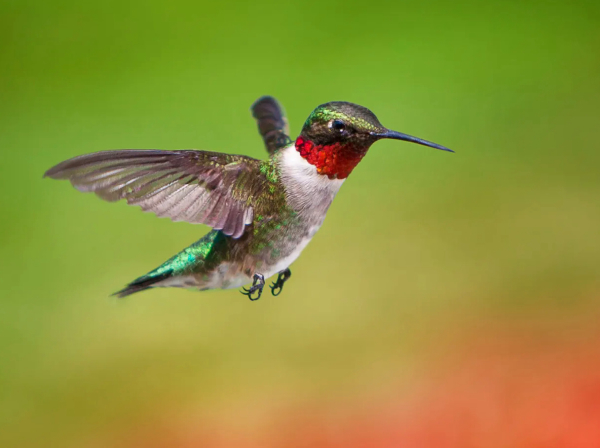
Hummingbirds that nest in northern latitudes are making important migration stopovers to rest and feed at backyard feeders.
Among the top hummingbird feeders that provide bee deterrents are the Perky-Pet top-fill feeders, like the Diamond Wine Top-fill Glass Hummingbird Feeder and Sugar Maple Top-Fill Glass Hummingbird Feeder.
Perky-Pet has developed colorful, soft, flexible artificial flowers for some hummingbird feeders that are designed with a long stem that acts as a bee guard to keep insects out while hummingbirds have no problem reaching the feeder’s nectar.
As late summer dispersal and migration continues, you may be looking for some tips and ideas about how to better serve hummingbirds in your yard, and perhaps at a business location or school. With that in mind let’s consider basics, some advanced ideas, and some potential problems: Problems like ants, bees, and wasps; Basics like cleaning feeders and providing sugar-water nectar, and Advanced aspects of hummingbirding like keeping feeders up after the last migrants pass through, just in case a vagrant Rufous Hummingbird finds its way to your yard.
Keeping it clean – Keeping your hummingbird feeder clean is easy, but like any other effort, it’s good to keep a regular schedule. Twice a week is a good cleaning plan, and that will keep the nectar clean and fresh too. Of course, if it’s particularly hot, or if you have many hummers feeding at your feeders, you may need to increase that cleaning and re-filling schedule.
Sugar-water ratio – The standard hummingbird sugar-water mix is 4 parts water to 1 part white cane sugar (never use honey, brown sugar, or sugar substitutes). We use a shot glass to easily measure parts although a measuring cup might be even better. This 4-to-1 mixture best represents the sugar content of natural nectar produced in flowers. Mix it yourself or buy one of the many options for pre-mixed hummingbird sugar-water nectar that use the same sugar-water mix ratio. Read more


 Henry Repeating Arms Company President Andy Wickstrom (L) presents a $50,000 check and a Henry Military Service Tribute Edition rifle to The American Legion National Paul E. Dillard (R) at the organization’s National Convention in Milwaukee, Wis., on August 30, 2022.