Utah: Anglers Urged to Keep Small Lake trout Caught at Flaming Gorge
VERNAL — Several agencies are asking for anglers to keep any lake trout under 25 inches that are caught at Flaming Gorge Reservoir, in an effort to improve the health of the fishery. Several fishing tournaments will be held to incentivize anglers to help in this effort.
Currently, the popular reservoir in northeastern Utah — known for producing some of the largest lake trout in the U.S. — has too many small lake trout in it. In Flaming Gorge, lake trout larger than 25 inches primarily consume kokanee salmon and rainbow trout. If the abundant population of smaller lake trout (under 25 inches) is not reduced, there could be impacts on the salmon and rainbow trout populations, as well as fewer fish to feed the trophy lake trout.
“In the 1990s, an 8-year-old lake trout was about 30 inches long,” Utah Division of Wildlife Resources Flaming Gorge Lead Fisheries Biologist Ryan Mosley said. “Today, an 8-year-old fish is about 23 inches long. On top of the decreased length, the number of small lake trout in the reservoir has increased, and we’re concerned the situation is going to get worse. We’re managing for a balanced fishery of predators and prey, and currently, there are too many predators. Reducing the number of small lake trout now will mean healthier lake trout in the future, while also increasing the survival of trout and salmon that are highly sought after by anglers. They’re already growing slower and unless we can ‘thin the herd,’ it will only get worse.” Read more
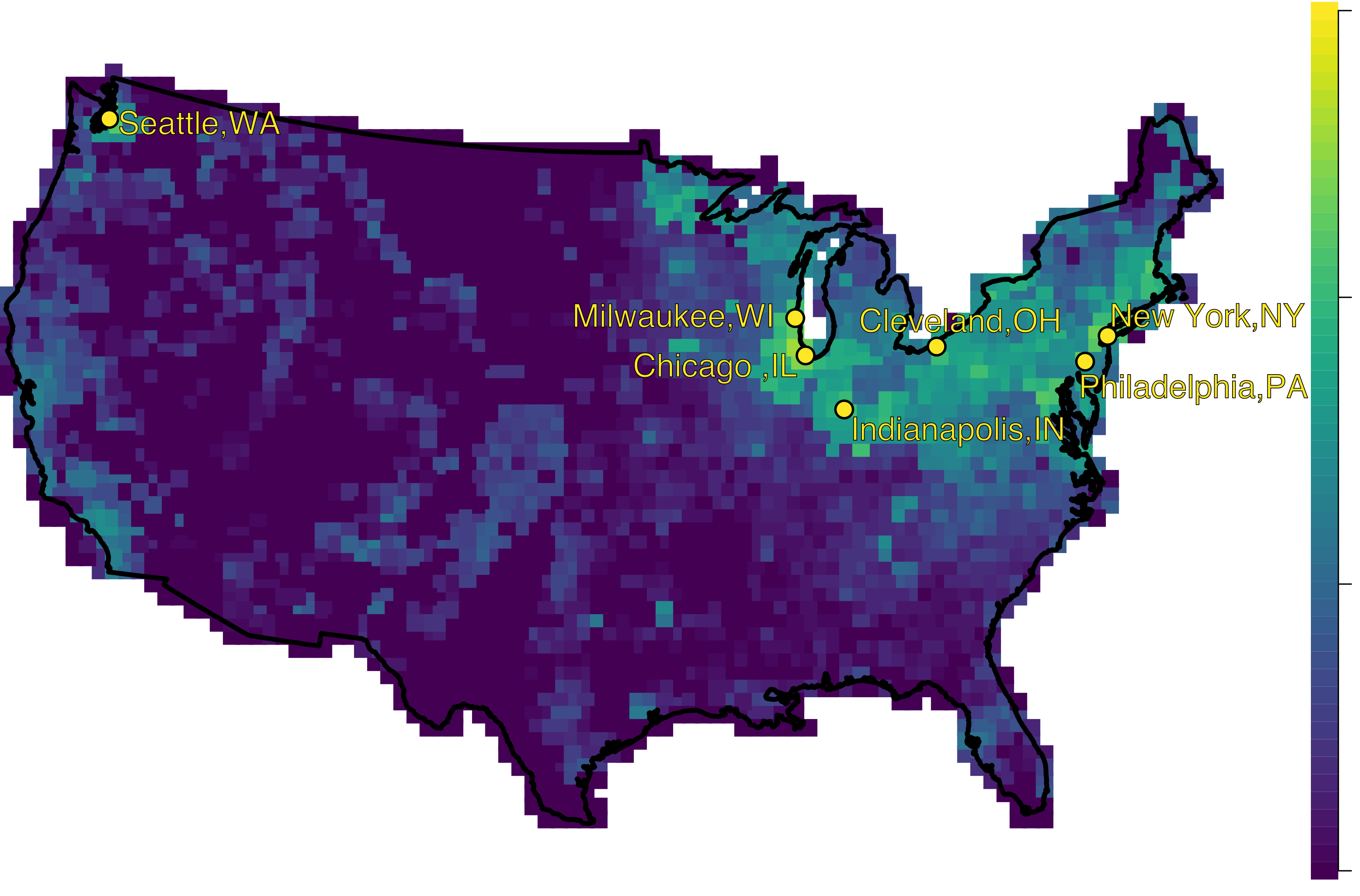 Several U.S. cities, shown in yellow, may be hotspots for tree mortality from the invasive emerald ash borer beetle. The map also shows other locations in the insect’s path over the next 30 years. Dark blue areas have lower risk, while lighter blue and green areas may experience greater risks and costs. (Source: Hudgins et al. 2022 Figure 2d)
 Though Michigan’s 2021 deer hunting seasons ended in late January 2022, the Michigan Department of Natural Resources is continuing to accept feedback from hunters about their experiences. Hunter harvest surveys have been sent to a random sample of the state’s deer hunters. In addition, hunters can take a