
Michigan: bringing history to life – costumed role playing at Fort Wilkins Historic State Park
Michigan Department of Natural Resources
This summer the Michigan History Center will enter its 41st season of a unique program in historic site interpretation at Fort Wilkins Historic State Park, at Copper Harbor, in Keweenaw County.
The Fort Wilkins living history, or “role-playing” program, was first introduced in cooperation with Michigan Technological University in 1976. The program is unique in that it combines an established interpretive program, professional museum staff and the History Center’s Future Historians youth program.
Check out previous Showcasing the DNR stories in our archive at Michigan.gov/DNRStories. To subscribe to upcoming Showcasing articles, sign up for free email delivery at Michigan.gov/DNR.
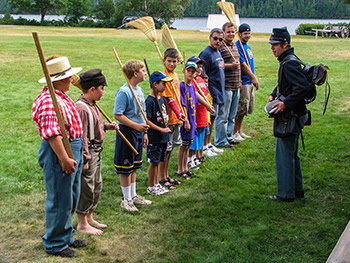
During the summer, college students and younger Upper Peninsula students are trained as costumed interpreters and portray characters from the past at the fort. The interpretive program has been an effective educational tool for participants in the program, as well as nearly 150,000 annual visitors to Fort Wilkins.
Located off the beaten path, Fort Wilkins provides an ideal setting for role-playing interpretation. Situated on a narrow strip of land between Copper Harbor and Lake Fanny Hooe, the fort stands as an excellent example of a mid-19th-century military post.
Built in 1844, 19 buildings survive, including two sets of company barracks, officers’ quarters, mess halls, a storehouse, post hospital, guardhouse, blacksmith shop, bakery and married enlisted men’s cabins. Of these, 12 remain from 1844 construction with another seven structures that are also historic but were rebuilt or restored later based on historical and archaeological research.
The buildings and fort grounds serve as the interpreters’ stage, and except for an occasional passing airplane or motorboat on Lake Fanny Hooe, people can view a landscape that closely resembles what soldiers and copper miners first encountered in the 1840s.

Here, for 10 weeks each summer, costumed interpreters bring the site to life. Read more


