Arizona: Gila Trout Stocked in Marijilda and Frye Creeks

Biologists and volunteers successfully stock Gila trout in Marijilda and Frye creeks

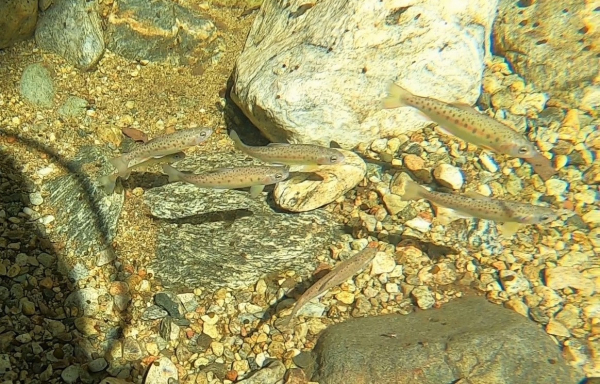
Staff from AZGFD’s Native Trout and Chub program, along with other staff from AZGFD, U.S. Fish and Wildlife Service, U.S. Forest Service, and volunteers from organizations such as Trout Unlimited, Backcountry Hunters and Anglers, and Arizona Wildlife Federation, successfully stocked Gila trout in both Marijilda and Frye Creeks in mid October.

A total of 250 Gila trout (Whiskey Creek lineage) were stocked into the upper section of Marijilda Creek, while 500 (South Diamond lineage) were stocked in the lower section of Marijilda Creek. At Frye Creek, 300 Gila trout (South Diamond) were successfully stocked. This was the second consecutive year of Gila trout stockings in Frye Creek following the Frye Fire in 2017, which eliminated the Gila trout population at that time.

Tennessee: Tennessee Aquarium, Partners Release Sturgeon into Tennessee River

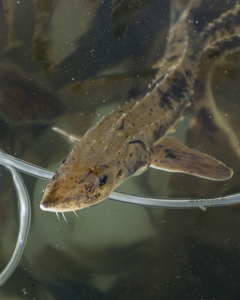
Chattanooga, TN – Beneath cornflower blue skies and surprisingly balmy weather on Friday afternoon, a group of scientists released about 100 baby dinosaurs into the chilly waters of the Tennessee River near downtown Chattanooga.

The team worked quickly and efficiently to shift dozens of juvenile Lake Sturgeon into the river from the water-filled plastic bins that were used to transport them to the release site from the Tennessee Aquarium Conservation Institute. The move was the culmination of more than a year of continuous care by Aquarium scientists.

This release was a bright moment in a year that has seen significant upheaval and hurdles thanks to the pandemic, says Dr. Anna George, the Aquarium’s vice president of conservation science and education. Read more

SAF, FPC, Louisiana Shooting Assn. Sue Over Handgun Ban

BELLEVUE, WA – The Second Amendment Foundation today filed a federal lawsuit challenging federal law that prevents young adults from purchasing and owning handguns.

SAF is joined by the Firearms Policy Coalition and Louisiana Shooting Association and two private citizens, Caleb Reese and Joseph Granich, both in the affected age group. The lawsuit was filed in U.S. District Court for the Western District of Louisiana. Plaintiffs are represented by attorneys Raymond M. DiGuiseppe of Southport, NC, Adam Kraut and Joseph Greenlee from Sacramento, CA, and John W. Dillon from Carlsbad, CA, and George J. Armbruster III from Lafayette, LA. Kraut is FPC’s Director of Legal Strategy and Greenlee is the group’s Director of Research. The case is known as Reese v. BATF.

Named as defendants are the federal Bureau of Alcohol, Tobacco, Firearms and Explosives and Acting Director Regina Lombardo, and Attorney General William Barr, in their official capacities.

Neither Reese or Granich have criminal records. Both are over age 18, and thus have reached what is generically called the age of majority, which means adulthood. Yet they are denied full rights under the Second Amendment to purchase and own handguns, according to the lawsuit, which states, “The Handgun Ban prevents (them) from purchasing handguns of the makes and models of (their) choice, with full manufacturer warranty and support…in violation of (their) constitutionally enumerated rights.”

“While both of these young men were able to vote in the recent national elections, and they can pursue other activities as legal adults, they are prevented by law from purchasing and using handguns,” said SAF founder and Executive Vice President Alan M. Gottlieb. “They can join the military and defend the nation, possibly at the risk of losing their lives. They can enter into contracts, start businesses, get married and even run for office. Preventing them from legally purchasing and owning handguns seems rather silly, and we believe their rights as adult citizens are being violated.” Read more

ZEISS and Peacemaker National Training Center Rifleman Membership Drive

ZEISS supports a new and cooperative membership outreach with the team at Peacemaker National Training Center, in Glengary, West Virginia. The co-op effort is designed to introduce new members, as well as existing members, to the science and mechanics of optics and long-range shooting. On November 7, 2020, the membership drive included four separate half-day clinics. This allowed attendees to use the presented optical gear on the range to gain immediate first-hand experience, while offering several saving incentives related to the cost of membership and associated ZEISS gear. There are other extended membership benefits beyond the initial optics and shooting clinics, and those details can be found at Peacemaker National Training Center. The initial clinics were spoken for and filled within just a few days of release.

“Our members are always interested to learn more about the finer details of optics, and how they actually work”, said Jennifer McCulloch, Owner and Operator of Peacemaker National Training Center. “We seek to provide our members with value and information far beyond access to a shooting range. We want to offer them experiences, products, and opportunities to participate and learn more about shooting that simply isn’t readily available elsewhere. ZEISS continues to help us, and our members, have access to more of what we are looking for.” Read more

Incentivized Harvest of Brown Trout on Colorado River

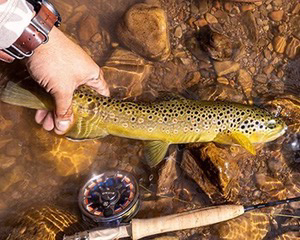
MARBLE CANYON, Ariz. — The National Park Service (NPS) and Arizona Game and Fish Department (AZGFD) are working with partners and seeking the public’s help in addressing the threat of brown trout in the Colorado River. Beginning Nov. 11, 2020, the National Park Service at Glen Canyon National Recreation Area will implement an Incentivized Harvest, a pilot research program, to reduce the growing population of brown trout in the Colorado River below Glen Canyon Dam.

The Incentivized Harvest will reward anglers $25 for each brown trout over 6 inches that is caught and removed from the river. The brown trout population in the Lees Ferry Reach has steadily increased since 2014. As adults, brown trout primarily feed on other fish, potentially threatening downstream native fish species. The goal of this program is to determine if an Incentivized Harvest can help manage and reduce the number of brown trout in the Colorado River between Glen Canyon Dam and the mouth of the Paria River. The initial research into the use of this tool is designed to last three to four years at which time the program will be evaluated for its effectiveness. Read more

Deer Hunting’s Tradition

By Glen Wunderlich

Charter Member Professional Outdoor Media Association

The pursuit of whitetail deer has been a challenging way to put meat on the table for as long as there have been tables – and, even before that.  Of course, in days long ago successful hunters were rewarded with protein-laden venison that was literally life-sustaining; poor hunters were dubbed as vegetarians.  And, before chemists were invented, deer hides were tanned with the brains from the downed animals to produce clothing and footwear and other goods that could be traded for life’s necessities.

In exactly one week, Michigan’s modern iteration of the ageless process takes place marked with the beginning of firearms deer season November 15th.  And, the more things change, the more they stay the same.

Many of us still head north – not because there are more deer to hunt there, but because of tradition – a tradition that takes us away from it all, be it the ever-present virus, politics or the timeless practice of getting ahead.  It becomes family reunions of sorts where friends and family meet and leave it all behind.

Where once the journey to the northern countryside was an adventure all its own, today it’s cruise control accompanied by music from the clouds.  Just imagine packing all the gear into a Model A Ford and poking along at 30 miles per hour on roads that were not even paved.  Somehow without GPS, cell phones or radial tires, hopeful hunters forged their adventurous paths to their personal secret spots.

Having never hunted deer I took the advice of my father in-law and purchased my first deer gun 50 years ago: a Sears model .30-30 manufactured by Winchester.  It was several years before I ever saw a buck deer in the woods but that ol’ gun did the job on one of the largest bucks taken at the historic tent-camp site.  However, another hunter had shot at the same buck and met me in the thick cover where I stood over the magnificent animal; he claimed it was his!  We flipped a coin to settle the matter and I field dressed my first deer.  (The deer proved to be mine all the while upon further review.)

The tent was military surplus with plenty of room that could never be heated adequately with the tired kerosene heater that produced more light than heat.  I didn’t know much about good socks or boots, but I learned quickly that cold feet and a warm heart still meant cold feet.

We didn’t have blinds of any nature, either – portable or otherwise.  Nobody had them back then.  Hunting with firearms from elevated stands was illegal, too.  And, there were no extended seasons, either, unless one were to include archery or muzzleloader seasons in which participation was minimal.

Certainly, much has changed.  Yet, there remains sameness – a connection with our past and those that came before us.  We find peace among the wildlife and the rising sun that warms our chilled bodies in our quest to be one with nature.  Although we find it difficult to slow down in everyday affairs, there is no rush to go anywhere else or to do anything else.

Yes, we will get away from it all, and in my way of thinking that makes our individual journeys purposeful and satisfying. And, through it all, I’ve even learned to keep my feet warm.

Most Migrating Birds Follow a Green Wave

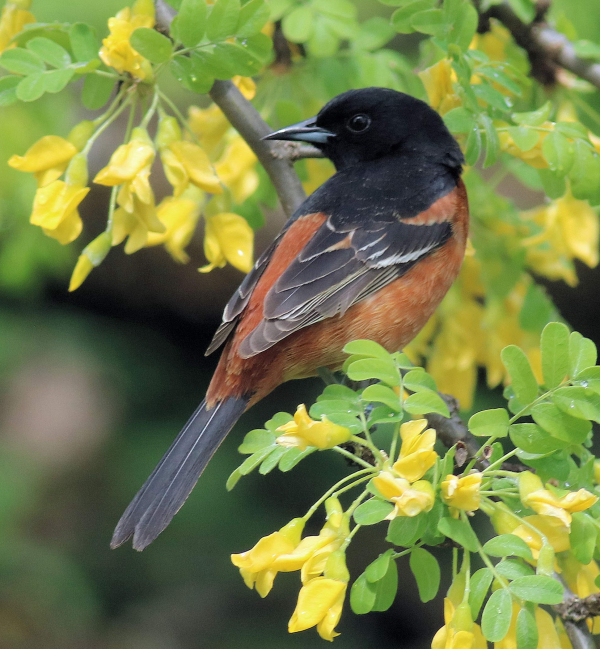
Many songbirds, including Orchard Orioles, appear to follow a “green wave” north each spring (photo by Paul Konrad).

A new study confirms that most birds synchronize their migratory movements with seasonal changes in greening vegetation. Expansive plant green-up in the spring is controlled by changes in temperature and precipitation; while during fall die-back of vegetation is controlled by temperature change and reduced hours of daylight – all important factors in the timing of bird migrations. This was the first study of its kind to cover the Western Hemisphere during the year-long cycle of North American migratory birds that feed on plants, seeds, flower nectar, insects, or meat.

Ornithologists from the Cornell Lab of Ornithology used data collected by satellites to estimate the greenness of vegetation year-round and cross-referenced that information with eBird observations for 230 North American migratory bird species from 2006 through 2018. The results were published today in the Journal of Animal Ecology.

”As you might expect, migration synchronization with vegetation greenness is strongest for birds that eat vegetation, seeds, or both, during spring and fall migration, but especially during spring,” explained lead researcher Frank La Sorte with the Cornell Lab of Ornithology. “You could say they follow the ‘green wave’ north in the spring, then follow it in reverse during the fall, keeping pace with a wave that is retreating ahead of the North American winter.” Read more

Michigan: Avoid Bear Conflicts As Bruins Approach Hibernation

Even though the weather has gotten cooler, black bears are still active throughout the fall as they prepare for hibernation and search for foods rich in calories to build up their fat reserves.

The Michigan Department of Natural Resources advises northern Michigan residents to be aware of this autumn bear activity and take steps to avoid conflicts with bears.

In Michigan, bears typically enter their dens for hibernation by December, but timing can vary depending on food availability. Read more

MSU Extension and QDMA partner with DNR to offer CWD test sample collection sites

Michigan Department of Natural Resources partners from Michigan State University Extension and the Quality Deer Management Association will host chronic wasting disease test sample collection sites in Kent, Ionia and Montcalm counties in November.

Hunters in these counties may submit their deer for free CWD testing at DNR check stations from Nov. 15-18 only; outside of this timeframe, hunters still can submit their deer for CWD testing for a fee by pulling appropriate tissue samples and submitting them to a USDA-approved laboratory.

MSU and QDMA staff and volunteers at test sample collection sites will be available to assist deer hunters with lymph node removal and will transport CWD samples to the Michigan State Veterinary Diagnostic Laboratory, a USDA-approved laboratory, for testing.

The sites will be open from 3 to 8 p.m. Sample collection dates and locations are as follows:

  • Nov. 8 – Rustic Sports Shop, 519 Ensley St., Howard City.
  • Nov. 20 – Magnum Sports, 6227 S. Greenville Road, Greenville.
  • Nov. 22 – Belding Hometown Hardware, 930 W. State St., Belding.
  • Nov. 28 – Sadler’s Great Outdoors, 3160 W. M-46, Six Lakes.

All hunters, regardless of where their deer was taken, are welcome and encouraged to bring their deer to these testing collection sites to get help collecting the appropriate tissue samples and submit those samples for CWD testing. Read more

1 … 909 910 911 912 913 … 2,102