New study of Saginaw Bay walleye movement and reproduction starts soon

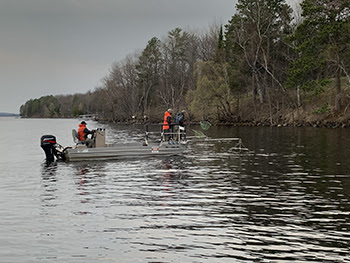
A new study begins this month on Saginaw Bay, using acoustic transmitters that will be implanted in walleye to help researchers with the Michigan Department of Natural Resources, Michigan State University and several partner agencies obtain data about where the fish spawn.

Fish in such telemetry projects have acoustic transmitters affixed to them. Each transmitter then beeps a fish-specific code every few minutes. Acoustic receivers deployed in Lake Huron decode the tag beeps and log when fish tags are detected. The network of acoustic receivers in Saginaw Bay includes receivers in the mouths of rivers to listen for tagged fish moving to spawning grounds and receivers in Saginaw Bay to determine where walleye may be spawning.

Having a better understanding of relative sources of natural reproduction for walleye will help fishery managers determine which rivers and reefs to protect and, when needed, where to invest in actions that enhance and improve fish habitat.

Volunteer charter boat operations are assisting in the study by collecting the walleye hook and line in May while the fish from all spawning sources are mixed post-spawn, but before any leave the bay. Then when the fish return for spawning next spring, their locations will be logged in the receivers. There are at least 15 rivers and five offshore reefs that are likely sources of walleye spawning. Read more

Johnny Morris Donates Yet Again to Conservation

— Frank Sargeant
Frankmako1@gmail.com

Johnny Morris is a classic American success story, starting out in his 20’s selling a little tackle out of his father’s liquor store in Springfield. Missouri in 1972.

Johnny Morris has built an empire on fishing, hunting and boating equipment sales, and has been remarkably generous with his wealth in supporting conservation and other worthy causes. (Bass Pro Shops)

Today, the company he built, based mostly on the Bass Pro Shops logo, has a value of about $6.5 billion and employs over 40,000.

It owns not only 152 Bass Pro Shops superstores nationwide and in Canada but also 50 Cabela’s stores as well as White River Marine Group, parent company of Tracker, Ranger, Triton, Mako and other well-known boating brands sold at hundreds of dealerships around the nation.

And Morris has done an amazing amount of good with the money he and his team have earned. Just this month, as reported in yesterday’s TOW, he donated an added $1.5 million generated by the Bass Pro Shops World’s Fishing Fair and Concert in Springfield, Missouri

As with a number of other high-profile outdoors companies these days, the Bass Pro Shops empire has done its best to support the fish, wildlife and the outdoors fans that have made success possible. It all comes back to Johnny Morris, who has made a lifelong commitment to conservation.

The company has an ongoing effort to seek out and support worthwhile causes—see details here: https://about.basspro.com/community/support.

(In full disclosure, I worked for Outdoor World Television, a part of Bass Pro Shops, for eight years in the early 2000’s.)

More fishing news below… Read more

Utah: Anglers Urged to Keep Small Lake trout Caught at Flaming Gorge

VERNAL — Several agencies are asking for anglers to keep any lake trout under 25 inches that are caught at Flaming Gorge Reservoir, in an effort to improve the health of the fishery. Several fishing tournaments will be held to incentivize anglers to help in this effort.

Currently, the popular reservoir in northeastern Utah — known for producing some of the largest lake trout in the U.S. — has too many small lake trout in it. In Flaming Gorge, lake trout larger than 25 inches primarily consume kokanee salmon and rainbow trout. If the abundant population of smaller lake trout (under 25 inches) is not reduced, there could be impacts on the salmon and rainbow trout populations, as well as fewer fish to feed the trophy lake trout.

“In the 1990s, an 8-year-old lake trout was about 30 inches long,” Utah Division of Wildlife Resources Flaming Gorge Lead Fisheries Biologist Ryan Mosley said. “Today, an 8-year-old fish is about 23 inches long. On top of the decreased length, the number of small lake trout in the reservoir has increased, and we’re concerned the situation is going to get worse. We’re managing for a balanced fishery of predators and prey, and currently, there are too many predators. Reducing the number of small lake trout now will mean healthier lake trout in the future, while also increasing the survival of trout and salmon that are highly sought after by anglers. They’re already growing slower and unless we can ‘thin the herd,’ it will only get worse.” Read more

Michigan DNR and MSU celebrate 20 years of lake sturgeon research and management

For the past 20 years, the Michigan Department of Natural Resources and Michigan State University have focused on lake sturgeon management, hatchery production, research and outreach at Cheboygan County’s Black Lake.

To celebrate this milestone, the DNR and MSU invite the public to attend an event celebrating lake sturgeon restoration efforts on May 7 at the Black River spawning site at 11 a.m. before continuing at the Black River streamside research and hatchery facility at 1 p.m.

The event will showcase the restoration work of this iconic species, recognize the important contributions of partners and raise public awareness of lake sturgeon. Attendees will have a chance to observe fisheries staff collect data from spawning lake sturgeon as well as go on a hatchery tour. Additional activities will recognize the contributions of agency, academic, industry and citizen partners who have made sustained sturgeon renewal efforts possible.

Rehabilitation of lake sturgeon in the Cheboygan River watershed is a cooperative effort involving the DNR, the Black Lake Chapter of Sturgeon for Tomorrow, Michigan State University, Tower-Kleber Limited Partnership, the Bay Mills Indian Community, the Grand Traverse Band of Ottawa and Chippewa Indians, the Little River Band of Ottawa Indians, the Little Traverse Bay Bands of Odawa Indians and the Sault Ste. Marie Tribe of Chippewa Indians. Read more

Michigan: Inland Fishing Surveys Critical to Management

Contact: Jay Wesley, 616-490-5090

Collecting key data on Michigan’s world-class fisheries is critical for successful management of our diverse fisheries resources. Michigan Department of Natural Resources fisheries management units completed over 260 fisheries surveys across Michigan in 2021. Specifically, DNR fisheries staff surveyed 152 inland lakes and 115 streams.

Overall, the surveys revealed that most of our lakes and streams have healthy, self-sustaining populations of fish.

The surveys are useful for tracking inland fisheries populations, evaluating if stocking increases angler opportunities or addressing concerns from anglers throughout the year.

So, just what are crews looking for?

According to Jay Wesley, DNR Fisheries Division Lake Michigan basin coordinator, surveys fall into three categories:

  1. Evaluating management actions.
  2. Understanding status and trends.
  3. Finding answers to new questions or concerns.

“The management units stepped up last year and safely conducted these surveys to evaluate if management actions, like fish stocking or habitat improvement projects, had the desired effect,” Wesley said. “Surveys help us understand whether or not our management actions resulted in better recreational fishing in certain areas or improved a lake’s overall health.” Read more

Fish stocking creates fishing opportunities throughout Michigan

Have you seen fish stocking trucks out on the road this spring? We’re in the midst of our spring fish stocking season. This time of year, you’ll find Michigan Department of Natural Resources fish stocking trucks releasing their prized recreational cargo at hundreds of lakes and streams throughout the state.

Fish stocking is a valuable tool used by fisheries managers for different reasons, including:

  • Restoring ecosystem balance.
  • Providing diverse fishing opportunities.
  • Rehabilitating low fish populations.
  • Reintroducing extirpated (locally extinct) species.

The DNR does not stock on top of wild populations when it can be avoided. Fish production staff take great pride in the quality of the fish they produce, but – when feasible – prefer relying on naturally reproducing fish that are adapted to their local ecosystem.

However, there are instances where the combination of angling pressure and habitat limitations keep wild fish from maintaining the desired population level on their own. In those instances, hatchery fish are stocked to supplement natural reproduction.

The DNR accomplishes this work by rearing fish at its six fish production facilities throughout the state; cooperatively managing up to 29 rearing ponds and six Great Lakes imprinting net pen/pond locations (which help developing fish return to spawning waters when mature); and by maintaining a fleet of 18 specialized fish stocking vehicles. Read more

A Vessel Safety Check Will Keep Your Boat Up-to-Date with New Boating Safety Equipment Regulations

A no cost, no penalty vessel safety check ensures you’re in compliance

SPRINGFIELD, Va.– How do you know your boat is ready for a safe summer boating season and complies with new U.S. Coast Guard regulations? A no cost, no penalty vessel safety check from the U.S. Coast Guard Auxiliary and U.S. Power Squadrons can help, and to get one all you have to do is go to cgaux.org/vsc. Appointments can be made for a vessel examiner to come to your boat or you can learn where scheduled inspections are taking place around your town.

Upon successful completion, the vessel is awarded a U.S. Coast Guard / Auxiliary / U.S. Power Squadrons decal that informs law enforcement and safety agencies that your boat was in full compliance with all federal and state boating laws during a safety check for that year. The program is sponsored by the BoatUS Foundation for Boating Safety and Clean Water.

“With the recent changes in regulations on engine cut-off switches as well as changes to fire extinguishers and new 12- year expiration date, a free vessel safety check can help ensure your vessel is in compliance,” said BoatUS Foundation president Chris Edmonston. “It also gives you peace of mind that your boat meets federal safety standards and that in an emergency you will have the necessary equipment to save lives and summon help.”

Boat clubs, marinas, boat yards and municipalities with launch ramps are also encouraged to reach out to their local U.S. Coast Guard Auxiliary or U.S. Power Squadrons to schedule a vessel safety check day at their property.

California: DFW Wants Dog Owners “Be Mindful of Salmon Poisoning Disease

Dog owners in northern California are reminded to take precautions to protect their pets from Salmon Poisoning Disease. Salmon Poisoning Disease is a potentially fatal condition seen only in dogs after they eat certain types of raw or cold smoked fish like trout and salmon that are infected with a bacteria-like organism, Neorickettsia helminthoeca, which is transmitted by the parasitic flatworm (or “fluke”) Nanophyetes salmincola. Read more

Michigan: Boardman Weir in Operation to Support Fisheries Study

Staff from the Great Lakes Fishery Commission, in collaboration with Michigan Department of Natural Resources and the Grand Traverse Band of Ottawa and Chippewa Indians, are conducting a trapping study to determine the run size of white suckers and longnose suckers in the Boardman River. In order to complete the study, the Boardman River Weir, in Grand Traverse County, will be in operation from approximately April 11 to May 30.

Anglers are reminded that while the Boardman weir is in operation, fishing is closed from 300 feet upstream of the weir to 300 downstream of the weir, as indicated on page 54 of the 2022 Michigan Fishing Guide.

Traps will be installed both upstream and downstream of the weir to capture migrating suckers in the river. After capture, the suckers will be measured, marked with a combination of fin clips, external tags and internal tags, and released on the opposite side of the weir from which they were caught. All fish species, including steelhead, captured in the traps will be released on the opposing side of the weir (e.g., fish moving upstream will be permitted to continue up toward the Union Street Dam). Read more

MAPLand Act Passes Senate, Heads to President’s Desk

MAPLand Act would fund land management agencies to standardize, compile, release digital map records to public

WASHINGTON – The Modernizing Access to Our Public Land Act, or MAPLand Act, which would modernize and digitize map records for the benefit of public lands hunters, advanced through the U.S. Senate late Wednesday under a procedural vote that allowed the unanimously supported bipartisan bill to move without objection.

Led by Sens. Jim Risch (R-ID) and Angus King (I-ME), the Senate vote follows the MAPLand Act’s near unanimous passage through the House of Representatives in March. Strong support by sportsmen’s and women’s groups, including Backcountry Hunters & Anglers, helped propel the bill to the president’s desk to be signed into law.

“Inadequate or faulty data can spell disaster for the public land hunter,” said BHA President and CEO Land Tawney, “and the importance of reliable, comprehensive information on access opportunities on our public lands cannot be overstated. Backcountry Hunters & Anglers thanks our Senate and House leaders who championed this foresighted, commonsense effort to address the problem of limited public access.”

The MAPLand Act would fund public land management agencies, including the Bureau of Land Management, U.S. Fish and Wildlife Service, Forest Service, National Park Service, Bureau of Reclamation and Army Corps of Engineers, to standardize, compile and release digital map records to the public. The publicly available information would include the open or closed status of roads and trails on public lands, vehicle-use regulations and boundary details. Read more

1 44 45 46 47 48 138