By Glen Wunderlich
Growing up in the ‘50s, my brother and I learned the value of hard work, courtesy of my father. There was never any backtalk or debate when it came to household chores. We took turns washing dishes, taking out the trash and mowing the lawn and were rewarded with a weekly allowance for our efforts. Oh, how happy we were when we received our very first raise from 10 to 15 cents per week.
I also recall the old reel mower that certainly would have qualified for today’s green movement. It produced zero emissions into the atmosphere, had no cord or batteries. The only sound was that of the grass clippings falling back to earth. We trimmed, edged, raked, and swept each week – all with no more than boy power. Not so curious was my father’s purchase of his very first motorized lawn mower – one week after I had left the homestead for good.
Decades later – in fact only a week ago – those early life lessons would mean one more deer hunting stand. The coveted hideout sits nestled along Osborn Drain (a tributary of the Looking Glass River) and overlooks some of the most productive hunting ground we have. The soil is so rich that it needs no special fertilizer or lime to yield turnips the size of volleyballs.
However, there was one glaring problem: our motorized machines could not navigate the rain-saturated ground enroute to our paradise. The overgrown weeds were 3 to 4 feet tall, after having their way all season long and had to be cut down to begin the process of planting. It was then that those boyhood lessons from over a half century gone by came to mind.
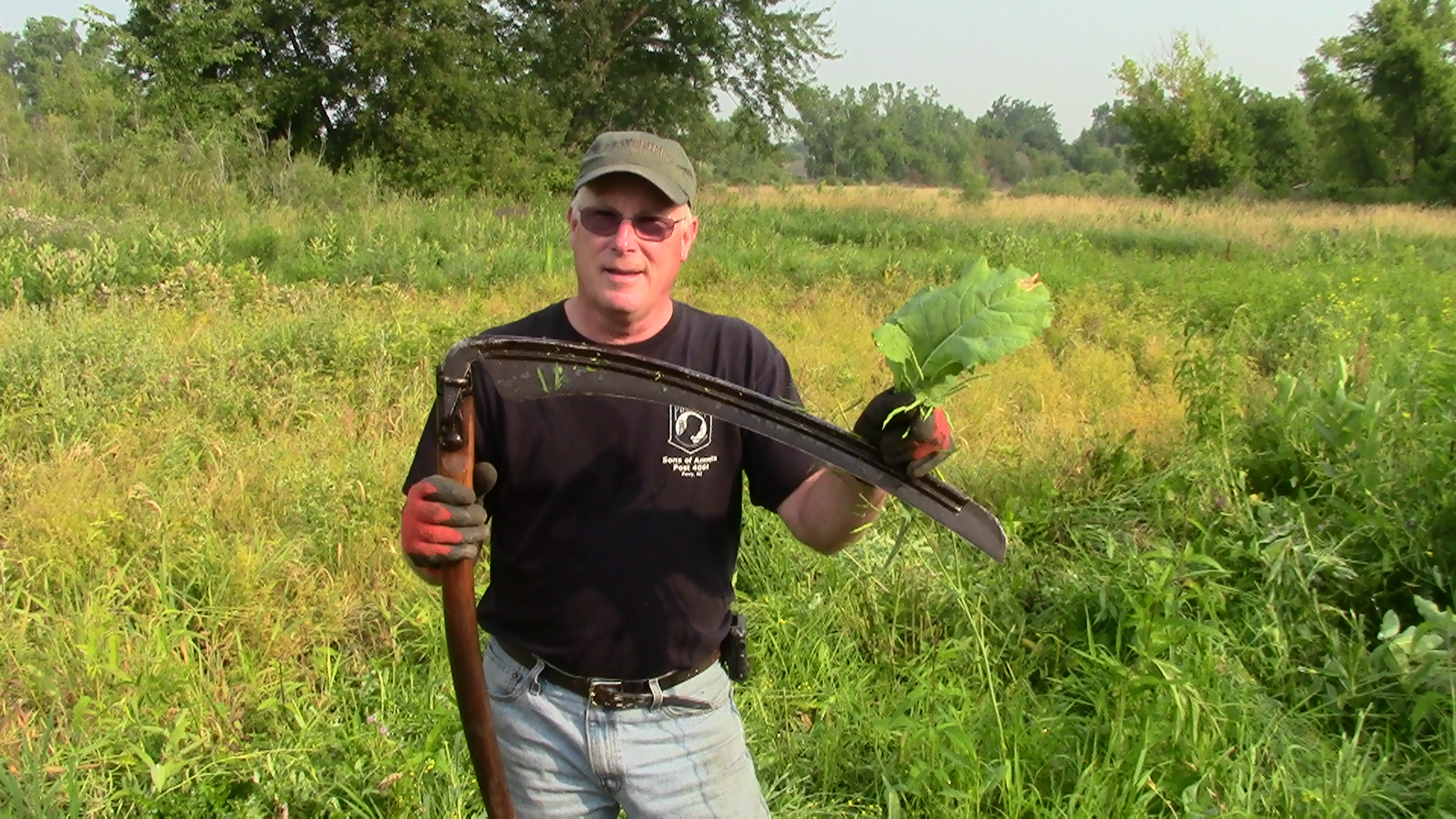
I pulled the mowing scythe ( an agricultural hand tool for mowing grass or reaping crops) from the rafters of the garage to see if it was ready for the “green movement.”
Scythe
To minimize effort, the long, curved blade was honed to a razor’s edge with a sharpening stone. A loose handle was tightened and I ventured with it to the remote location with my friend, Joe, who had volunteered to spray the area with a backpack sprayer.
Joe thought it might be fun to give it a whirl, so I watched intently as he overworked himself into submission without having cleared much more than a patch large enough to stand on. The laughter was getting the best of me, so I put my experience and muscle together and promptly took over.
The tool works best without swinging; rather it is rhythmically drawn with the keen edge parallel to the ground. Within an hour, the heat and humidity had won, but not before the mission was accomplished.
Oh, how much finer will be the taste of the venison that will be yielded from that ground and the wisdom of my father.


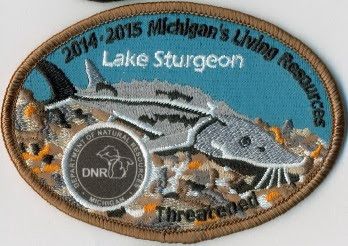 Lake sturgeon, the only sturgeon species common to the Great Lakes basin, are the largest freshwater fish native to that system. Lake sturgeon can be considered a near-shore, warm-water species preferring water temperatures in the range of mid-50 to low-70 degrees Fahrenheit and depths 15 to 30 feet (although sturgeon in the Great Lakes are often found at greater depths). Lake sturgeon are benthivores, which means they feed on small invertebrates such as insect larvae, crayfish, snails, clams and leeches they find along the bottom of lakes and rivers.
  In the earliest records of birds in Michigan, bald eagles were reported to be found nesting from Monroe County in the south all the way up to Gogebic County in the north. In fact, bald eagles were found from the Atlantic to the Pacific and from northern Canada all the way to Mexico, and their numbers were estimated to be as high as 100,000 nesting birds.
  New Haven, MO – Browning Camping has updated the Shadow Series Pop-Up Ground Blinds with a new window curtain system for 2014. Designed for a wide range of window openings, it is sure to satisfy any hunter’s needs. The 4 models of blinds offered by Browning Camping (Powerhouse, Phantom X, Phantom, and Mirage) all now feature the Silent Track Window System.