A new peregrine falcon, an endangered species in Michigan, has arrived in its family’s new home atop the Campbell Ewald Building on VanDyke in Warren. The strong chick is thriving under the care of its attentive parents.
While sightings of peregrine falcons have been reported on and off near the Campbell Ewald Building since 2004, the falcons just took up residence this year.
“It’s like Christmas,” said Campbell Ewald Building Manager Paul Lenney. Lenney installed a nest box and a nest camera atop the building in 2006, hoping to entice a pair of falcons. His patience and hospitality paid off. Just seven years later, the falcons have arrived. Read more
Overland Park, Kan – Bushnell Outdoor Products, an industry-leader in high performance sports optics for 65 years, has introduced a new 8x 30mm digital camera binocular. The new ImageView 8x 30mm combines eight power magnification optics with a camera that delivers both high resolution photos and high definition (HD) video, allowing users to capture incredible images with clarity and ease.
GW: This is the first I’ve heard about this proposal. Sounds good!
The Michigan Department of Natural Resources (DNR) today advised the public that a local organization will hold an informational meeting regarding a proposed deer antler point restriction (APR) on June 4 at the East Lansing High School.
A group known as the Lower Peninsula Deer Management Initiative (LPDMI) has proposed a four-point APR for all of Zone 3 in southern Michigan. Read more
The Department of Natural Resources today announced that, with support provided by the Arbor Day Foundation, it planted more than 7 million seedlings this spring on state forest land. In all, the DNR reforested about 7,500 acres in April and May. The Arbor Day Foundation supported the planting of 400,000 tree seedlings in both the northern Lower Peninsula and the Upper Peninsula. Read more
GW: …the Court found that the groups merely disagreed with the legislature’s policy of allowing wolf harvests…And, that’s what happens when you come to conclusions based on feelings.
Washington, D.C. – Based on arguments presented by Safari Club International (SCI) the Minnesota Court of Appeals has dismissed a legal challenge to Minnesota’s wolf harvest. The Court ruled that the Center for Biological Diversity (CBD) and Howling for Wolves failed to show their members were harmed by the process used by the Minnesota Department of Natural Resources to establish the state’s wolf season. Read more
The Department of Natural Resources, in partnership with Macomb County and the Detroit Zoo, banded two healthy, male peregrine falcon chicks last week. The banding occurred on the 11th floor of the Macomb County Building in Mount Clemens. The chicks, hatched on May 1, are the offspring of Hathor and Nick, longtime residents of the Macomb County Building.
Pictured above: DNR Southeast Regional Wildlife Supervisor TimPayne (left) and Macomb County Executive Mark Hackel. Read more
For a birder, being outdoors in the springtime can’t be beat. New sights and sounds abound and they just plead to be identified. But, on this day, we were seeking the main ingredient for a turkey soup recipe.
My friend, Joe, sat with me in the comfort of a large portable blind two weeks earlier but we could not entice a gobbling tom into our trap. It was time to try again.
For this session, we set up a large pop-up blind in the middle of a wheat field under the shade of a lone hickory tree. Even though the camouflaged material was totally wrong with its brown patterns, it had worked for me earlier in the season.
Conspicuous Contraption
This would be the ultimate test to learn if this conspicuous contraption could keep us concealed, while allowing us to get a mature tom close enough for a personal invitation to join us for dinner.
By 6:30 am several hen turkeys had flown down from their roosting trees 200 yards away. Previous observations found the turkeys poking around for hours in the burgeoning wheat after they had hit the ground, so we were content to let it happen.
A pair of sandhill cranes
Sandhill Crane
and Canada geese joined the festivities and made for some good viewing and photos. Finally, I spotted some bright red heads moving in their direction of the hens and determined that three one year-old male turkeys (jakes) were making their way toward the ladies.
In short order, we observed the jakes separate from the hens after their intentions were thwarted. Then, Joe alertly noticed a coyote staring at our decoy from 80 yards away. I spun the camera toward it, and off it went only to pause for one last glimpse at us.
The hens saw it too and all eyes were tuned to the imminent threat. At long last, things returned to normal and the birds began feeding, once more.
Joe and I lost track of the jakes until they reappeared directly in front of us in the company of our rubber decoy. Only 26 yards from our off-color hideout, they were oblivious to our presence, as they began an attempt to acquaint themselves with our teasing accomplice.
Joe had already made up his mind to let them grow to adulthood, so we took it all in, while I captured the interaction on video along with some still photos. Previously, the camera was set so that I could hear the shutter sound and I’m sure the young gobblers could hear it, as well. But, we remained motionless as their bird brains calculated.
Eventually, the stuck-up female’s total disinterest sent the love-struck losers away from us, but the excitement of the moment was well worth the price of admission.
We called it a day and one worth remembering, at that.
A publication of the U.S. Sportsmen’s Alliance 05-25-2013
The ongoing IRS scandal that is hitting Washington has yet another twist with new questions surrounding the number one group on our Dirty Dozen List, the Humane Society of the United States (HSUS). The latest twist comes after the person at the heart of the IRS scandal, Lois Lerner, was found to have ties to this anti-hunting organization.
Lerner is the Director of the IRS’s tax-exempt organizations division, which has come under investigation for improperly targeting conservative groups. Lerner’s involvement might not stop there, however. Now questions are being raised as to whether the IRS ignored accusations regarding HSUS’s tax exempt status because of Lerner’s active membership with HSUS. Read more


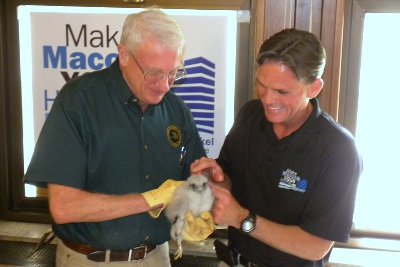 The Department of Natural Resources, in partnership with Macomb County and the Detroit Zoo, banded two healthy, male peregrine falcon chicks last week. The banding occurred on the 11th floor of the Macomb County Building in Mount Clemens. The chicks, hatched on May 1, are the offspring of Hathor and Nick, longtime residents of the Macomb County Building.

