2026 Hunting Forecast: North-central Montana Big Game Forecast (Region 4)

GREAT FALLS – Big game species across most of FWP’s Region 4 came out of the 2025–26 winter in good condition, with strong overwinter survival rates for not only adults but also the fawns and calves born in 2025. During the winter and spring much of the region experienced a continuance of the moderate to severe drought that reduced habitat quality, but timely and abundant rainfall in late spring and early summer rapidly and significantly improved forage and overall habitat conditions. As a result, elk, deer and pronghorn are entering the critical fall and winter period of 2026 in very good body condition for the first time in the past several years. This turnaround gives wildlife managers optimism, and barring a particularly harsh winter, they anticipate strong fawn and calf production next year – setting the stage for improved hunter success and big game populations in the seasons ahead.

Access in Region 4 consists of large areas of state and federal land that provide big game hunting opportunities that are open to everyone, although hunters who are willing to hike away from roads and access points and concentrate on less accessible terrain generally have better chances of locating animals. Region 4 also has well over a million acres of private land enrolled in the state’s Block Management Program, which allows public access to private land. Other private lands may also offer some hunting access, especially to hunters willing to harvest antlerless animals. As always, hunters should contact landowners well in advance of the season to secure hunting permission.

Elk

Elk numbers in Region 4 are very strong and generally meet or exceed population objectives in all districts, but the distribution of elk on the landscape varies widely. Many elk concentrate in large numbers on private lands which offer limited or no public access, while nearby public lands may hold relatively few animals.

Access to private-land elk hunting in Region 4 varies considerably, both among districts and among individual landowners. Some landowners allow hunting only for antlerless elk, while others permit either-sex harvest. Opportunities to hunt bulls differs widely depending upon the district, and in many districts, hunters with a general elk license may pursue bulls. But in several districts, especially island mountain ranges, the Missouri River Breaks and certain state-owned wildlife management areas bull hunting is limited to hunters who drew a limited entry permit.

Several hunting districts in Region 4 have shoulder seasons, which offer hunting for antlerless elk outside of the general archery and rifle seasons. Hunters should read their regulations carefully before hunting, and consider taking advantage of these special opportunities to harvest antlerless elk.

Mule Deer Read more

Free Gun Friday Delivers Serious Firepower With the Mossberg 990 AfterShock SPX

Free stuff is always good. Free guns are better. And when that free gun is a Mossberg 990 AfterShock SPX, things get downright interesting. Bleecker Street Publications is giving readers the chance to win the Mossberg 990 AfterShock SPX, a compact, feature-loaded 12-gauge semi-auto firearm that looks like Mossberg decided to take everything people love about a tactical shotgun and crank the dial until it broke off. This isn’t a participation trophy with a trigger. It’s a serious firearm with an MSRP of $1,204, and one lucky winner is going to get it without writing that check.

The Mossberg 990 AfterShock SPX is built around a simple premise: make a compact semi-auto firearm that is fast, maneuverable and ready for modern accessories and then make it look damn good doing it. And Mossberg didn’t stop with the basics. The receiver is optic-ready, using an RMSc footprint and including three additional adapter plates for RMR, Docter and Leupold footprint optics. That means the winner isn’t stuck living in the past when it comes to aiming solutions.

One of the defining features is the AfterShock grip, which is shaped to provide a firm hold while helping minimize felt recoil. A rubberized palm pad adds shooting comfort, while the grip also incorporates a rear swivel-stud port. That’s a particularly welcome feature on a compact 12-gauge. Because while 12 gauge is a glorious thing, physics remains undefeated. Read more

SCI and Sportsmen’s Alliance Foundation Urge Supreme Court to Extend Second Amendment to Commonly Used Hunting Firearms

Safari Club International (SCI) and the Sportsmen’s Alliance Foundation (Sportsmen’s) urged the U.S. Supreme Court to protect semi-automatic firearms commonly used in hunting under the Second Amendment to the U.S. Constitution. These organizations submitted an amicus brief asking the Supreme Court to strike bans enacted by Cook County, Illinois, and the State of Connecticut, on use of these rifles by hunters, sportsmen, and recreational shooters.

In the brief, SCI and Sportsmen’s highlight their longstanding commitment to protecting hunting access and defending Second Amendment rights in connection with lawful hunting. Firearms are central to America’s hunting heritage, serve as essential tools for lawful hunting and wildlife management, and generate significant conservation funding nationwide.

The brief explains that semi-automatic rifles are protected “arms” and cannot be banned when commonly used for lawful purposes, including hunting. For more than a century, hunters have used semi-automatic rifles and continue to use these firearms due to their accuracy, adaptability, portability, affordability, and suitability for wildlife management and hunting.

“This case is about far more than a particular type of firearm. It is about protecting the constitutional rights of law-abiding Americans and preserving the tools hunters have safely and responsibly used for generations,” said W. Laird Hamberlin, CEO of SCI. “Semi-automatic rifles are commonly used for lawful purposes, including hunting and wildlife management. Bans on these firearms threaten our hunting heritage, undermine conservation efforts funded by hunters, and conflict with the Second Amendment’s protection of arms that are in common use.”

About Safari Club International: Safari Club International is a global leader in protecting the freedom to hunt and promoting wildlife conservation worldwide. Through advocacy, litigation, and education, SCI fights to promote the sustainable use of wildlife resources and to defend the rights of hunters. Visit www.safariclub.org today to join the mission.

Read more

Hornady Introduces VEXIS, a New Era of Biometric Security Powered by Palm Vein Recognition Technology

Hornady® is redefining biometric access with the introduction of VEXIS™, a patent-pending palm vein recognition technology that delivers unmatched speed, accuracy, privacy and reliability. Rather than relying on fingerprints, facial recognition or access codes, VEXIS™ identifies users by the unique vein pattern beneath the skin of their palm, providing secure, contactless access in less than half a second.

Unlike surface-based biometric systems, VEXIS™ reads internal vein patterns that cannot be copied, photographed, forged or left behind. The technology captures more than 2.5 million data points during each scan, resulting in exceptionally low false acceptance and false rejection rates while maintaining user privacy through locally stored data that is never uploaded or shared.

“Security should be both uncompromising and effortless,” said Jason Hornady, Vice President of Hornady. “VEXIS™ combines advanced biometric technology with the dependability our customers expect, creating one of the most secure and user-friendly access systems available today.”

Built around harmless near-infrared technology, VEXIS™ recognizes vein patterns that remain stable throughout adulthood. Each device stores up to 10 unique users while supporting multi-factor authentication through a keypad and mechanical key backup.

VEXIS™ Product Line

VEXIS™ Night Guard®
Item No. 98235

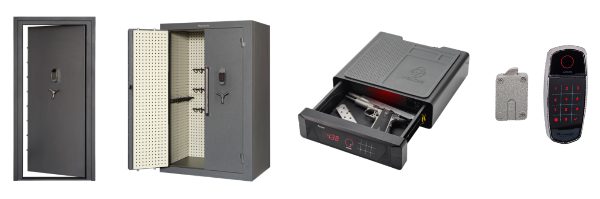
Designed for immediate bedside access, the VEXIS™ Night Guard® opens by scanning your palm, opening a padded compartment for firearms and valuables. Read more

NSSF-Adjusted NICS Background Checks for August 2026

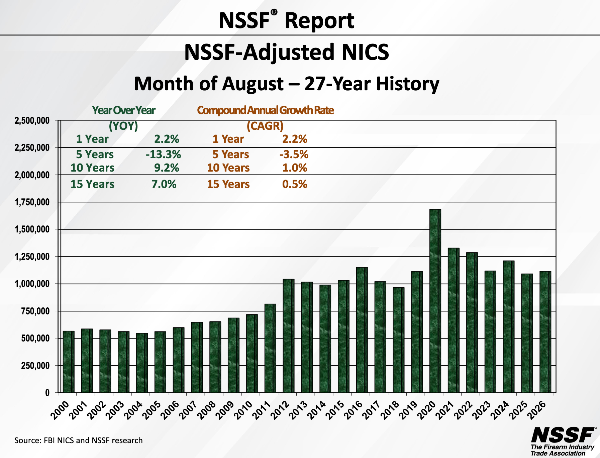
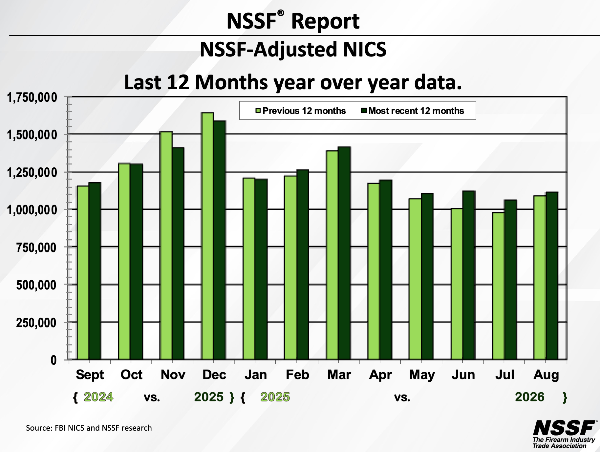
The August 2026 NSSF-adjusted National Instant Criminal Background Check System (NICS) figure of 1,115,410 is an increase of 2.2 percent compared to the August 2025 NSSF-adjusted NICS figure of 1,091,342. For comparison, the unadjusted August 2026 FBI NICS figure of 1,917,379 reflects a 10.0 percent increase from the unadjusted FBI NICS figure of 1,743,509 in August 2025.

New for 2026 – Monthly NFA checks (Form 1 and 4) to provide improved market insights:

Top-5 States for NFA Checks in August:

Texas

28,030

Florida

12,808

Georgia

8,512

North Carolina

8,269

Pennsylvania

5,463

  • The August 2026 NFA figure of 185,744 is an increase of 201.6 percent compared to the August 2025 figure of 61,594.

Additional insights on the month-over-month NICS data from GunBroker, NICS Reporting & Analysis (July 2026 data), available in the member portal under Industry Research.

    • Top-5 States for Adjusted NICS Checks: TX, CO, FL, CA, PA
    • Top-5 States for FBI NICS Handgun Checks: TX, FL, PA, CO, CA
    • Top-5 States for FBI NICS Long Gun Checks: CO, TX, PA, FL, CA

Read more

2026 Hunting Forecasts: Southwest Montana Big Game Forecast (Region 3)

BOZEMAN – Hunting opportunities for a variety of wildlife are plentiful in southwestern Montana. Hunters should remember that crowding will occur on easily accessible public lands, and wildlife may be visibly concentrated on private lands where access is limited. Hunters should acquire landowner permission well before hunting on private land and remember that continued access opportunities depend upon hunter behavior, ethics, and safe hunting practices. Please treat all lands—public and private—with respect, abide by land use rules from the landowner or land management agency, and be courteous with other hunters and landowners sharing the landscape.

Elk Read more

SCI and WYOGA Support Draft Environmental Impact Statement Prioritizing Hunting for Elk Management on National Elk Refuge

Safari Club International (SCI) and the Wyoming Outfitters and Guides Association (WYOGA) applaud the U.S. Fish and Wildlife Service’s release of the Draft Environmental Impact Statement (EIS) for the National Elk Refuge Bison and Elk Management Plan. The draft EIS advances an adaptive management approach that protects one of western Wyoming’s most important elk herds, recognizes hunting as an essential conservation tool, and avoids unnecessary starvation and suffering among Jackson elk.

For more than a century, the National Elk Refuge has sustained elk whose historic winter range has been diminished by human development. The Service and the Wyoming Fish and Game Department rely on supplemental winter feeding when necessary to prevent widespread starvation and reduce conflicts with private landowners. SCI and WYOGA have consistently supported maintaining this adaptive feeding program until sufficient alternative winter habitat is available.

Throughout the EIS development process, SCI and WYOGA have represented sportsmen, outfitters, guides, and other stakeholders committed to conserving the iconic Jackson elk herd and protecting the significant economic benefits generated by elk hunting and wildlife tourism.

The draft EIS recognizes both the importance of the elk herd and the need to address challenges associated with elk concentration on the Refuge, including the risk of the spread of brucellosis and Chronic Wasting Disease (CWD). Rather than imposing a rigid end to supplemental feeding, the preferred alternative seeks to reduce elk congregation over the next decade through a combination of potential management and feeding adjustments as well as targeted hunting.

“SCI is pleased to see the Service embracing adaptive management and proven conservation tools, including regulated hunting, to maintain healthy elk herds in western Wyoming,” said SCI CEO W. Laird Hamberlin. “Wildlife managers should not accept mass starvation and suffering based on arbitrary criteria and speculation. Hunters have long championed science-based wildlife management, and regulated hunting remains the most effective and responsible tool for managing wildlife populations.” Read more

Michigan Sturgeon Palooza

Help celebrate 25 years of sturgeon research at Sturgeon Palooza!

The Black River Lake Sturgeon Hatchery and Research Center is celebrating 25 years of conservation, research, and education dedicated to the recovery of Michigan’s lake sturgeon. This important work would not have been possible without support from the Department of Natural Resources, Michigan State University, Tower-Kleber Limited Partnership, Great Lakes Fishery Trust, Sturgeon for Tomorrow and many others.

Join us in celebrating this milestone!

When: September 25, 2026, 3–6:30 p.m.
Where: MSU Molecular Plant Sciences Building Atrium, 612 Wilson Rd, East Lansing, MI 48824

Program of events

Sturgeon Palooza will feature a reception, along with two showings of the Dinosaur Fish documentary followed by panel discussions.

  • 3 p.m. – Dinosaur Fish first showing
  • 3:30 p.m. – Student/alumni panel discussion
  • 4–5:30 p.m. – Reception with displays from partners, light refreshments and an opportunity to meet this year’s Black River sturgeon
  • 5:30 p.m. – Dinosaur Fish second showing
  • 6 p.m. – Expert panel discussion Read more

Michigan bear hunting season starts next week

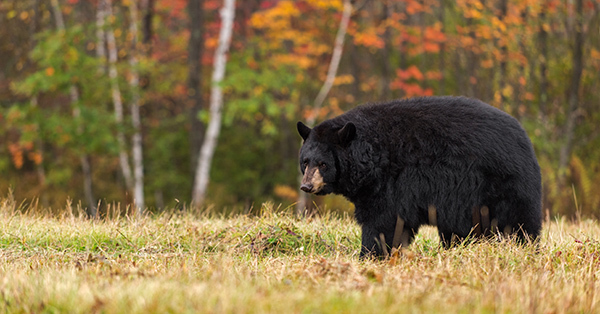
black bear in field with fall forest in background

The first bear hunting period of 2026 kicks off Sept. 9 in the Upper Peninsula as thousands of bear hunters prepare to take to the field this fall.

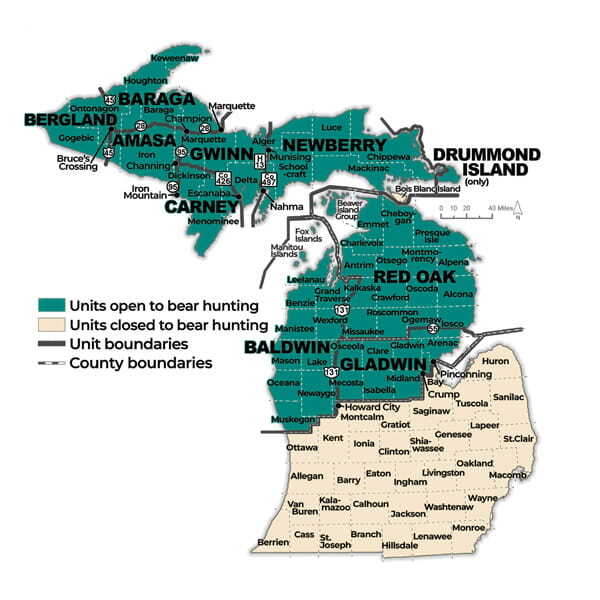
The Michigan Department of Natural Resources is issuing 6,278 bear licenses for the 10 bear management units across the state in 2026. Bear hunting is allowed in the U.P and the northern half of the Lower Peninsula.

More than 72,500 people applied for a bear license or preference point this year. Licenses are awarded through an annual drawing that’s based on the number of points each hunter has earned. The number of points needed to obtain a bear license depends on the BMU and hunting period. It’s generally easier to get a bear license in the U.P. based on the higher density of bears.

Here’s more information about bear hunting in Michigan.

Season dates

BMU MapUpper Peninsula

Here are the season dates for the three hunt periods in the Amasa, Baraga, Bergland, Carney, Gwinn and Newberry bear management units of the U.P.:

  • Hunt period 1: Sept. 9 – Oct. 21.
  • Hunt period 2: Sept. 14 – Oct. 26.
  • Hunt period 3: Sept. 25 – Oct. 26.

Drummond Island has one hunting period this year: Sept. 9 – Oct. 21.

Northern Lower Peninsula

Season dates for the one bear hunting period in the Baldwin, Gladwin and Red Oak units of the Lower Peninsula are Sept. 12-22 and the Oct. 2-8 archery-only period.


Bait or dogs? Read more

FPC Asks Federal Court to Block Louisiana’s Ban on Gun Carry Permits for 18-to-20-Year-Old Adults

Firearms Policy Coalition (FPC) announced today that it has filed a motion for preliminary injunction in its Pool v. Besson lawsuit, asking the United States District Court for the Western District of Louisiana to immediately block Louisiana’s ban on handgun carry permits for 18-to-20-year-old adults.

The lawsuit is brought by Louisiana residents Ella Pool, Christian McDuffie, and Charles Matthews, along with FPC. Each individual plaintiff is a peaceable adult between the ages of 18 and 20 who is legally eligible to possess firearms and would apply for a Louisiana concealed handgun permit, but is prevented from doing so because of the State’s age restriction.

Louisiana generally allows adults 18 and older to carry a concealed handgun without a permit. But the State still prohibits 18-to-20-year-old adults from obtaining a Louisiana concealed handgun permit. That ban has significant real-world consequences, including restrictions on carrying within 1,000 feet of school grounds under federal law and the denial of legal protections Louisiana grants to permit holders.

But this lawsuit could have been avoided if Louisiana had simply fixed the constitutional problem when FPC first raised it.

In April 2025, while FPC was working with Louisiana officials to resolve constitutional problems raised in its Mate v. Wescott litigation to end the State’s non-resident carry permit ban, FPC’s counsel warned Louisiana Solicitor General Ben Aguiñaga that the State’s carry laws also violated the rights of 18-to-20-year-old adults, and provided Louisiana with proposed legislative language addressing both problems. The proposal would have allowed nonresidents to obtain Louisiana permits and lowered the minimum carry permit age from 21 to 18. Read more

1 … 25 26 27 28 29 … 2,108