Trash and trees don’t mix – help protect Michigan’s forests

Record numbers of people are heading to Michigan’s outdoors this summer, exploring forests to enjoy the beauty of wildflowers, bright songbirds and splashing waterways. This captivating scenery is, unfortunately, sometimes marred by something less beautiful: dumpsites.

Trash in the forest isn’t just ugly – it’s hazardous to people, wildlife and the environment. If you want to help care for the wild places you love, join Adopt-a-Forest, a volunteer-driven cleanup program bringing people together to protect the outdoors. Because of this program, more than half of illegally dumped trash removed from public lands in the last 10 years has been recycled. Read more

Auto-Ordnance Makes the 20’s Roar with the Bootlegger Thompson, 1911

Greeley, PA: The Thompson is often called the “gun that made the 20’s roar”, but it was not the only reason for that saying. In fast cars with loads of moonshine, 1920’s bootleggers roared down country roads, evading the law and delivering white lightning to speakeasies. Lawmen raced after the motor bandits, wielding Tommy Guns and 1911s. It was not long before Hollywood depicted these duels on the big screen. The Roaring 20’s blazed a trail into American pop culture and history. Auto-Ordnance’s latest custom guns are produced in collaboration with Outlaw Ordnance, and commemorate the era with the “Bootlegger” Thompson and 1911. Jodi DePorter, Director of Marketing for Kahr Firearms Group, commented on them saying, “Auto-Ordnance is devoted to preserving American History, and the Bootlegger series invokes images of the roaring 20’s–a time people find fascinating! Owning one of these guns is truly owning a piece of American history.”

Range Worthy Art

The Bootlegger Thompson and 1911 are works of art, and refined shooting implements. Each gun is artfully engraved with depictions of 1920s autos, newspaper print, wanted posters, and historical images from the time. The Thompson barrel is marked “Speakeasy”. The 1911 slide and Thompson receiver are engraved “Bootlegger Prohibition Edition”, and “150 Proof Tennessee Moonshine”. Beautiful scrollwork covers the American Walnut wood furniture, and sections of the steel. The finish is distressed Bronze Cerakote with a clear coating overlayed. The wood furniture is also distressed and then stained. Both guns are completely American made firearms, chambered in .45 ACP. The Thompson features a 16.5” barrel, 20 round stick, and 50 round drum magazine. MSRP for the Bootlegger Thompson is $2,883 (T1-14C3). The 1911 comes with one 7 round magazine. MSRP for the Bootlegger 1911 is $1,496 (1911BKOC9). Read more

Hobie to Light-Up ICAST with Mirage Lynx

Low-profile watercraft teams Hobie’s famous MirageDrive® 180 propulsion system with a versatile featherweight fishing and touring platform that turns on a dime.

OCEANSIDE, Calif. – Anglers and outdoors enthusiasts who relish a grab-and-go lifestyle are going to absolutely love Hobie’s new Mirage Lynx. A sleek, lightweight, stable and rugged platform, it’s intelligently designed to provide the flexibility and versatility necessary to load and launch with minimal effort at a moment’s notice. Coupled with the power of Hobie’s one of a kind, patented MirageDrive propulsion system, its low-profile, flat-bottom design really drives to the heart of the matter with powerful performance, superior speed, amazing maneuverability and ease of transport unmatched in its class.

Hobie, the leading manufacturer of premium kayaks and watersport products, aimed to minimize weight while maximizing transport and fishing efficiency with the Lynx’s unique design…and they nailed the bullseye. With a hull weight of just 45 pounds, the 11-foot long by 36-inch-wide Lynx boasts a 350-pound capacity and is light enough to easily take anywhere. A hard-shell evolution of Hobie’s proven and popular inflatable 11 design, it features Hobie’s ACE-TEC construction for rigidity and durability, a removeable rudder system for optimal steering control, and a premium MirageDrive 180 propulsion system with Kick-Up Fin technology that affords maximum control with forward and reverse pedaling, even in shallow water. A V-hull entry, wide bow, and innovative waterflow tunnel system combine to ensure a smooth ride, ultimate maneuverability, and stability that allows kayakers to push back into lilies, stick-ups, reeds, mangroves and shallow pockets inaccessible to others, all while keeping hands free to execute that perfect cast or frame the ideal photograph.

The new Mirage Lynx platform also includes molded-in tracks for mounting accessories, EVA standing traction pads, and ample bow and cargo room with bungee tie downs that can be utilized for a variety of applications. The Hobie H-Bar standing support can easily be added for maximum stability. For the ultimate package, effortlessly position more accessories by upgrading to a Hobie H-Rail mounting platform with integrated, patented RAM® Hand-Track™. Hobie’s optional Sail Kit and Bimini Sunshade can also be added using the accessory mount. Aside from its feathery weight, additional features like ergonomic handles and loading pads make transporting the Lynx hassle free. It even comes with a two-piece paddle for back-up propulsion or squeezing in a little upper body exercise.

“Lynx owners enjoy the versatility and flexibility of this addition to the Hobie fleet,” says Morgan Promnitz, Hobie’s Director of Fishing Development. “Whether you want to portage it between remote fishing and touring waters or simply drop it in a lake or river close to home, you can just grab it and go. From a fishing perspective, it’s an exceptional choice for pursuing smallmouth bass or trout in river conditions where maneuverability is key to success, on backwaters where poking silently onto the flats reveals tailing fish, and bays, harbors or even the open ocean due to its impressive ability to stay on schools of feeding lunkers despite wind and current. I also love the transducer cavity included on the Lynx that allows for quick installation of a fish-finder despite the low-profile design. This really is a fun and practical watercraft.”

For a lightweight platform, the Lynx features some serious technology and is easily accessorized. It’s ACE-TEC construction, for example, sees a foam core coated in fiberglass and then finished in plastic, which makes it super tough, nearly unsinkable and easy to repair if necessary. Intelligently designed for both user comfort and battling the elements, its elevated and breathable mono-mesh fabric seat improves visibility while keeping kayakers cool, comfortable and above the spray in a moderate chop. A seatback storage pouch makes it easy to stash items such as sunscreen or a jacket so they’re always within reach.

“This kayak is like a stand-up paddle board with a MirageDrive and a seat that you can customize to fit your specific fishing needs,” says professional kayak angler Kristine Fischer. “It’s super stable, lightweight and at home anywhere from small creeks to big water. Just throw it in the back of your truck or secure it to your car roof and head off to fish a remote river, take it down to the coast, or hit your favorite reservoir. I love that for anglers it’s a blank canvas you can really make your own. Rig it however you want and head on out. Hobie couldn’t have done this any better.” Read more

Michigan: second year-class of Arctic grayling eggs arrives from Alaska

A striking fish with a sail-like dorsal fin and slate-blue coloration, the Arctic grayling was virtually the only native stream salmonid (a fish of the salmon family) in the northern Lower Peninsula until the population died off nearly a century ago. Three factors contributed to the grayling’s demise in Michigan: habitat destruction, unregulated harvest and predation/competition from nonnative fish species.

Since 2016, the Michigan Arctic Grayling Initiative – comprised of the Michigan DNR, the Little River Band of Ottawa Indians and more than 40 other partners – has worked to bring this locally extinct species back to Michigan.

Late this past spring, the DNR received the 2021 year-class of brood eggs from Alaska. A year-class is a group of fish raised from the same year’s egg-take – in other words, fish that are the same age. The eggs from this year-class will help establish a brood population in Michigan.

How do fish eggs get from Alaska to Michigan? Very carefully. They were transported to Michigan by plane as the carry-on luggage of a Michigan State University researcher. Upon arrival, they were kept at the MSU lab in East Lansing before the final leg of their journey to Oden State Fish Hatchery in Emmet County. The fish are growing well after hatching, and mortalities in this group have been remarkably low.

The 2021 year-class is not the first to make the trip from Alaska to Michigan. In 2019, the DNR received another class of Arctic grayling, and they continue to thrive at Marquette State Fish Hatchery. The fish are growing well with very few mortalities. The next class is planned for May 2022, when the DNR and the Alaska Department of Fish and Game will collect eggs from Alaska’s Chena River.

The initiative to return Arctic grayling to Michigan waters could not have been possible without help from local and state partners. The DNR has received incredible support from the Alaska Department of Fish and Game; even though the agency temporarily paused its Arctic graying rearing program, staff there organized and executed the 2021 egg take, collecting eggs from wild stock in the Chena River specifically for Michigan’s reintroduction efforts.

When will you see Arctic grayling in Michigan waters? The first fish from Michigan’s Arctic grayling broodstock are expected to be available for reintroduction in 2024 or 2025. Read more

Get More Distance with Easton 4MM Axis Long Range

Salt Lake City, Utah – When 5MM AXIS came on the scene it revolutionized hunting arrows. The small shaft innovation offered better accuracy and mitigated friction to retain velocity and add penetration. Now the concept has gone forward to the next level with the introduction of the new 4MM AXIS Long Range.

The Long Rang AXIS will offer bowhunters even more of what they want in a micro diameter arrow. 4mm AXIS uses a lighter weight carbon for more speed to the target in order to drive broadheads deeper upon impact. “Additionally it adds penetration as the shaft passes through with less friction behind the broadhead channel” said Gary Cornum, Easton Director of Marketing. “Millions of successful hunts testify to the awesome effectiveness of a simple concept that equates to more downed big game—it’s like getting magnum ammunition made for a bow.”

Made in Easton’s Utah factory, the AXIS Long Range is engineered with specialized carbon-fiber to increase arrow velocity. Easton 4mm nocks and front-of-center boosting 8-32 half-outs are included to help tighten arrow grouping. 4MM AXIS Long Range is available in four sizes, 250, 300, 340, and 400 in both standard straightness and in the ultra-precise ±.001 Match Grade.

  • High-strength, lighter weight carbon adds velocity for longer range
  • Includes 8-32-point half-outs
  • Pre-installed 4mm nocks
  • Four sizes: 250, 300, 340, & 400
  • Available in standard straightness and in the ±.001” Match Grade
  • Made in USA

MSRP: $105.99 6-pack fletched (standard straightness) Read more

Misting Mosquitos

By Glen Wunderlich

Charter Member Professional Outdoor Media Association (POMA)

Got skeeters?  Welcome to the club!  While most of us are good at bellyaching about the swarms terrorizing us outdoors, there’s little we can do to eliminate them.  Oh, sure, we can get rid of some obvious breeding sources of standing water.   Or, we can spray all manner of repellants or pesticides on our lawns and shrubbery, where moisture and darkness provide the perfect environment for reproduction.  The chemical companies will appreciate any futile efforts to do something.  And, draining the myriad swamps around us is about as likely as fulfilling promises to do the same in Washington, D.C.

Maybe you missed a few, when you emptied the birdbath or tipped over anything holding water where the blood-sucking varmints hide.  Heck, they’re in the bushes, lawns, trees and just about anywhere there’s some shade; you won’t get them all and it only takes one to threaten victims with disease, or some incessant, itchy discomfort for a while.

But, what’s more maddening than one hungry mosquito in your bedroom at night?  Or, how about when you pull your vehicle into your garage, the door comes down and you’re left there to get attacked, while unloading the groceries?   Commercial sprays are poison, and anything chemists invent to repel or kill the tiny pests is not good for humans.

Fly swatters can create a breeze in front of them and the forceful push of air often blows mosquitos away for a clean escape.  When you finally smack one, you’ve got a bloody mess (your blood of that of a loved one) to clean up.

The solution is just that:  a solution of water and dish soap.  The trick is how to apply the fatal blow to the blood-thirsty aerial acrobats – and this discovery has made all the difference in my indoor control.

I was getting ready for a shooting event on Independence Day and ran across a 3-In-1 Balloon Pumper that I thought would be helpful inflating balloons for targets.  The Discovery Balloon Pumper can fill balloons with water or air but it also can perform eradication duty with its built-in mister.

It is this mister feature that has given me the edge.  If you have any household sprayers that produce the fine atomized mist needed, you can repurpose them; I found a small spray bottle of Renuzit air freshener worked great, too.

The Balloon Pumper holds over a quart of liquid but gets only a small fraction of dish soap and water for skeeter duty.  A squirt of dish soap is all that is needed and it works on any insects including bees, ants, and the like.

That example above of the garage swarm actually happened, when my wife came home the other day.  To the rescue, I came with the Balloon Pumper.  With the garage door already closed, hundreds of skeeters buzzed about and when the hatch of the car was opened, some flew inside.  I started high on the garage door with the fine mist and let it cascade onto the concrete floor.  The entire squadron fell harmlessly to the floor with the tiny droplets.  Next, into the vehicle with a shot or two and the excitement was over.  It took about 30 seconds and we were free to bring the goodies indoors.

Being the hunter that I am, I search them out before bed looking on all walls and ceilings.  In one hand is the Balloon Pumper and the other a towel to clean up sprayed-on moisture and dead mosquitos; incidentally, I’ve never had cleaner windows.

The beauty of the soapy mist is that the odor is neutral and it’s generally safe to apply wherever the enemy exists.  It’s an environmentally friendly alternative that’s cheap, effective and as readily available as skeeters themselves.


Michigan: Grand Rapids Man Convicted in Assault on DNR Conservation Officer

Devinci Osiris Dumas , 21, of Grand Rapids, was found guilty of assault charges by a jury today in Lake County Trial Court’s 79th District. The charges stemmed from an incident with a Michigan Department of Natural Resources conservation officer in March.

Felony charges against Dumas include:

  • Assault with intent to do great bodily harm less than murder or by strangulation; penalties include 10 years in prison or up to $5,000 in fines.
  • Assaulting, resisting, obstructing causing injury to a police officer; penalties include four years in prison and/or up to $5,000 in fines.

“The department and community are fortunate that our officer is doing well and has since resumed regular duties,” said Lt. Joe Molnar, DNR district law supervisor. “We’re grateful, not only for the training and equipment our officers receive to ensure their safety while on patrol, but also to the two citizens who stopped and assisted the officer in getting the assailant back under control.”

Dumas is expected back in court for sentencing at a later date. Read more

Delta Waterfowl Awarded Grant for Hen Houses in Manitoba

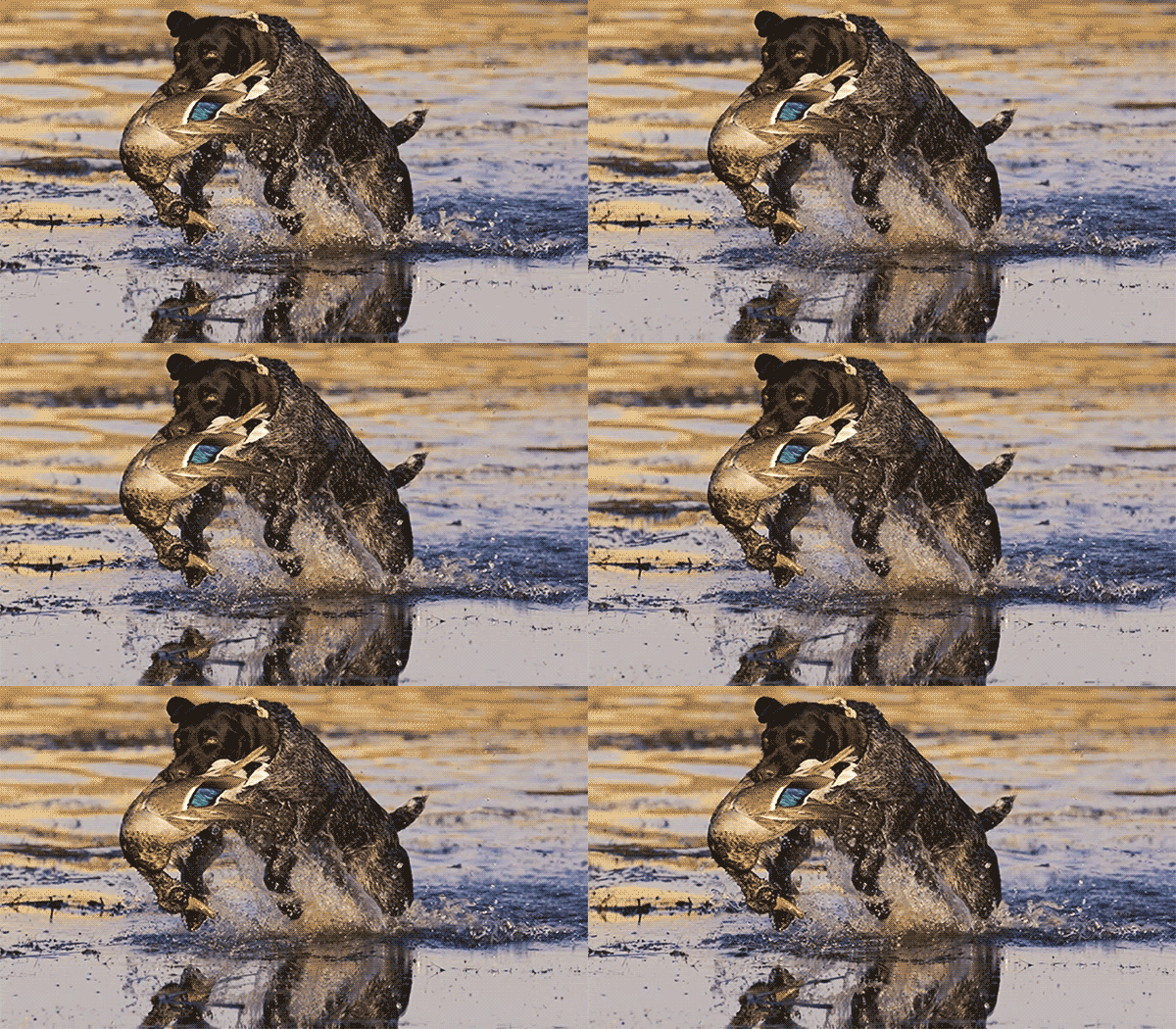
Funds from the Manitoba Conservation Trust will help The Duck Hunters Organization make mallards.

WINNIPEG, MANITOBA — A large grant will help Delta Waterfowl send more ducks winging south from prairie Canada.

The Manitoba Conservation Trust announced plans this month to fund the construction and maintenance of 150 new mallard-producing Hen Houses in southwest Manitoba. Since its founding in 2018, the Trust has consistently rallied behind the mission of The Duck Hunters Organization.

“The new Delta Hen Houses will help add mallards to the 2022 fall flight and every year thereafter,” said Jim Fisher, senior director of Canadian conservation and hunting policy for Delta Waterfowl. “This is an exciting addition to the 500 Hen Houses that the Manitoba Conservation Trust has previously funded, which were already installed and ready to make ducks in time for last spring.”

The grant was awarded by the Manitoba Habitat Heritage Corporation, a former federal corporation that’s now a non-profit entity administering Manitoba’s Conservation Trust. The Conservation Trust has a $204 million endowment that has distributed more than $18 million to conservation in just a few short years, including $8 million in 2021 alone.

“We are grateful to the MHHC for its generous gift toward Delta’s duck production efforts,” Fisher said. “This grant will certainly benefit Manitobans, but also hunters farther down the flyways.”

Hen Houses, which are used primarily by mallards, are wire nesting cylinders placed over water in small wetlands. Delta focuses nest structures in wetland areas with limited nesting cover where predators such as red foxes, raccoons and skunks easily find duck nests in sparse patches of grass. Past research in Manitoba has shown that mallards using Hen Houses are 12 times more likely to hatch a nest than those nesting in the grass. Read more

Indiana: Four Illinois Juveniles Charged in Two-State Poaching Case

Indiana Conservation Officers’ portion of a six-month-long multi-state poaching investigation resulted in charges being filed against four juveniles from Mount Carmel, Illinois by the Gibson County Prosecutor’s Office.

The juveniles were charged with committing a combined 119 wildlife violations in Indiana and Illinois during a two-year span.

The investigation originated on Jan. 7, after Illinois DNR Conservation Police Officers (ICPOs) received information regarding alleged poaching near Mount Carmel, Illinois and Gibson County, Indiana. ICPOs obtained multiple search warrants, executed them on Jan. 8, and contacted Indiana Conservation Officers after discovering that numerous wildlife violations occurred in Indiana.

The states’ investigation found that the four juveniles had illegally killed more than 20 deer in the two states during the 2019, 2020, and 2021 deer seasons. Multiple deer were shot from trucks, shot with the aid of spotlights at night, and intentionally run over with vehicles, and then stabbed or kicked to death.

The wide range of misdemeanor violations includes torture or mutilation of a vertebrate animal, wanton waste, illegal taking of white-tailed deer, use of artificial light to take deer /jacklighting, fail to procure non-resident deer license, hunting without landowner consent, criminal trespass, criminal trespass on railroad train car, hunt/shoot from public roadway, take more than one antlered deer, and take/chase wild animal with the use of motor driven conveyance. Read more

Michigan: DNR Offices Reopen to the Public Tuesday

Customer service centers will be open Tuesdays, Wednesdays and Thursdays through Labor Day

In another step toward resuming regular operations, Michigan Department of Natural Resources customer service centers and certain field offices will open to the public Tuesday, July 20, starting a three-days-per-week schedule – Tuesdays, Wednesdays and Thursdays – that will last through Labor Day.

Staff in these offices are busy this week preparing for visitors. Customer service centers** and field offices in the following locations will be open July 20, 21 and 22:

Baraga**
Bay City**
Cadillac**
Crystal Falls
Detroit**
Escanaba**
Gaylord**
Lansing**
Marquette**
Naubinway
Newberry**
Norway
Plainwell**
Roscommon**
Sault Ste. Marie**
Traverse City**

These DNR offices sell hunting and fishing licenses and fuelwood permits and answer questions about hunting and fishing regulations, trails and many other outdoor recreation topics. Residents and visitors frequently stop at these locations while traveling throughout Michigan, and staff is eager to reopen the doors to the public. Read more

1 773 774 775 776 777 2,073