This from www.HumaneWatch.org…
HSUS runs a 20-year-old affiliate called the Wildlife Land Trust (WLT), whose reason for existence is to inherit land from people and subsequently prohibit development and hunting—forever. Essentially, WLT seems like a disjointed effort at creating wildlife preserves across the U.S., and it claims to hold rights to property in 32 states.
One such range of land is 3,000 acres in Oregon called the Greenwood Preserve. HSUS wants to build a water guzzler there to help the wildlife out with another source of water (despite, by WLT’s admission, that the preserve “contains three year-round sources of water – a rarity in the West”). HSUS has launched a “crowd-funding” campaign to raise $12,200 to build the guzzler, essentially a contraption that collects rainwater. Crowd-funding works by collecting small ($5 or $10) donations for a specific effort.
Here’s our question: Why?
HSUS’s budget is $120 million. The Wildlife Land Trust has a $6.9 million budget. Can’t they find $12,200 in there to build a watering hole? That’s about 0.0096% of their combined budgets, or nine one-thousandths. Not exactly breaking the bank.
The trouble with the crowd-funding exercise is that it frees up more money for HSUS to waste on other things. This wouldn’t be bad if HSUS was already a fiscally responsible organization, but it isn’t one. CharityWatch finds that HSUS spends up to 45 percent of its budget on overhead. The watchdog Animal People puts the figure higher—at 55 percent. There’s a lot of money to go around, but HSUS wants to spend it on direct mail.
So while HSUS is “crowd-funding” a project that could be easily financed using existing dollars, it can put that $12,200 it’s not spending on the water guzzler towards mailing costs and to conduct more fundraising. This might be a small drop in the pond, but it speaks volumes about the priorities at HSUS.

 A suspected sighting of the highly invasive plant parrot feather (Myriophyllum aquaticum) was reported to the Department of Environmental Quality (DEQ) in the fall of 2013. Following recently developed state agency protocols, the DEQ transferred the report to the Department of Natural Resources (DNR) Wildlife Division. A team of Wildlife Division staff, utilizing the new Early Detection and Response Plan, conducted verification and assessment at a small detention pond in Wayne County’s Brownstown Township.
 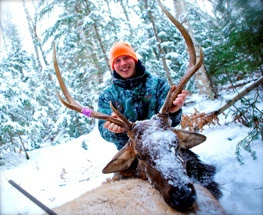 Michigan’s 2013 elk hunting season that just wrapped up was a successful season all-around. While hunters walked away with an experience they’ll never forget, Department of Natural Resources (DNR) staff members are happy management goals were met, both safely and legally.


